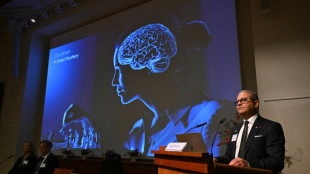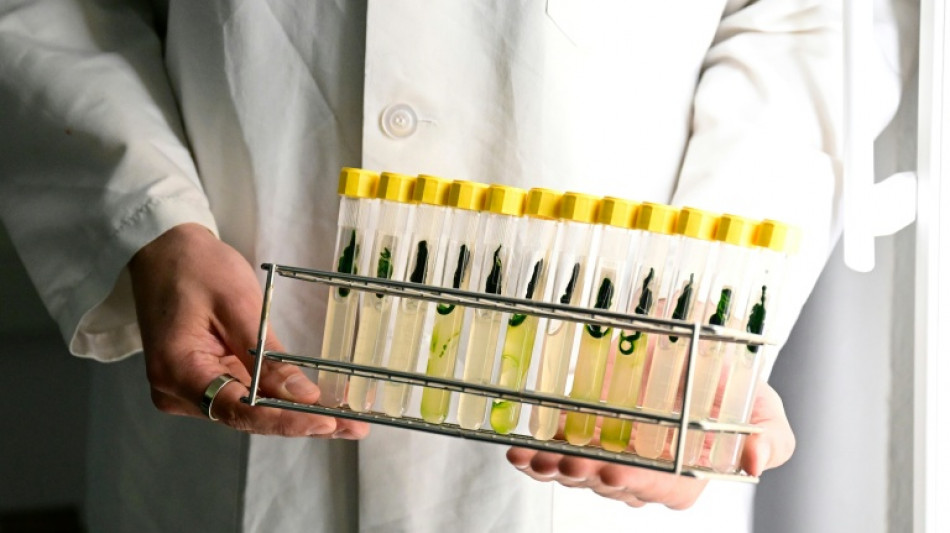
Switching on brain cells: the Nobel-winning science of optogenetics / Photo: Tobias SCHWARZ - AFP
In optogenetics, scientists control neurones by stimulating them with light -- potentially unlocking breakthroughs for conditions such as dementia, depression and blindness.
Three scientists won the Nobel medicine prize on Monday for their work in the field: US neurologist Karl Deisseroth and German scientists Peter Hegemann and Georg Nagel.
"Being able to manipulate cells with a combination of light and genetics has been transformational across the biological sciences," said Simon Schultz, neurotechnology professor at Imperial College London.
Here are some key facts about optogenetics and its uses.
- Protein discovery -
In a type of green algae, Hegemann and Nagel discovered a light-sensitive protein that they dubbed channelrhodopsin.
Deisseroth introduced it genetically into a cell and stimulated it with light, which triggered a nerve signal in rats and mice.
Controlling the light, scientists can switch a neurone's signal on off with minute precision.
By turning off some neurones and observing others, they can track which areas affect certain functions.
Introducing the prize, Nobel medicine committee member and neuroscientist Abdel El Manira said the discovery shed light on functions "from parental behaviour and aggression to anxiety and fear, as well as fundamental physiological drives such as thirst and water intake".
- Memory -
Schultz said his own teams had used optogenetics "as a closed loop treatment for memory disorders" by lengthening the pulses that help the brain store memories.
"The next step is to demonstrate that we can improve learning and memory in complex tasks," he said in comments released by the college.
- Blindness -
Jose-Alain Sahel, founder of the Vision Institute in Paris, told AFP his team carried out promising trials using optogenetics to treat a degenerative disease.
They used gene therapy to introduce the key protein to a patient's defective eye cells and projected light through special goggles -- successfully activating the retinal cells.
"Vision restoration is probably the most fertile ground for relatively rapid medical advances" in the field, Marco Tripodi, a senior molecular biologist at Cambridge University, told AFP.
- Nerve illnesses -
Beyond such direct therapeutic interventions, optogenetics could serve as "as a discovery tool that reveals new therapeutic targets for neurological and psychiatric disease", said Tripodi.
Epilepsy and Parkinson's disease "provide obvious examples where the ability to control defined neuronal populations with high precision could ultimately be valuable", he said.
The prizewinning research could help "understand what goes wrong in diseases such as Alzheimer's and epilepsy", Jorge Brotons Mas, a neural researcher at CEU Cardenal Herrera University in Spain, in comments published by the Science Media Centre.
- Mental health -
Research also aims to help address depression and anxiety disorders, several scientists said.
Christopher Rowlands, associate professor in bioengineering at Imperial College, noted there are "nascent trials" underway looking to use it to treat conditions such as post-traumatic stress disorder and addiction.
- Conscience and AI? -
Journalists at the award ceremony in Stockholm questioned the committee about whether the science shed light on parallels between real and artificial brains.
Could it help us understand subjective consciousness?
"For now, this tool does not help us understand what conscious is," said El Manira.
"It will be a Nobel Prize some years ahead, I'm sure."
H.Sasidharan--DT