BCC
0.4950
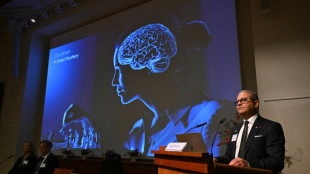
The Nobel medicine prize was awarded Monday to US psychiatrist and neurologist Karl Deisseroth and German scientists Peter Hegemann and Georg Nagel for their pioneering work in the neuroscience field of optogenetics.
Optogenetics involves controlling nerve signals with light, and helps researchers understand how specific cell types contribute to behaviours like learning, fear, addiction and movement.
The trio were honoured "for their discovery of a molecular switch for nerve cells", the Nobel Assembly said.
"It's an incredible honour and unexpected, but I'm deeply honoured," Deisseroth told the Nobel Foundation in an interview, adding that he had been working late on the US west coast and had just laid down to sleep when the call came from Stockholm.
"Now I don't think I'll be able to sleep for quite a while."
Using light, researchers are now able to switch individual neural circuits on or off in a brain.
They have been able to reveal neural circuits governing specific memories, feelings, and behaviours relevant for neurological and psychiatric disorders.
In clinical medicine, the method has been used on humans on a very limited basis, particularly to treat a specific form of blindness, and may one day lead to treatments for disorders such as Parkinson's disease and epilepsy.
"Optogenetics provides opportunities for mapping the brain in a way that we could once only dream of," Per Svenningsson, chair of the Nobel committee, said in a statement.
The jury said the field had "fundamentally altered our understanding of the brain".
The secretary general of the assembly, Thomas Perlmann, told reporters he was able to reach the three laureates by phone to break the news.
"I first called Deisseroth, he was very tired when he answered. He was definitely asleep, but he woke up," he said.
"All three said the same thing, that they thought it was absolutely wonderful to receive the prize with the other two."
- 'Seen it coming' -
"This is one of those Nobel prizes that we've all seen coming for quite a while now," Simon Schultz, professor of neurotechnology in the department of bioengineering at Imperial College London, said in comments sent to AFP.
"Being able to manipulate cells with a combination of light and genetics has been transformational across the biological sciences," he said.
One of the key areas for future development is its use in humans, said Konstantin Nikolic, visiting professor in electrical and electronic engineering at Imperial College London.
While there were initial ethical and safety concerns about introducing genes encoding non-human, typically microbial, proteins into human cells, "the field has progressed considerably, and optogenetic approaches have already entered early-stage clinical trials," he said.
Deisseroth, 54, is a professor at Stanford University in the US, while Hegemann, 71, is a neuroscience professor at Humboldt University of Berlin.
Nagel, 73, is a biophysics professor at the University of Wuerzburg.
In a comment posted on X, German Chancellor Friedrich Merz said: "This award shows that German research is top-notch. International collaboration in science remains crucial."
- Illumination -
In the early 2000s, Hegemann and Nagel were examining why a single-celled alga was able to swim toward a light source.
They discovered an algal protein with unique properties, called channelrhodopsin, found on the surface of the cell.
When illuminated by blue light, a channel opens through the protein.
Charged ions then flow into the cell, creating an electrical impulse. They found that any cell they put the protein in became light sensitive.
Deisseroth then introduced the gene for channelrhodopsin into nerve cells from rats.
By illuminating the cells with blue light, he was able to trigger a nerve signal.
He published his breakthrough in 2005, and two years later, made the light-controlled switch for nerve cells work in the brains of living mice.
Deisseroth is also a psychiatrist who treats patients with severe psychiatric and neurodevelopmental disorders, such as affective disorders and autism-spectrum conditions.
In his interview with the Nobel Foundation, he said that work was "a constant source of new perspectives, and a connection to what actually matters to people and to people who most need help".
"Seeing what actually matters to the patient helps me in a continuous fashion of designing experiments in the laboratory, talking to students, being able to convey what actually matters in an altered state in the human brain."
This year's laureates will receive their prizes -- a diploma, a gold medal and a $1.2-million award to share -- on December 10, the anniversary of the death in 1896 of the prize's founder, scientist Alfred Nobel.
A.Krishnakumar--DT