Going online helps Pakistan's women doctors back to work / Photo: Rizwan TABASSUM - AFP
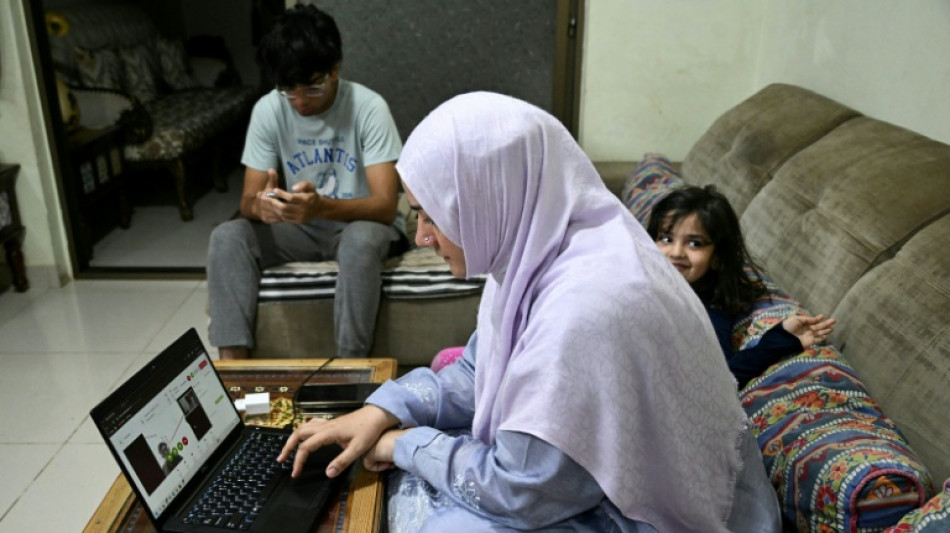
With her four-year-old nestled nearby, doctor Saniya Jafri consults from home in Karachi with a patient on the other side of Pakistan via her laptop.
She is one of thousands of Pakistani female doctors returning to practice through "telemedicine" after leaving the profession because of family obligations and workplace barriers to women in the conservative society.
Although women outnumber men in Pakistan's medical registrations, many stop practicing after marriage, exacerbating the fast-growing nation's shortage of doctors.
Jafri, a mother of three, gave up cardiology after marriage.
"I did not want to choose long working hours and be away from home for a long time," she told AFP.
But an initiative by digital health firm Sehat Kahani helped her back into the workforce by providing a digital platform to connect home-based, mostly female doctors, with patients in underserved communities.
Private clients are also catered for.
The initiative has brought 7,500 doctors back into practice, its co-founder says, and aims to boost healthcare for disadvantaged areas in Pakistan that face a dearth of services -- especially female patients who often feel more comfortable speaking with women medical staff about health issues.
Gallup surveys and doctor associations suggest more than a third of Pakistan's female medical graduates never enter the profession -- or leave it after marriage -- due to lack of family support, poor childcare facilities, and harassment.
The situation is symptomatic of wider challenges for women in Pakistan who face significant economic and social disparities, with the World Economic Forum ranking the nation second-to-last for gender equality.
- 'Doctor Brides' –
Jafri now balances caring for her children and household chores with attending to patients online.
"I wanted to stay with my children," the 43-year-old said of the flexible arrangement.
An overwhelming majority of the tens of thousands of aspirants who compete for places in government-run medical universities are women -- a rare instance in Pakistan of female student admissions outnumbering men.
Yet working at hospitals and clinics is widely seen as incompatible with family life for women, especially those with young children.
"The lady doctor who advises mothers to exclusively breastfeed for six months does not have such a facility at her own workplace," said Zakiya Aurangzeb, President of the Pakistan Islamic Medical Association.
She said long hours and the risk of sexual harassment and mob violence from the families of patients who suffered poor outcomes also put off women and their families.
Seeing those challenges as well as Pakistan's dismal healthcare access in poor communities, doctor Sara Saeed Khurram set up Sehat Kahani, a digital network that includes 80 clinics where patients visit for a remote consultation with a doctor, guided by an in-person nurse.
She hoped to realise the full benefits of the years of training and government subsidies for degrees that many families seek for their daughters due to the social status they confer in Pakistan society, where a "Dr" honorific is considered to improve marriage prospects for women.
"When that wedding card goes out that you're marrying a doctor... it just raises the social stature of the entire family," said Khurram.
"Once that purpose is done... then it becomes very difficult for you to challenge the societal norms that exist in that family to let her work."
Khurram understands the situation first-hand.
"I also became what we call the doctor bride or the 'doctor bahu'," she said, using the Urdu term for "daughter-in-law".
Though she remained in the workforce, Khurram watched her mostly-female medical school cohort drop out of work one by one, facing pressure from in-laws to focus on tending the home.
- Healthcare gap –
The lack of female doctors is deepening the strain on Pakistan’s healthcare, a mix of public and private systems with sharp disparities between cities and rural areas in the country of 250 million people and poor outcomes for urban working-class neighbourhoods.
Around 70,000 women -- almost a fifth of the 370,000 total registered doctors -- are listed in official registries but not practicing, according to medical associations.
Ushering female doctors back to the workforce online also provides better options for patients.
In an impoverished neighbourhood of Karachi, Muhammad Adil was able to take his eight-year-old son to a nearby Sehat Kahani–run health unit because it saves him time and money.
"When we come here, we are able to save our daily wage because it's close," he said, after a free consultation with Jafri on his son's chickenpox.
Digital healthcare improved flexibility and could help women back into the workforce, Jafri said, but cautioned that ultimately family backing was key.
"If a woman doctor receives support from her husband, parents, and in-laws, she can excel," she said.
"Those who get it go on to succeed, but many who don't are forced to give up".
Y.Amjad--DT