
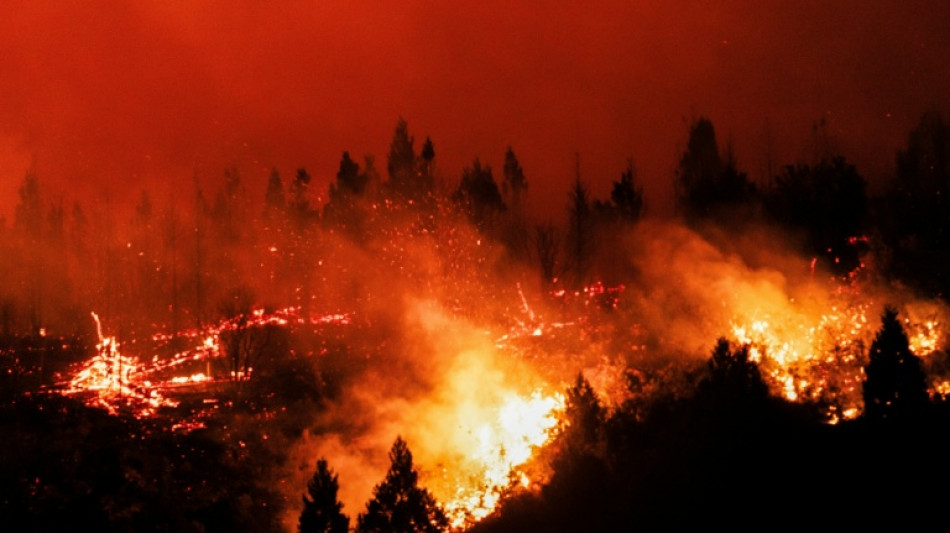
Tropical forest loss eases after record year: researchers / Photo: Gonzalo KEOGAN - AFP/File
The pace of tropical forest destruction slowed in 2025 after record losses the year before but remained at worrying levels equivalent to 11 football fields per minute, researchers said Wednesday.
The world lost 4.3 million hectares (10.6 million acres) of tropical primary rainforest last year -- down 36 percent from 2024, said researchers from the World Resources Institute (WRI) and the University of Maryland.
"A drop of this scale in a single year is encouraging -- it shows what decisive government action can achieve," said Elizabeth Goldman, co-director of WRI's Global Forest Watch platform.
"But part of the decline reflects a lull after an extreme fire year," Goldman said.
The researchers also warned that fires fuelled by climate change have become a "dangerous new normal" which threatens to reverse the recent gains made by government efforts to tackle deforestation.
The warming El Nino weather phenomenon is expected to return in the middle of the year, which could push global temperatures even higher, raising the threat of heatwaves, droughts and wildfires.
The researchers, who used satellite data for their report, noted that last year's forest loss was still significant -- about the size of Denmark and 46 percent higher than a decade ago.
Despite last year's progress, global forest loss remains 70 percent above the level required to meet the 2030 goal of halting and reversing forest loss, the researchers said.
"A good year is a good year, but you need good years forever if you're going to conserve, for example, the tropical rainforest," Matthew Hansen, director of the GLAD Lab at the University of Maryland, said in a media briefing.
- Government policies -
Much of last year's slowdown was due to sharp declines in Brazil, home to the biggest rainforest in the world.
Brazil's forest loss, excluding fires, was 41 percent lower than in 2024 -- its lowest rate on record.
"Brazil's declines are associated with stronger environmental policies and enforcement since President Lula took office in 2023," Goldman said in a news briefing, referring to Brazilian leader Luiz Inacio Lula da Silva.
Lula relaunched an anti-deforestation action plan and increased penalties for environmental crimes, she said.
But the country's forests are still threatened by agriculture, which remains the largest driver of forest loss to make room for soy fields and cattle ranches.
Some states in the Amazon have passed legislation to weaken environmental protections, the researchers said.
"Several countries showed that strong policy action can reduce forest loss quickly," Goldman said.
Forest loss in neighbouring Colombia fell 17 percent, the second lowest year on record since 2016, thanks to government policies and agreements limiting forest clearing.
Government policies also helped to limit forest loss in Indonesia, where it increased by 14 percent but was well below the highs seen a decade ago.
In Malaysia, government efforts have helped to stabilise forest loss in the country.
Tropical forest loss remained high in other parts of the world, including in Bolivia, the Democratic Republic of Congo, Cameroon and Madagascar, the researchers said.
- 'Near-permanent state of emergency' -
Global tree cover loss fell by 14 percent last year.
While agricultural expansion is still the leading driver of tree cover loss across the tropics, fires played a major role worldwide, accounting for 42 percent of the destruction.
"For the past three years, fires burned more than twice as much tree cover as they did two decades ago," Goldman said.
While humans cause most fires in the tropics, climate change is intensifying natural fire cycles in northern and temperate regions, the researchers said.
Canada had its second-worst fire year on record last year as wildfires tore through 5.3 million hectares of forest.
"Climate change and land clearing have shortened the fuse on global forest fires," Hansen said. "They are turning seasonal disturbances into a near-permanent state of emergency."
T.Jamil--DT



