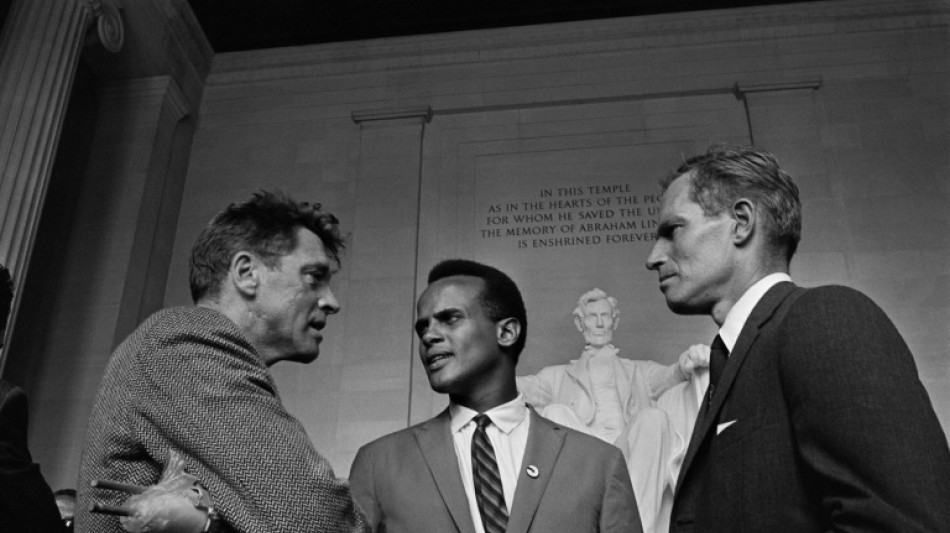
Harry Belafonte: legendary singer who lived out activism / Photo: - - AFP/File
Even at the height of his fame as a groundbreaking musician, Harry Belafonte was only interested in the money or the celebrity insofar as it could fuel his campaigns for social justice.
As the US civil rights movement gained momentum, Belafonte took on a role that went far beyond moral support. He became a confidant of Martin Luther King Jr. and personally opened his wallet to fund the cause.
"I could have made $2 billion or $3 billion -- and ended up with some very cruel addiction -- but I chose to be a civil rights warrior instead," the trailblazing singer and actor said in a 2007 interview.
Belafonte, who died of congestive heart failure on Tuesday at the age of 96, soared to the highest heights of showbiz -- the African American artist won an array of awards for his performances, introducing Caribbean flair to mainstream US music.
But he is also remembered for his deep personal investment in civil rights -- from the American struggle for racial equality to famine in Ethiopia to South Africa's battle against apartheid.
"When people think of activism, they always think some sacrifice is involved, but I've always considered it a privilege and an opportunity," he said in a 2004 speech at Emory University.
- Life of struggle -
Born in Harlem on March 1, 1927 to a Jamaican mother and a father from the French territory of Martinique, Belafonte spent part of his childhood in Jamaica before returning to New York, a binational upbringing that shaped his musical and political outlooks.
Despite his vocal gifts and striking good looks, Belafonte did not grow up believing he would enjoy a promising career.
He suffered dyslexia and dropped out of high school to serve as a US Navy munitions loader in World War II. When he returned, he had few employable skills and worked as a janitor.
But he showed gusto at the job and, as a tip, was given two tickets to a performance at the American Negro Theater, where he was mesmerized by the magnetic pull of the stage.
He took acting classes and, at the theater in Harlem, made a lifelong friend who became another groundbreaking African American actor: Sidney Poitier, who was born just eight days before Belafonte to parents from The Bahamas.
Belafonte said that his own Jamaican roots shaped "almost everything" in his life.
His mother came from Jamaica "to find the generosity of the American dream and discovered that that was not available to her," he told public television.
- Early fame... and controversy -
Belafonte's calypso, the genre of Caribbean music that drew from West African and French influences, offered a dash of exoticism for a United States in the midst of post-World War II prosperity and suburbanization.
His third album, entitled simply "Calypso" and released in 1956, became the first LP to sell more than one million copies in the United States.
The album featured what became Belafonte's signature song, "Day-O (The Banana Boat Song)." Based on a Jamaican folk tune, Belafonte sings with a Caribbean accent, "Stack banana 'til de morning come / Daylight come and we wan go home."
Belafonte scoffed at suggestions that the song was simply feel-good dance music, calling the track a rebellious take on workers who were demanding fair wages.
Even in his early career, Belafonte did not shy away from controversy.
He starred in the 1957 film "Island in the Sun" as an upwardly mobile Black politician on a fictional island who becomes involved with a woman from the white elite, in one of Hollywood's earliest depictions of inter-racial romance.
- Key role in US civil rights movement -
Belafonte broke racial barriers in entertainment and worked for racial justice in politics.
In 1954, he became the first African American man to win a Tony Award, for his role in the Broadway musical "John Murray Anderson's Almanac."
Six years later, he became the first African American to win an Emmy Award for "Tonight with Belafonte," his musical television program. He also won three Grammys.
Always wary of politicians, Belafonte met for three hours in 1960 with then-presidential candidate John F. Kennedy, who hoped to gain support from a prominent African American.
Kennedy did not initially win his endorsement, with Belafonte recalling later that the senator from Massachusetts "knew so little about the Black community."
But Belafonte helped arrange a meeting between King and Kennedy, who with his brother Robert F. Kennedy intervened months later when the civil rights leader was arrested in Georgia.
After his election, Kennedy appointed Belafonte to the advisory committee of the newly created Peace Corps, through which the young president hoped the United States would showcase its power through non-military means.
But Belafonte said that while many in the Peace Corps hoped to "show how beautiful we are as a people," his mission was different -- to expose young Americans to the struggles of the developing world.
Belafonte brought King and the Birmingham, Alabama pastor Fred Shuttlesworth to his New York apartment to plan out the 1963 campaign to integrate the notoriously racist southern city.
When King was thrown into a Birmingham jail, Belafonte raised $50,000 -- nearly $500,000 in current value -- to post his bail, at a time when the rise of pop music was bringing wealth and lavish lifestyles to many entertainers.
Later, Belafonte spent increasing time in Africa, especially Kenya, and became one of the foremost US artists fighting apartheid in South Africa.
His final album, "Paradise in Gazankulu," released in 1988, revolved around the oppression of black South Africans and was recorded partially in Johannesburg with local artists.
Belafonte also initiated the USA for Africa supergroup whose "We Are The World" song in 1985 raised millions of dollars for Ethiopia's famine victims.
- Fallout with King children -
Belafonte remained strident in his views late in his life.
In 2008, he called then-president George W. Bush "the greatest terrorist in the world" in reference to the Iraq invasion as the singer visited Venezuela to rally behind its firebrand president Hugo Chavez, a frequent US nemesis.
But Belafonte increasingly saw a gap with a younger generation.
In 2012, he took to task Jay-Z and his wife Beyonce, saying that the titanic music couple had "turned their back on social responsibility."
Jay-Z hit back in song, rapping "Mr. Day-O, major fail."
More painfully, Belafonte fell out with King's three surviving children, who kept him away from the funeral of the civil rights leader's widow Coretta Scott King, in part due to the singer's embrace of Chavez.
In 2014, Belafonte settled a lawsuit with the children, whom he accused of veering from their father's legacy, in a dispute over the singer's possession of documents from King.
Despite his frequent criticism of US policies, Belafonte said that the United States "offers a dream that cannot be fulfilled as easily anywhere else in the world" -- but one that is only attainable through "struggle."
I.El-Hammady--DT