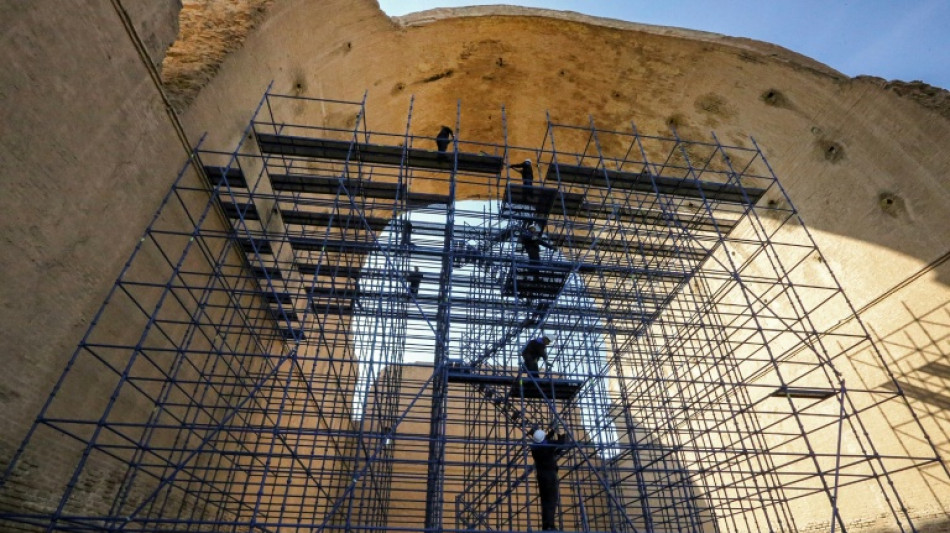
Archaeologists forced by Mideast war to cut short Iraq digs / Photo: Sabah ARAR - AFP
Iraq is home to ruins from some of the world's earliest civilisations, but teams led by international archaeologists have been forced by drone and rocket attacks in the Middle East war to cut short their expeditions.
Archaeologists told AFP that some of the projects interrupted by the war had been planned for years, but their teams have had to evacuate ancient sites since the United States and Israel attacked Iraq's neighbour, Iran.
Like other countries around the region, Iraq has become engulfed in the war, bringing to an abrupt end a period of nascent stability.
Iraq's precious archaeological sites, some dating back thousands of years, had for years faced threats ranging from climate change to successive conflicts.
Under normal circumstances, around 60 international teams would have been working on digs, a government official told AFP, but "all of these missions have left Iraq".
- 'Like a musician' -
Adelheid Otto of Germany's Ludwig-Maximilians-University started a long-planned dig at ancient Shuruppak, modern-day Tell Fara, on February 28.
That same day, Israel and the US launched strikes against Iran, sparking a war that has dragged Iraqi armed groups into the fray -- and cutting short Otto's work.
"We are Near Eastern archaeologists. So that is our work. That is like a musician who can no longer play an instrument," she told AFP.
Her team -- 18 German archaeologists, geologists, geophysical experts and students and seven Iraqi archaeologists -- initially stayed, reasoning travelling the 750 kilometres (460 miles) overland to Turkey was more dangerous.
"After some days we got kind of used to the rockets and drones above our heads," she said.
But Iraqi officials repeatedly urged them to depart, despite their discovery of ancient cuneiform tablets.
"It is impossible" to leave, she told authorities, insisting on staying extra days. "We have to document it. We have to take photos of everything."
"I told the students you have to work on all the small finds that we have," said Otto, 59, who boasts four decades of experience.
"You never know in any of these countries if you will ever return," she said.
- 'Guarantors' -
Many German institutions had just started relaxing travel restrictions to Iraq after a succession of conflicts, including the 2003 US-led invasion and the extremist Islamic State group.
Now, said Otto, archaeologists once again face being shut out.
Iraq's State Board of Antiquities and Heritage head Ali Obeid Shalgham told AFP Iraqi security forces were the sites' "true guarantors", especially as many are in remote rural areas.
He said the country is installing so-called protective "blue shields" -- nicknamed "the Red Cross of heritage" -- at archaeological sites.
The presence of foreign teams is "crucial", said Aqeel al-Mansrawi, an Iraqi landscape archaeologist.
"They work to protect heritage through conservation," he said.
He also emphasised the training Iraqi experts receive from foreigners, vital after years of isolation and war.
"We are always training a lot of Iraqi archaeologists and colleagues," said Otto, of the German institute.
"If it would be cut again, it would be terrible," she said.
Foreign digs must work with Iraqi archaeologists, bringing their international expertise.
Shalgham said the arrangement allows Iraqis "to keep up with global advancements in new technologies and state-of-the-art equipment".
- 'Can't catch a break' -
Chicago University professor Augusta McMahon was in southern Iraq, working at the 6,000-year-old Nippur site, when the war began.
Having worked in the Middle East for almost four decades, this was her third evacuation.
In 2024, she had to leave Iraq, while in 2011, she left Syria.
"We had pressure from a lot of different directions in terms of having to leave," she said, with her eight-person team departing under an Iraqi escort on March 10.
"It is quite frustrating, along with everything else, I feel terribly bad for [my] Iraqi colleagues," she said.
The war has also rippled beyond the immediate: an initiative to finally return the preeminent Rencontre Assyriologique Internationale (RAI) conference to Iraq was cancelled by the University of Baghdad.
The city last attempted to host the event in 1990, according to the university, but it was scrapped with the Gulf War.
"Now 36 years later, they finally pulled themselves together... and its cancelled again," said McMahon, who was due to be presenting.
"It's like they can't catch a break."
Y.Amjad--DT