Dubai Telegraph - Indonesia rations fuel as prices soar over Mideast war

EUR -
AED 4.215948
AFN 74.619015
ALL 91.711012
AMD 416.750041
ANG 2.0553
AOA 1052.695881
ARS 1733.468927
AUD 1.614369
AWG 2.06923
AZN 1.954453
BAM 1.956035
BBD 2.312178
BDT 140.976928
BGN 1.932553
BHD 0.432752
BIF 3453.383756
BMD 1.147978
BND 1.464636
BOB 11.680403
BRL 5.889015
BSD 1.147938
BTN 110.072217
BWP 15.567869
BYN 3.489819
BYR 22500.365711
BZD 2.308877
CAD 1.606193
CDF 2652.976898
CHF 0.94668
CLF 0.027871
CLP 1100.497208
CNY 7.700119
CNH 7.695926
COP 3641.867867
CRC 513.561665
CUC 1.147978
CUP 30.421413
CVE 110.783279
CZK 24.310266
DJF 204.424546
DKK 7.476204
DOP 67.673173
DZD 153.388418
EGP 59.847071
ERN 17.219668
ETB 187.515316
FJD 2.544379
FKP 0.853725
GBP 0.859468
GEL 2.990464
GGP 0.853725
GHS 13.213587
GIP 0.853725
GMD 84.950254
GNF 10092.211813
GTQ 8.759052
GYD 240.138834
HKD 9.006688
HNL 30.8117
HRK 7.535898
HTG 150.023639
HUF 362.988186
IDR 20386.938503
ILS 3.482833
IMP 0.853725
INR 110.131828
IQD 1503.880577
IRR 1577981.642811
ISK 139.410174
JEP 0.853725
JMD 181.161753
JOD 0.813907
JPY 179.065028
KES 148.766919
KGS 100.390935
KHR 4675.113388
KMF 491.33421
KPW 1033.180423
KRW 1585.115944
KWD 0.354128
KYD 0.956715
KZT 511.371402
LAK 25712.087355
LBP 102802.343898
LKR 380.755719
LRD 199.173916
LSL 18.701146
LTL 3.38968
LVL 0.6944
LYD 7.291876
MAD 10.934813
MDL 20.15342
MGA 4985.598641
MKD 61.532388
MMK 2410.368684
MNT 4129.105481
MOP 9.276814
MRU 45.988522
MUR 54.712705
MVR 17.736693
MWK 1990.639024
MXN 19.702169
MYR 4.704754
MZN 73.353136
NAD 18.701146
NGN 1527.442219
NIO 42.245073
NOK 10.803706
NPR 176.115147
NZD 2.00205
OMR 0.441303
PAB 1.147938
PEN 3.875565
PGK 5.107613
PHP 72.001193
PKR 318.193507
PLN 4.357006
PYG 6790.815401
QAR 4.184602
RON 5.263022
RSD 117.439255
RUB 97.005713
RWF 1693.903394
SAR 4.262789
SBD 9.184411
SCR 16.224464
SDG 690.512323
SEK 11.275961
SGD 1.464474
SHP 0.8575
SLE 28.286119
SLL 24072.512046
SOS 656.078778
SRD 43.332145
STD 23760.823579
STN 24.502942
SVC 10.045206
SYP 14926.008199
SZL 18.694245
THB 38.215928
TJS 10.590172
TMT 4.017922
TND 3.377005
TOP 2.764055
TRY 55.954848
TTD 7.793936
TWD 36.588918
TZS 3044.866606
UAH 51.29956
UGX 4511.541719
USD 1.147978
UYU 46.155542
UZS 13517.623116
VES 970.563549
VND 29861.199636
VUV 135.81391
WST 3.148804
XAF 655.957
XAG 0.0176
XAU 0.000264
XCD 3.102468
XCG 2.068948
XDR 0.81168
XOF 655.957
XPF 119.331742
YER 271.668526
ZAR 18.681411
ZMK 10333.179708
ZMW 22.529705
ZWL 369.648397
SSP 6495.460381
MXV 2.233816
  • CMSC

    0.1900

    20.67

    +0.92%

  • BCC

    0.2200

    75.53

    +0.29%

  • RBGPF

    0.0000

    69.99

    0%

  • AZN

    3.2500

    166.14

    +1.96%

  • CMSD

    0.1600

    20.45

    +0.78%

  • GSK

    0.7700

    51.06

    +1.51%

  • RIO

    2.2500

    98.04

    +2.29%

  • RYCEF

    0.4200

    20

    +2.1%

  • BCE

    -0.2200

    22.28

    -0.99%

  • VOD

    0.0600

    17.52

    +0.34%

  • RELX

    0.1100

    34.38

    +0.32%

  • JRI

    0.1100

    11.61

    +0.95%

  • BTI

    -0.0700

    56.02

    -0.12%

  • BP

    0.0400

    45.42

    +0.09%

  • NGG

    1.5700

    77.6

    +2.02%

Indonesia rations fuel as prices soar over Mideast war
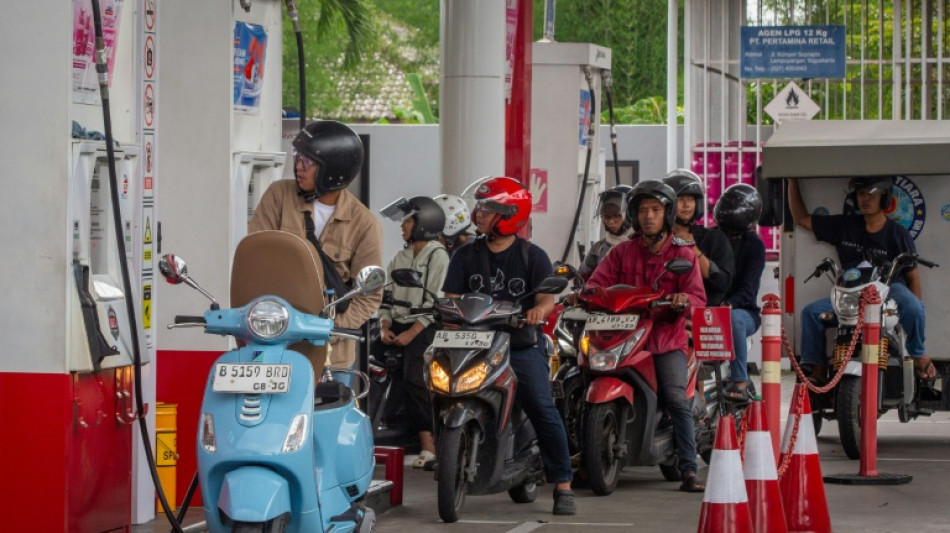
Indonesia rations fuel as prices soar over Mideast war / Photo: DEVI RAHMAN - AFP/File

Indonesia rations fuel as prices soar over Mideast war

Indonesia on Tuesday announced fuel rations and mandated work from home for civil servants, as it seeks to conserve energy stocks amid global price hikes due to the Middle East war.

Text size:

"To ensure fuel distribution, the government will regulate purchases... with a reasonable limit of 50 litres per vehicle" per day for private consumers, said Airlangga Hartarto, the coordinating minister of economic affairs.

Speaking at a virtual news conference from Seoul, he also said that civil servants will work from home every Friday, part of the government's efforts to save energy.

The government said earlier Tuesday it would not increase the price of fuel, which is heavily subsidised in Indonesia.

The Southeast Asian archipelago is an oil producer but nevertheless a net importer.

The government has doggedly defended the subsidy, which at $12.3 billion represents about five percent of the total annual budget for 2026.

Observers say the government's hand may eventually be forced given that Indonesia is required by law to keep its fiscal deficit under three percent of gross domestic product.

The 2026 fuel subsidy calculation was premised on a global oil price of $70 per barrel, but prices have since topped $100.

Airlangga said that "the national economic condition remain stable with strong fundamentals. National fuel stocks are safe and fiscal stability is maintained."

Bahlil Lahadalia, the energy minister, said: "We need the support and cooperation of the public. We need to purchase fuel reasonably and wisely."

- 'No price adjustment' -

A government statement sent to AFP earlier said there would be no increase "for subsidised or non-subsidised" fuel from April 1.

It warned against "misinformation" about a pending price hike, quoting presidential spokesman Prasetyo Hadi as saying "we guarantee the availability of fuel... And there is no price adjustment."

Previous fuel price hikes in Indonesia have resulted in mass protests.

Unlike some of its neighbours, Southeast Asia's biggest economy has not seen long fuel queues as global oil prices have soared due to Iran's de facto closure of the strategic Strait of Hormuz.

A fifth of the world's crude supplies and a substantial amount of gas normally run through the waterway, but traffic has effectively halted during the war, which began with US-Israeli strikes on Iran on February 28.

Earlier this month, the Indonesian presidency spokesman Prasetyo said the government was looking to set aside up to 80 trillion rupiah (about $4.7 billion) to shield the economy from the fallout.

On Sunday, the government announced a one-day-per-week reduction in its free school meals programme, though not for areas with high malnutrition rates.

President Prabowo Subianto seeks to raise the economic growth rate from 5.1 percent last year to eight percent by 2029, powered by high public spending.

F.Chaudhary--DT