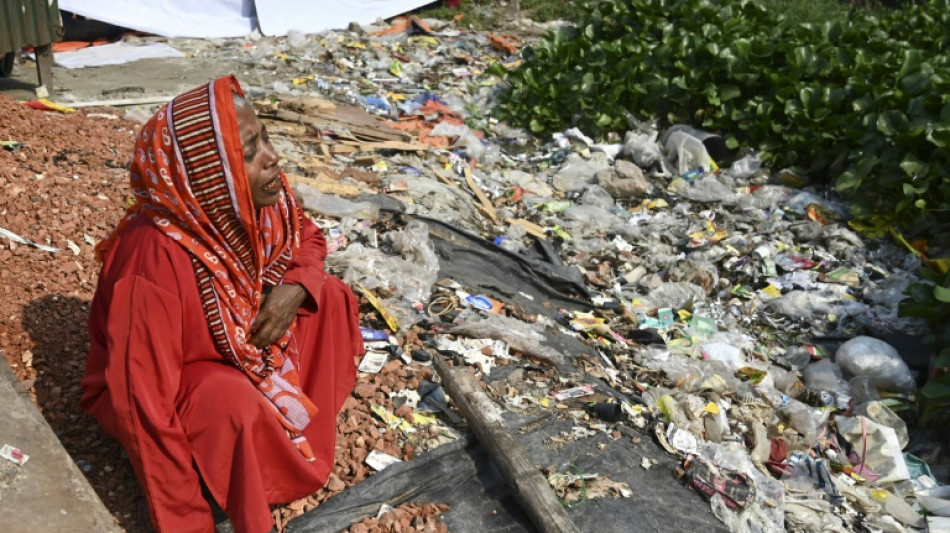
Sweat shops: textile industry's dark side / Photo: MUNIR UZ ZAMAN - AFP/File
The deadly consequences of fast fashion were spotlighted a decade ago after 1,138 people were killed when the nine-storey Rana Plaza garment factory collapsed in Bangladesh.
While the tragedy piled pressure on top brands churning out ever-rising mountains of clothes to ensure better standards, abuses in the textile industry continue:
- Factory hellholes -
The collapse of Rana Plaza near the capital Dhaka was the worst in a series of disasters in textile factories in Bangladesh, the world's second-largest garment exporter after China, and other Asian countries.
A year earlier, at least 111 workers were killed in a fire at a textile factory in Dhaka that produced for US retail giant Walmart, among others, and more than 250 workers died in a blaze in a factory in the Pakistani city of Karachi that produced jeans for German discount chain KiK.
The scale of the disaster at Rana Plaza, which produced clothes for Primark and Benetton, among others, proved a turning point.
Under intense scrutiny, top brands, retailers and trade unions agreed to work together to improve safety conditions in Bangladeshi factories.
About 1,820 factories -- accounting for more than 80 percent of exports -- have been inspected since. Most have been declared fully or almost fully safe.
While Bangladesh has had no major textile factory disasters since 2013, such tragedies have continued to occur elsewhere.
Several people have died in fires at illegal garment factories in the Indian capital New Delhi and in Morocco, 28 people died when heavy rain flooded an illegal basement factory in the port city of Tangiers in 2021.
- Forced labour allegations -
China is accused of having interned more than a million Uyghurs, a Muslim minority living in the northwestern Xinjiang region, in political re-education camps and exploiting some of them for forced labour in cotton fields.
Beijing has dismissed the charges, saying it is operating vocational training centres to counter religious extremism.
Global brands including Adidas, Gap, Nike and Puma were drawn into the controversy after it emerged they were using cotton from Xinjiang, which produces a fifth of the world's supply.
In 2021, French magistrates opened an inquiry into claims that four fashion groups, including Uniqlo and the owner of Zara, were complicit in crimes against humanity by profiting from forced labour in Xinjiang.
- Rock-bottom wages -
The meagre salaries of textile workers in the Indian subcontinent are often flagged, but being paid a pittance to deliver fast fashion is an issue in Europe and the United States, too.
In Britain in 2020 for example, investigations by the NGO Labour Behind the Label and several media outlets found textile workers in the central English town of Leicester were sometimes earning as little as two British pounds ($2.63) an hour.
Low wages have sparked protests around the world, notably in Asia.
After years of violent, deadly demonstrations in Cambodia, garment workers finally secured a minimum monthly wage that is higher than most other countries in the region. In 2023, it was set at $200.
- Toxic dumping grounds -
In the era of fast fashion, the average person buys 60 percent more clothing than 15 years ago, while each item is kept for only half as long, according to the UN in 2022.
A throw-away culture generates growing mountains of waste, much of which ends up in mega dumps in the southern hemisphere.
"Every second, the equivalent of one garbage truck of textiles is dumped in a landfill or burned", said the UN.
The Dandora landfill in Nairobi, for example, receives 4,000 tons of rubbish per day, according to Changing Markets Foundation.
- Top polluter -
The textile industry is also a major polluter, causing between two and eight percent of global carbon emissions, according to the UN in 2022.
It is responsible for 25 percent of the pollution of the world's waters and a third of microplastic discharges into the oceans -- a toxic substance for fish as well as humans.
Y.Rahma--DT