Dubai Telegraph - Five rescuers killed in Philippine typhoon

EUR -
AED 4.385863
AFN 77.625902
ALL 96.496787
AMD 452.681252
ANG 2.137792
AOA 1095.121647
ARS 1725.099786
AUD 1.696815
AWG 2.151132
AZN 2.027435
BAM 1.952691
BBD 2.406679
BDT 146.017548
BGN 2.005577
BHD 0.450221
BIF 3539.6096
BMD 1.194244
BND 1.507819
BOB 8.256856
BRL 6.211184
BSD 1.194903
BTN 109.757731
BWP 15.63511
BYN 3.397506
BYR 23407.179097
BZD 2.403184
CAD 1.618338
CDF 2675.106521
CHF 0.917907
CLF 0.026011
CLP 1027.037422
CNY 8.305548
CNH 8.29219
COP 4383.304789
CRC 593.065805
CUC 1.194244
CUP 31.647462
CVE 110.090204
CZK 24.311759
DJF 212.780375
DKK 7.46686
DOP 75.181574
DZD 154.372194
EGP 55.928108
ERN 17.913657
ETB 185.802613
FJD 2.619036
FKP 0.866545
GBP 0.866042
GEL 3.218488
GGP 0.866545
GHS 13.060209
GIP 0.866545
GMD 87.179544
GNF 10485.439474
GTQ 9.167444
GYD 249.992027
HKD 9.321013
HNL 31.5338
HRK 7.530184
HTG 156.480891
HUF 380.865847
IDR 20062.102125
ILS 3.681119
IMP 0.866545
INR 109.817706
IQD 1565.314661
IRR 50307.521589
ISK 144.802028
JEP 0.866545
JMD 187.31181
JOD 0.846677
JPY 183.213121
KES 153.997363
KGS 104.436889
KHR 4803.41357
KMF 492.028581
KPW 1074.899637
KRW 1713.788253
KWD 0.366179
KYD 0.995819
KZT 602.054085
LAK 25743.126182
LBP 107003.50448
LKR 370.002526
LRD 221.059012
LSL 18.999733
LTL 3.526292
LVL 0.722386
LYD 7.504023
MAD 10.803901
MDL 20.038184
MGA 5331.512534
MKD 61.593164
MMK 2508.405093
MNT 4259.73915
MOP 9.602953
MRU 47.700862
MUR 53.919881
MVR 18.463461
MWK 2072.001491
MXN 20.51293
MYR 4.690389
MZN 76.145062
NAD 18.999733
NGN 1664.513237
NIO 43.970554
NOK 11.432294
NPR 175.612171
NZD 1.970777
OMR 0.459185
PAB 1.194898
PEN 3.998135
PGK 5.114922
PHP 70.471092
PKR 334.274054
PLN 4.204049
PYG 8024.192345
QAR 4.344602
RON 5.09585
RSD 117.380227
RUB 90.473105
RWF 1743.324726
SAR 4.478888
SBD 9.646715
SCR 16.801913
SDG 718.34237
SEK 10.56403
SGD 1.511052
SHP 0.895992
SLE 29.017334
SLL 25042.695149
SOS 681.714749
SRD 45.491212
STD 24718.436143
STN 24.461366
SVC 10.455399
SYP 13207.829097
SZL 18.991846
THB 37.271749
TJS 11.166371
TMT 4.179853
TND 3.417274
TOP 2.875452
TRY 51.860284
TTD 8.110123
TWD 37.505822
TZS 3039.350406
UAH 51.077388
UGX 4278.189365
USD 1.194244
UYU 45.218204
UZS 14457.04573
VES 428.107931
VND 31050.339618
VUV 142.79457
WST 3.244534
XAF 654.914413
XAG 0.010053
XAU 0.000216
XCD 3.227503
XCG 2.153481
XDR 0.814503
XOF 654.911676
XPF 119.331742
YER 284.711769
ZAR 18.850494
ZMK 10749.631313
ZMW 23.748293
ZWL 384.546026
  • SCS

    0.0200

    16.14

    +0.12%

  • RBGPF

    0.0000

    82.4

    0%

  • RYCEF

    -0.5500

    16.6

    -3.31%

  • GSK

    -0.7000

    50.1

    -1.4%

  • BP

    0.0800

    37.7

    +0.21%

  • RIO

    0.4600

    93.37

    +0.49%

  • NGG

    0.3700

    84.68

    +0.44%

  • CMSC

    -0.1000

    23.7

    -0.42%

  • BTI

    -0.1800

    60.16

    -0.3%

  • CMSD

    -0.0457

    24.0508

    -0.19%

  • BCE

    -0.2500

    25.27

    -0.99%

  • RELX

    -0.9800

    37.38

    -2.62%

  • VOD

    0.0700

    14.57

    +0.48%

  • BCC

    -0.8900

    80.85

    -1.1%

  • JRI

    -0.6900

    12.99

    -5.31%

  • AZN

    -2.3800

    93.22

    -2.55%

Five rescuers killed in Philippine typhoon
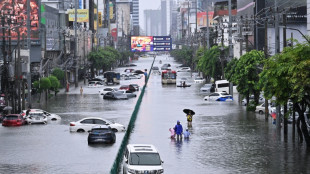
Five rescuers killed in Philippine typhoon / Photo: Ted ALJIBE - AFP

Five rescuers killed in Philippine typhoon

Five rescuers were killed in the Philippines after they were sent to a flooded community during a powerful typhoon, authorities said Monday, the first confirmed casualties of the strongest storm to hit the country this year.

Text size:

The typhoon dumped heavy rain and unleashed fierce winds as it swept across the main island of Luzon on Sunday and Monday, toppling trees and flooding low-lying communities.

So far, there have been no reports of widespread severe damage.

The five rescuers were in San Miguel municipality in Bulacan province, near the capital Manila, when they died.

"They were deployed by the provincial government to a flooded area," said Lieutenant-Colonel Romualdo Andres, chief of police in San Miguel.

Andres said the rescuers were wading through floodwaters when a wall beside them collapsed, sending them into the fast current.

The Philippines is regularly ravaged by storms, with scientists warning they are becoming more powerful as the world gets warmer because of climate change.

Super Typhoon Noru smashed into the archipelago nation on Sunday after an unprecedented "explosive intensification" in wind speeds, the state weather forecaster said earlier.

It made landfall about 100 kilometres (62 miles) northeast of the densely populated capital Manila, before weakening to a typhoon as it crossed a mountain range, coconut plantations and rice fields.

Nearly 75,000 people were evacuated from their homes before the storm hit, as the meteorology agency warned heavy rain could cause "serious flooding" in vulnerable areas, trigger landslides and destroy crops.

But on Monday morning there was no sign of the widespread devastation many had feared.

"We were ready for all of this," President Ferdinand Marcos Jr told a briefing with disaster agencies.

"You might think that we overdid it. There is no such thing as overkill when it comes to disasters."

Burdeos municipality on the Polillo islands, part of Quezon province, bore the brunt of Noru as it made landfall.

Fierce winds ripped off some roofs and brought down large trees while heavy rain flooded riverside houses, said Ervin Calleja, a 49-year-old teacher.

"It was really worrisome," Calleja told AFP by mobile phone.

"The wind was whistling and it had heavy rains. That's the more dangerous part."

Despite taking the full force of the typhoon, authorities said it passed over quickly and there were so far no reports of major damage to houses. But some crops were wiped out.

"Here at the town centre all banana trees were flattened, 100 percent," said Liezel Calusin, a member of the civil defence team in Polillo municipality.

"We still have no electricity, but the phones are working."

In Banaba village near Manila, Terrence Reyes fled his riverside home with his family and neighbours during the storm as floodwaters rose.

They returned home Monday to find their belongings caked in mud.

"We just have to throw them away and start over again," Reyes, 25, said.

"It happens each time there is a storm here."

The Philippines -- ranked among the most vulnerable nations to the impacts of climate change -- is hit by an average of 20 storms every year.

Y.Chaudhry--DT