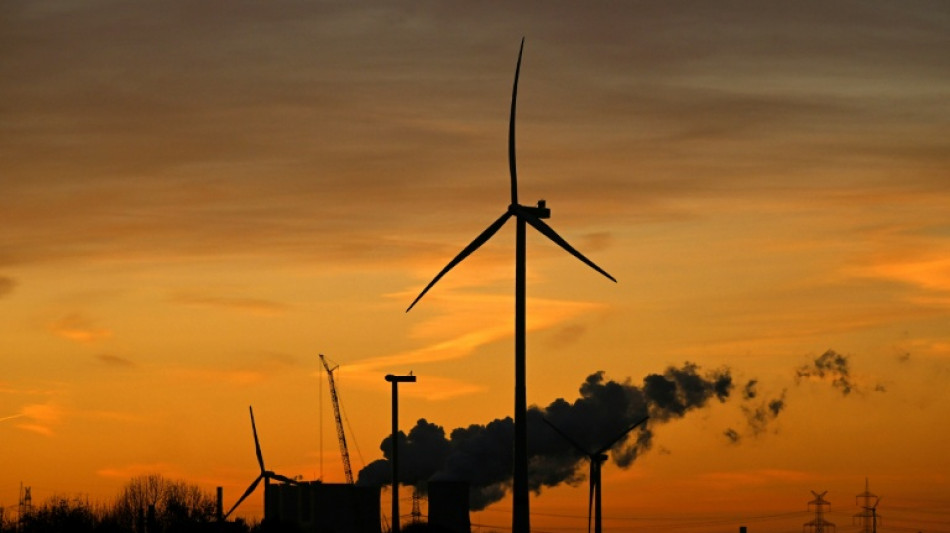
German emissions cuts slow, North Sea has warmest year on record / Photo: Ina FASSBENDER - AFP
Germany's greenhouse gas emission cuts slowed sharply in 2025 as the North Sea experienced its warmest year on record, piling pressure Wednesday on the conservative-led government to boost climate protection efforts.
Emissions in Europe's largest economy fell by just 1.5 percent from the previous year, according to a study by climate think tank Agora Energiewende, lower than the three-percent drop in 2024 and 10 percent the year before that.
If the current trend continues, Germany risks failing to hit its medium-term goal of cutting emissions by 65 percent compared to 1990 levels by 2030, said Julia Blaesius, the think tank's Germany director.
"Germany is losing ground on climate protection," Blaesius told a press conference. "The 2030 target is still achievable, but it's subject to major uncertainties."
When burnt, fossil fuels emit greenhouse gases such as carbon dioxide that trap heat near the Earth's surface, driving climate change and global temperature rises.
Highlighting the worsening picture, Germany's BSH maritime affairs agency reported Wednesday that the North Sea experienced its warmest year on record in 2025.
"The North Sea reached an average temperature of 11.6C, the highest value in the BSH's data series since 1969," Tim Kruschke, head of the agency's climate team, said in a statement.
The news might pile pressure on conservative Chancellor Friedrich Merz, whose government was already facing criticism that it is not committed to the climate change fight.
His coalition has championed policies that critics argue damage these efforts, but which Merz insists are needed to reduce the burden on the struggling economy.
He led criticism of an EU plan to ban new combustion-engine car sales from 2035, which the bloc is moving to water down, and his coalition has agreed to scrap an unpopular law requiring newly installed heating systems to run for the most part on renewable energy.
His economy minister, a former energy executive, has proposed scrapping some solar energy subsidies and building new gas-fired power stations.
It comes against a backdrop of the wider European Union moving to weaken new environmental rules as it seeks to boost competitiveness and following complaints from business.
- 'Need more speed' -
Blaesius stressed that 2025 was a transition year with "relatively few clear decisions" in Germany given the change of government.
But the emissions trend "makes it clear that we need more speed", and upcoming overhauls of legislation regarding renewable energy and heating would be "crucial", she said.
Last year's emissions cuts were driven by falls in energy-intensive industries, many of which have struggled as the economy stagnates, as well as record solar power generation, according to Agora.
But transport and building emissions rose again in 2025, noted the study, criticising "years of insufficient progress" in the shift to electric vehicles and heat pumps.
Germany's 2025 emissions totalled 640 million tonnes overall, a reduction of nine million tonnes from the previous year, according to the think tank.
National emissions are down 49 percent from 1990 levels. Germany is aiming for greenhouse gas neutrality by 2045.
There were some signs of positive momentum in 2025.
Around 300,000 environmentally friendly heat pumps were sold last year, passing gas boilers for the first time.
The share of new EV registrations rose sharply from a year earlier, accounting for about a fifth of all vehicles sold, the study said, although the sector was recovering from a dire year in 2024.
Nevertheless, Blaesius said that debates on issues such as the combustion-engine car ban "certainly don't help".
"These debates don't help the businesses that need to move ahead with e-mobility. And they don't help consumers either," she said.
Y.Chaudhry--DT