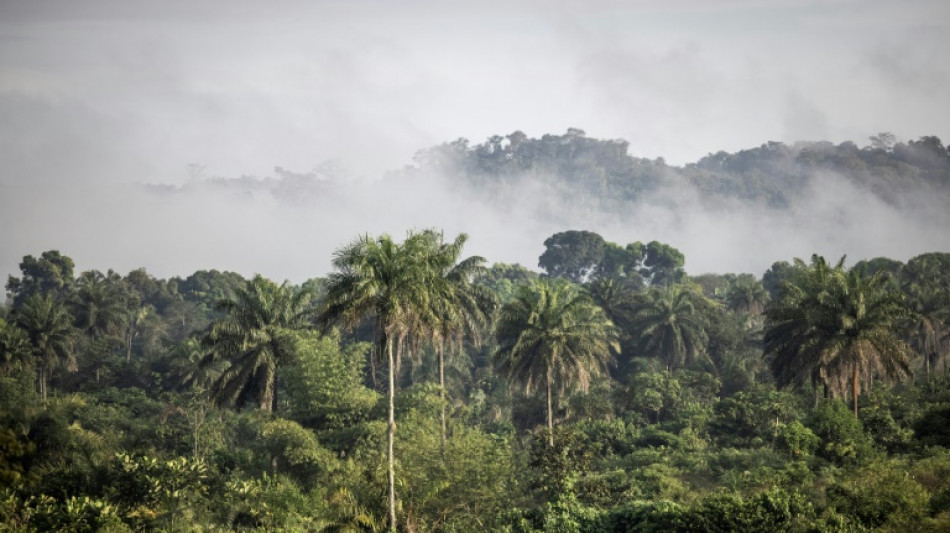
The case of Africa's 'vanishing' carbon deals / Photo: JOHN WESSELS - AFP
When Liberia's government signed an agreement with a little-known Dubai company run by a royal sheikh in 2023, the "carbon credit" deal promised to protect vast tracts of forests and offset big polluters' emissions.
It was one of a flurry of deals UAE-based Blue Carbon signed that year covering millions of hectares of forests across Africa from Liberia to Zimbabwe -– in one case amounting to a fifth of a country's landmass.
African governments would safeguard forests for a share of revenues from carbon credit sales, benefits for communities and help fighting deforestation. It was promoted as a win-win.
But more two years on, Liberia's Blue Carbon deal has stalled. Other accords across Africa and elsewhere have also gone nowhere, while the UAE company itself appears to have fallen silent, according to a joint investigation by AFP and Code for Africa, an investigative organisation.
"It was stopped," Elijah Whapoe, Liberia's National Climate Change Steering Committee (NCCSC) coordinator, told AFP when asked about the status of the Blue Carbon agreement.
"As we speak, there is no attempt to my knowledge, anything, about trying to resuscitate it."
Blue Carbon's Africa venture highlights the complexity of delivering on carbon credits, schemes that still lack oversight and are often criticized for offering large polluters a chance to "greenwash" emissions with little or no impact on climate change.
Carbon credits or offsetting allow greenhouse gas producers to "cancel out" some of their emissions by investing in projects that prevent or reduce carbon dioxide production. Forests store huge amounts of carbon dioxide, and protecting them prevents the planet-warming gas from being released.
Most of the Africa agreements were signed before or on the sidelines of the COP28 summit in the United Arab Emirates in 2023. Blue Carbon's Chairman Sheikh Ahmed Dalmook Al Maktoum, a member of Dubai's royal family, was often present.
Blue Carbon presented them as a model for carbon trading under the Article 6 of the United Nations climate agreement that was signed in Paris in 2015 and sets the rules for how countries can trade carbon credits.
Blue Carbon also said its work would help the United Arab Emirates achieve its carbon reduction goals, according to a company statement released when it launched in October 2022.
For environmentalists, Blue Carbon's Africa agreements were at best mismatched with local realities. At worst, critics say, they were a means to allow oil-producer the UAE to earn "green" credentials before hosting the COP28 summit.
Under Liberia's deal, approximately one million hectares of forests -– around 10 percent of the country's landmass -- would be protected, local communities engaged and the government rewarded 30 percent of revenues in a deal for sustainable forest management, according to a Blue Carbon statement and a preliminary copy of the Memorandum of Understanding seen by AFP.
Like Liberia's deal, other Africa accords were so-called REDD+ frameworks where some developing countries can receive financing for reducing emissions by stopping deforestation.
But Blue Carbon's Liberia agreement soon ran into a barrage of criticism from activists and environmentalists who said the deals would trample over local community ownership agreements, undermine existing legal rights and offer little transparency.
Saskia Ozinga, the founder of Fern, an organisation working to protect forests and their communities, said the Blue Carbon deals in Africa were unprecedented in scale, unclear about how they would protect forests and lacked consultations with communities.
"Blue Carbon was clearly aimed to greenwash," she said. "It was a bizarre idea from many different perspectives, which would have never worked for the climate, for forests and for people."
- Deals across Africa -
One of Blue Carbon's initial agreements on the continent was in March 2023 with Tanzania to help "preserve and manage its 8 million hectares of forest reserves," according to a Blue Carbon statement.
With Zambia, it covered 8 million hectares while Zimbabwe's agreement involved 7.5 million hectares that would generate "profound benefits for local communities", according to company statements on social media. Blue Carbon inked another deal with Kenya and with Nigeria's north central Niger state.
Soon after Liberia's finance minister Samuel Tweah signed, a United Nations agency and local NGOs urged the government to reconsider the Blue Carbon deal because of the risks of legal challenges and other concerns.
A letter from the UN Resident Coordinator and the Coordinating Partners Group dated August 2023 sent to Tweah warned of "serious and credible concerns that the concessions arrangement conflicts with existing community and individual land rights," it said.
Vincent Willie, a former lawmaker and chairman of a committee for natural resources and environment, said Blue Carbon had made initial proposals, but that amounted only to signing the non-binding MOU.
"As far as I am concerned that is the only place the government stopped," he told AFP of the MOU.
Whapoe, the head of Liberia's climate change secretariat, said the Blue Carbon deal was halted because it had not been "consistent" with how carbon deals are meant to be managed, including more local input.
Outreach to communities was started, but James G. Otto, a Liberian activist from the River Cess region, said visits by government agencies and civil society organisations left the community with more questions.
"They say and insist that any agreement on the use of their land and forest resources should be directly driven by them," Otto told AFP. "As far as our information gathering is concerned, there has been no formal work initiated under the Blue Carbon deal."
- Africa and beyond -
Other Blue Carbon programmes appear to have gone little further, according to activists and officials who spoke to AFP.
Blue Carbon hailed the Zimbabwe deal, which was to cover about 20 percent of the country's landmass, as a "historic achievement for climate action".
But Zimbabwe's deal was only an expression of interest, and implementation still requires a formal project, said Washington Zhakata, Zimbabwe's director for climate change.
"Blue Carbon has yet to submit its project idea note. Nonetheless, the company has already applied for an account on the Zimbabwe Carbon Registry," Zhakata said.
Douty Chibamba, Zambia's Permanent Secretary at the Ministry of Green Economy and Environment, also told AFP nothing came of his nation's Blue Carbon agreement.
"The MOU lapsed without any action," he said.
Kenyan and Tanzanian officials did not respond to requests for details.
Another high-profile Blue Carbon deal outside of the continent has appeared to meet a similar fate.
Papua New Guinea signed an MOU with Blue Carbon in 2023 on the sidelines of the COP28 in Dubai. Papua New Guinea Prime Minister James Marape's office said then his nation's "vast mangrove areas" could be harnessed.
However, Papua New Guinea's Climate Change Authority told AFP in July the agreement had "not progressed at all".
To sell the planned PNG carbon credits, Blue Carbon partnered with Singapore-based AirCarbon Exchange as its "preferred platform". But this agreement, too, has gone nowhere.
"Our MOU with the Dubai company 'Blue Carbon', signed in 2023, has since lapsed," an AirCarbon Exchange spokesperson in a statement to AFP. "There has been no active engagement between the parties."
- 'Hot air' –
Today, the company appears to have no global registration and no operational footprint in any recognised global carbon market system, according to a digital investigation by Code for Africa, a South Africa-based operation whose iLAB is Africa's largest forensic data investigation unit.
Code for Africa found no trace of Blue Carbon or its projects on the three main databases for global carbon credit certification, run by the United Nations Framework Convention on Climate Change (UNFCCC), and companies Verra and Gold Standard.
And there was no sign of Blue Carbon having filed notifications of intent that are required under Article 6.4 of the Paris Agreement framework for new deals to go ahead.
Blue Carbon's publicity campaign has also evaporated.
"Blue Carbon aims to be at the forefront of sustainable climate change investment," the company said in an October 2022 statement announcing its launch that also explicitly linked its work to the UAE's official greenhouse gas reduction strategy.
"Blue Carbon will serve as an enabler of blue and green economy operational frameworks that will set the agenda for the implementation of international climate agreements as well as to contribute to the UAE Net Zero by 2050 strategic initiative."
During 2023, Blue Carbon also released statements and photos on its social media accounts showing African officials signing MOUs with the company's leaders.
But its Instagram account, which first posted in October 2022 to coincide with the company's launch, has not had a new post since December 2023.
Similarly, the company's official X account, @BlueCarbonDxb, posted 27 times between October 18, 2022 and March 28, 2023, and has been inactive ever since. Its final post announced the signing with Liberia.
Blue Carbon's website no longer works, having gone offline between May and July 2025, according to archival records examined by Code for Africa's iLab.
AFP attempted multiple ways to contact Blue Carbon, including emails to [email protected] and calls to a number for one of the company's executives, but received no reply.
An AFP journalist also visited the Blue Carbon address listed in the Liberia MOU in Dubai. A guard initially said Blue Carbon was based there. But later he said there was no Blue Carbon office, and advised the reporter needed an appointment. There was no Blue Carbon sign visible in the lobby.
The UAE's government did not respond to a request for comment.
Carbon credit projects, particularly those involving forest protection, have frequently run into problems ranging from failing to protect designated forests to links with rights violations of local residents. Efforts are currently under way to improve oversight and regulation of crediting schemes.
"There are a number of lessons emergent from Blue Carbon saga, chief among them the importance of robust standards related to the supply and use of carbon credits internationally," said Injy Johnstone, research fellow in net-zero aligned offsetting at Oxford University.
"We need to see more transparency related to Article 6 transactions, concrete standards related to environmental integrity of the projects themselves and public accountability from both the supplier and end-user to ensure they do not vanish into 'hot air' as this one has."
This investigation was supported by insights from Code for Africa's Anita Igbine, Eliud Akwei, Jacktone Momanyi, and Moffin Njoroge.
J.Chacko--DT