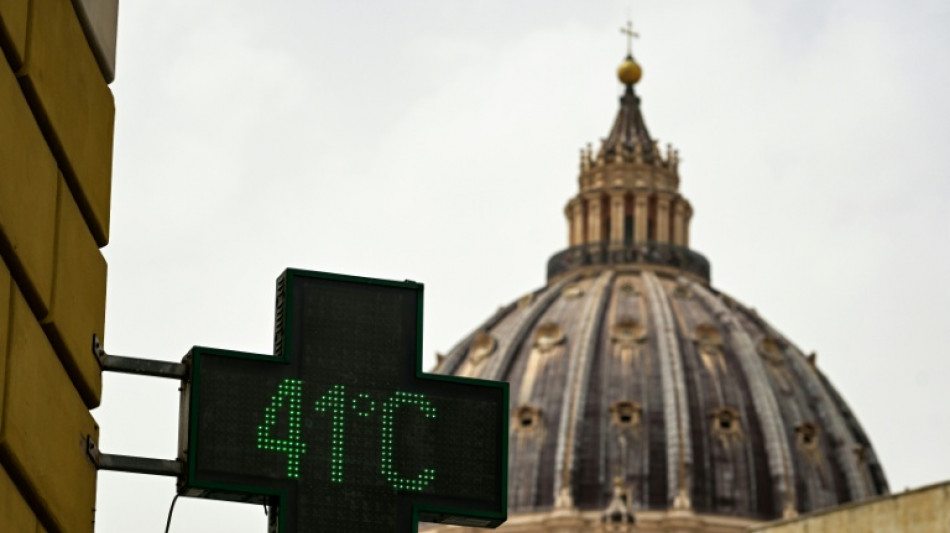
Over 60,000 Europeans died from heat during 2024 summer: study / Photo: Tiziana FABI - AFP/File
More than 60,000 people died from heat in Europe during last year's record-breaking summer, a benchmark study said Monday, in the latest warning of the massive toll climate change is having on the continent.
With Europe heating up twice as fast as the global average, the Spain-based researchers suggested an emergency alert system could help warn vulnerable people -- particularly the elderly -- ahead of dangerous heatwaves.
"Europe experienced an exceptionally deadly summer in 2024 with more than 60,000 heat-related deaths, bringing the total burden over the past three summers to more than 181,000," said the study in the journal Nature Medicine.
The researchers at the Barcelona Institute for Global Health (ISGlobal) reached this figure by analysing mortality data in regions across 32 European countries that covered a population of 539 million.
The death toll during last year's summer -- which was the hottest in recorded history for both Europe and the world -- was estimated to be 62,775.
This was nearly 25 percent higher than the 50,798 estimated for 2023's summer, according to the study's newly revised figures. It remained below 2022's toll of 67,873.
However there are several sources of uncertainty for this kind of research, which means these are not "ultimate and precise" numbers, lead study author Tomas Janos of ISGlobal told AFP.
Taking this uncertainty into account, the 2024 study gave a wider estimate range of between 35,00 to 85,000 deaths.
It is difficult to establish how many people are killed by rising temperatures, because heat is very rarely recorded as a cause of death.
Beyond immediate effects such as heatstroke and dehydration, heat contributes to a broad range of potentially deadly health problems, including heart attacks, strokes and respiratory conditions.
According to the study, Italy was the country with the most heat deaths last summer with an estimated 19,000, followed by Spain and Germany, both with over 6,000.
When the size of the country's population was taken into account, Greece had the highest rate with 574 deaths per million people, followed by Bulgaria and Serbia.
- What about 2025? -
But what about the summer that recently ended in Europe, which is thought to be the hottest ever recorded in countries including Spain and the UK?
Last week a rapidly produced analysis estimated that human-caused climate change was responsible for around 16,500 deaths this summer -- though that was only in European cities, or a fraction of the continent's population.
Rather than waiting months and years for countries to release mortality data -- and the lengthy process to get published in a peer reviewed-journal -- the British researchers aimed to give a quicker snapshot of the 2025 toll.
Unlike Monday's study -- which looked at actual recorded deaths -- the rapid attribution study estimated how many people died from heat by extrapolating from previous years.
Janos said that both kinds of research played an important role, one offering a "first assumption" of heat deaths and the other giving "more robust, precise estimates" that could guide policy.
Monday's study also evaluated a tool that used weather forecasts to issue emergency alerts ahead of potentially deadly heatwaves. It found the alerts were reliable at least a week before the heatwave struck.
This early warning system is an "unexplored opportunity to save lives among the most vulnerable populations," ISGlobal's Joan Ballester Claramunt said.
G.Koya--DT