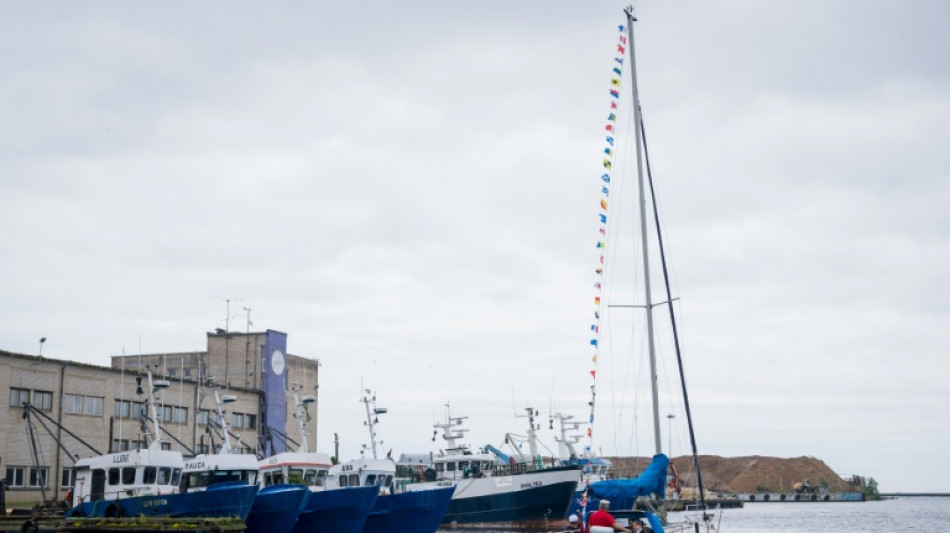
Life after cod: Latvia reinvents its coastal communities / Photo: Gints Ivuskans - AFP
Fishers do not usually wish for a "perfect storm". But Latvian boating communities are hoping for exactly that: a rare tempest that might, one day, revive waning stocks of Baltic cod.
Decreasing salinity in the Baltic Sea is robbing the saltwater fish of the conditions it needs to thrive.
And as its population shrinks, so do the fishing traditions that have long characterised villages along Latvia's 494-kilometre (307-mile) coastline.
The result for the communities in this small EU nation is a drive to reinvent themselves, to survive.
With the European Union steadily cutting allowable catches of Baltic cod, and moving towards a total ban to replenish stocks, towns and villages are diversifying into tourism and seafood processing.
"We launched a new marina for yachting, offered services for sea travellers, and a French investor opened a brand new shipyard for yacht building," Agris Stulbergs, harbourmaster for the port in the village of Engure, explained to AFP.
Leisure boating has become a favoured activity in this village, located just 50 kilometres from the capital Riga, and others.
Farther west, in the port city of Ventspils, Juris Petersons, a lifelong seaman, reminisced how Latvian fishers used to bring in lavish hauls of fish highly valued in kitchens from Russia to Britain.
"Back in the mid-80s the Latvian fishing fleet brought in 55,000 tons of Baltic cod, in addition to salmon, herring and many other saltwater fish," he said.
Now "the environmental conditions have become so unfavourable to cod growth that Latvian fishermen are allowed to catch just 16 tonnes of cod a year," he said.
"And even that amounts only to the accidental by-catch when we fish for herring," said Petersons, an industrial fishing boat skipper until he sold off his trawlers last year.
The Baltic Sea is fed by a number of large freshwater rivers. It is connected with the North Sea only through the shallow Danish straits, preventing Atlantic saltwater from entering the Baltic basin.
- Rare storm needed -
In order to recover, the cod population would need a rare seastorm, with just the right windspeed at the correct angle to push masses of saltwater into the Baltic Sea.
That "happened at least twice during the previous century, but currently we're waiting for that perfect storm for the third decade", Petersons said.
Given the smaller yield, many in the industry have focused on quality over quantity.
"All the fish canning companies... have either gone out of business or turned their production lines into making more valuable export-grade products," said Janis Megnis, chief of the Roja port administration.
Their high quality herring and anchovy products "can be found today from Walmart in the United States to stores in Australia and Japan", he said.
Political changes have also affected the industry.
Historically Latvia's fish processing industry mainly served markets in Russia and Belarus.
But with the Russian annexation of Crimea in 2014, followed by Moscow's invasion of Ukraine in 2022, and the resulting Western sanctions, Latvian fishing companies have been forced to seek other markets.
The biggest importers today are Canada, Ukraine, Poland, Romania, Denmark and the UK, according to the agriculture ministry.
New markets include Arab countries and South Africa.
- Tourists courted -
Many families in Latvia's coastal towns have also turned their former fisheries into guesthouses and vacation destinations or switched from selling raw fish to the more lucrative smoked, prepared and spiced varieties.
"My husband is a fifth-generation fisherman: he goes out to sea for fish, which we then smoke and turn into high-end products," said Iveta Celkarte, who runs a fishing estate in Berzciems village.
"We also have a family cafe... serving our own seafood," said Celkarte, who has also become a television and social media personality.
Celkarte offers three-hour tours about the history of traditional fishing, taking visitors on a stroll through dunes to the shore and finishing with a special meal.
"For me it is important to tell people about the traditions of our coast, the history of fishing and the life of previous generations working on the sea" she said.
Aivars Lembergs, a former mayor of Ventspils, said he began turning his city into a manufacturing hub and developing tourism has been key, and is paying off.
The city is seeing many tourists coming in from neighbouring Lithuania.
"During summers you'll sometimes see more Lithuanians on the streets of Ventspils than Latvians, as Lithuania has a very short Baltic coastline, and their tourists come here to enjoy the short Baltic summer," said Lembergs, who was mayor between 1988 and 2021.
H.El-Qemzy--DT