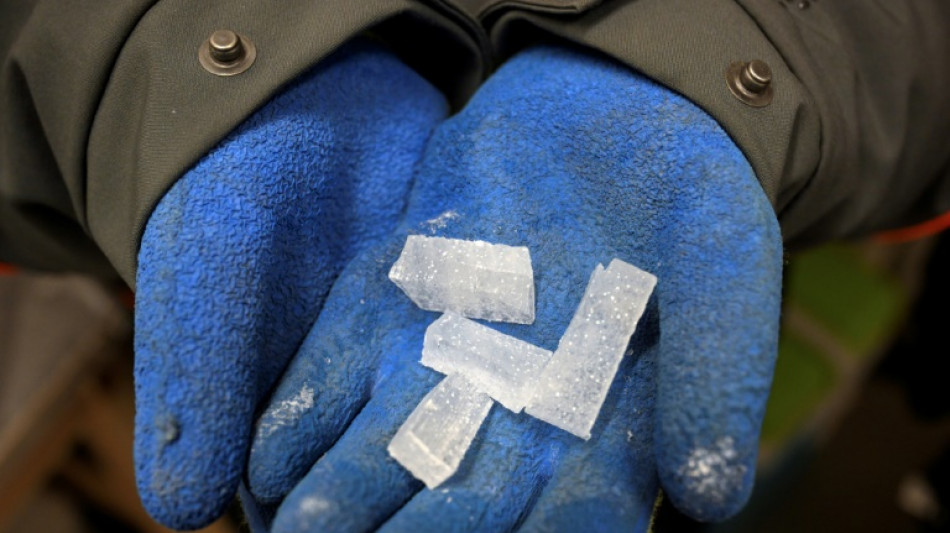
From Antarctica to Brussels, hunting climate clues in old ice / Photo: Nicolas TUCAT - AFP
In a small, refrigerated room at a Brussels university, parka-wearing scientists chop up Antarctic ice cores tens of thousands of years old in search of clues to our planet's changing climate.
Trapped inside the cylindrical icicles are tiny air bubbles that can provide a snapshot of what the earth's atmosphere looked like back then.
"We want to know a lot about the climates of the past because we can use it as an analogy for what can happen in the future," said Harry Zekollari, a glaciologist at Vrije Universiteit Brussel (VUB).
Zekollari was part of a team of four that headed to the white continent in November on a mission to find some of the world's oldest ice -- without breaking the bank.
Ice dating back millions of years can be found deep inside Antarctica, close to the South Pole, buried under kilometres of fresher ice and snow.
But that's hard to reach and expeditions to drill it out are expensive.
A recent EU-funded mission that brought back some 1.2-million-year-old samples came with a total price tag of around 11 million euros (around $12.8 million).
To cut costs, the team from VUB and the nearby Universite Libre de Bruxelles (ULB) used satellite data and other clues to find areas where ancient ice might be more accessible.
- Blue ice -
Just like the water it is made of, ice flows towards the coast -- albeit slowly, explained Maaike Izeboud, a remote sensing specialist at VUB.
And when the flow hits an obstacle, say a ridge or mountain, bottom layers can be pushed up closer to the surface.
In a few rare spots, weather conditions like heavy winds prevent the formation of snow cover -- leaving thick layers of ice exposed.
Named after their colouration, which contrasts with the whiteness of the rest of the continent, these account for only about one percent of Antarctica territory.
"Blue ice areas are very special," said Izeboud.
Her team zeroed in on a blue ice stretch lying about 2,300 meters (7,500 feet) above sea level, around 60 kilometres (37 miles) from Belgium's Princess Elisabeth Antarctica Research Station.
Some old meteorites had been previously found there -- a hint that the surrounding ice is also old, the researchers explained.
A container camp was set up and after a few weeks of measurements, drilling, and frozen meals, in January the team came back with 15 ice cores totalling about 60 meters in length.
These were then shipped from South Africa to Belgium, where they arrived in late June.
Inside a stocky cement ULB building in the Belgian capital, they are now being cut into smaller pieces to then be shipped to specialised labs in France and China for dating.
Zekollari said the team hopes some of the samples, which were taken at shallow depths of about 10 meters, will be confirmed to be about 100,000 years old.
- Climate 'treasure hunt' -
This would allow them to go back and dig a few hundred meters deeper in the same spot for the big prize.
"It's like a treasure hunt," Zekollari, 36, said, comparing their work to drawing a map for "Indiana Jones".
"We're trying to cross the good spot on the map... and in one and a half years, we'll go back and we'll drill there," he said.
"We're dreaming a bit, but we hope to get maybe three, four, five-million-year-old ice."
Such ice could provide crucial input to climatologists studying the effects of global warming.
Climate projections and models are calibrated using existing data on past temperatures and greenhouse gases in the atmosphere -- but the puzzle has some missing pieces.
By the end of the century temperatures could reach levels similar to those the planet last experienced between 2.6 and 3.3 million years ago, said Etienne Legrain, 29, a paleo-climatologist at ULB.
But currently there is little data on what CO2 levels were back then -- a key metric to understand how much further warming we could expect.
"We don't know the link between CO2 concentration and temperature in a climate warmer than that of today," Legrain said.
His team hopes to find it trapped inside some very old ice. "The air bubbles are the atmosphere of the past," he said. "It's really like magic when you feel it."
G.Gopalakrishnan--DT