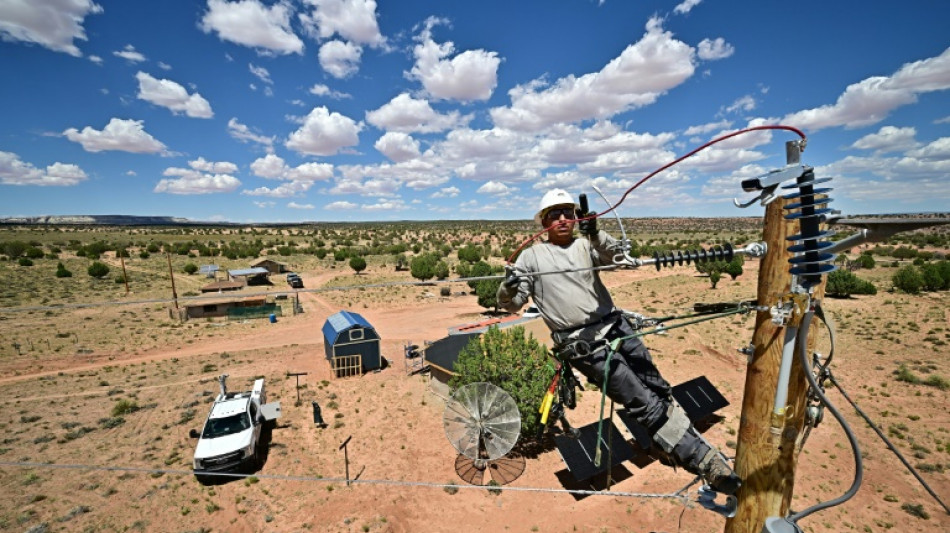
Faced with US heat waves, the Navajo push for power -- and A/C / Photo: Frederic J. BROWN - AFP
Workmen plant electricity poles in the rust-orange earth of the Navajo Nation and run cables to Christine Shorty's house -- finally giving her power against the searing Arizona desert heat.
It will be a luxury in the vast Native American reservation, the largest in the United States, where more than 10,000 families are still without electricity and therefore air conditioning.
"It's climate change. It's getting hotter," Shorty tells AFP.
"This would be easier for us with the fan and maybe air conditioning. And we look forward to that."
In her 70 years, Shorty has seen her isolated, tiny hamlet of Tonalea, a dot in the enormous area of the reservation, change dramatically.
Summer monsoon rains are rarer, and temperatures can touch 104 degrees Fahrenheit (40 degrees Celsius) in July and August -- previously unthinkable in the hamlet, located on a plateau at an altitude of 5,700 feet (1,730 meters).
The area's seasonal lakes are drying up, and in some years the livestock are dying of thirst.
Like many others, Shorty has a generator and small solar panels that allow her to power a gas fridge, cook and watch television.
But their power is limited, and she often has to choose which appliance to plug in.
Being hooked up to the electrical grid is "a big change. It's going to make my life a lot easier," she tells AFP.
- 'Survival mode' -
Most of the United States was electrified in the 1930s under president Franklin Roosevelt's New Deal initiatives.
But in the Navajo Nation, which stretches across Arizona, New Mexico and Utah, the first efforts only began in the 1960s, and there are still not enough power lines.
"This area was looked over," says Deenise Becenti of the Navajo Tribal Utility Authority (NTUA), the agency that manages the reservation's infrastructure.
"That surprises many people. They're saying, you know, why are there third world conditions that exist here in the United States, the greatest country in the world?"
To catch up, the semi-autonomous government of the reservation launched the "Light Up Navajo" project in 2019.
The humanitarian initiative sees electricity companies from all over the country send their employees to work in the reservation for around a dozen weeks a year.
Since 2019, electricity has been supplied to 5,000 families in the reservation, including 1,000 thanks to "Light Up Navajo," Becenti said.
But as climate change drives temperatures higher, families still without power in the reservation -- where many live below the poverty rate and unemployment is high -- are in "survival mode," she said.
- 'Angry' -
Elbert Yazzie's mobile home turns into a furnace in the summer, and he has already lost one member of his extended family to heat stroke.
"I used to like the heat," the 54-year-old, who lives in nearby Tuba City, tells AFP.
"But when you get older I guess your body can't take it no more."
His home was finally connected to electricity just weeks ago.
Since then, he has rigged up an evaporative air cooler, also known as a "swamp cooler," by salvaging three broken appliances from a garbage dump.
"Now we can turn on the A/C anytime we want, so we don't have to worry about the heat, and the generator and the gas, and all that stuff," he says.
"Now we don't have to go to (other) people's houses to cool down, we can just stay home, relax, watch TV, things like that."
He and Shorty are the fortunate ones.
Without more funding, connecting the remaining 10,000 Navajo families without electricity could take another two decades, Becenti says.
That is far too long for Gilberta Cortes, who no longer dares let her children play outside in the summer, for fear of getting heat-exacerbated nosebleeds.
An electricity pole has just been erected in front of the 42-year-old's house and a line is due to be extended to her in a few months' time.
But she has endured too much false hope to be serene.
"My mom and dad were in their 20s, they were promised power," but it never materialized, she says.
"I'm still angry."
A.El-Nayady--DT