Rotten insects, viral videos and climate change: S.Korea battles 'lovebug' invasion / Photo: ANTHONY WALLACE - AFP
K-pop's BTS are grossed out by them. A YouTuber ate them. Hikers plough through them: South Korea is dealing with a "lovebug" invasion that experts say highlights worsening climate change.
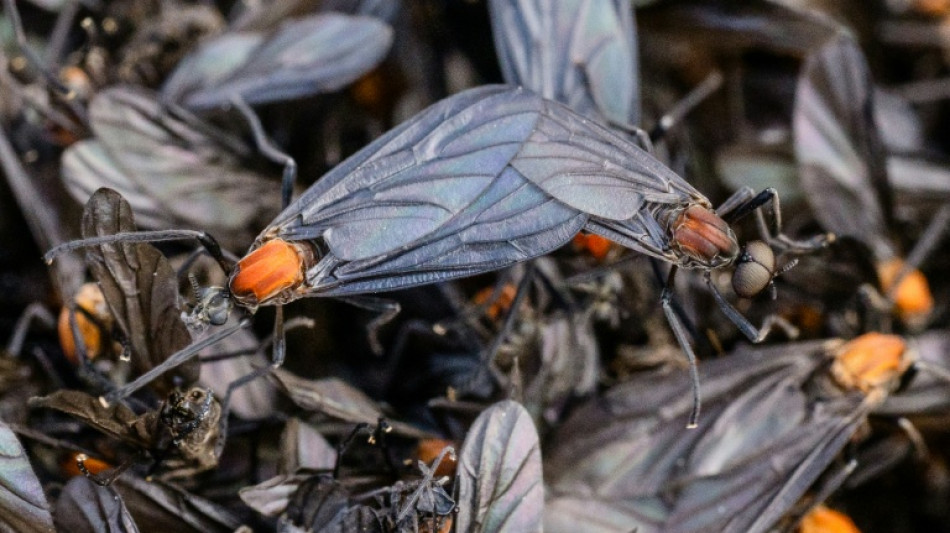
First identified in South Korea a decade ago, Seoul is now annually hit by a weeks-long infestation of the Plecia nearctica insect, a type of March fly nicknamed "lovebug" for their distinctive mating behaviour, which sees them fly around in coupled pairs.
Huge clouds of the insects, which are harmless to humans, blanket apartment walls and mountain trails and, after they quickly die, leave behind piles of rotting black remains and a foul stench.
Complaints about the bugs, which scientists believe came from southern China and have surged with rising temperatures linked to climate change, have risen sharply, Seoul city data showed.
Even K-pop BTS idol RM is seen seemingly cursing upon spotting the insects in a viral video, with fellow bandmember Jin separately seen casually blowing a lovebug out of his way mid-performance.
"In general, many insects tend to grow more rapidly in warmer temperatures," Ju Jung-won, a deputy researcher at the Korea Disease Control and Prevention Agency, told AFP.
"As for the lovebugs, it looks like the temperature and environment found in foreign regions where they are active are now taking hold in South Korea as well, allowing them to survive here."
At the peak of Gyeyangsan Mountain in Incheon, west of Seoul, public servants wearing makeshift protective gear struggled to clear piles of dead insects, as vast swarms of the bugs circled in the air, making it hard for people in the area to keep their eyes open.
At their worst, the piles of dead lovebugs in parts of the mountain were "stacked more than 10 centimetres (four inches) high," said Jung Yong-sun, 59, who was tasked with pest-control duties.
Walking through them, he added, "felt like stepping on something soft and cushiony."
The unpleasant odour took many by surprise.
"At first, I thought it was food waste... Turns out, it was the stench of dead bugs," said Ahn So-young, a 29-year-old hiker.
"I cried when I came up here. I was so scared."
- 'Really delicious' -
Park Sun-jae, a senior researcher at the National Institute of Biological Resources, told AFP that the bugs were first reported in South Korea in Incheon in 2015.
"Since 2022, the population has begun to surge," Park said, adding that they were now "found throughout the greater Seoul metropolitan area".
This year, the infestation has been widely documented online, with content creators flocking to the worst-affected areas to cash in on the inundation.
One YouTuber collected a massive pile of the bugs and turned them into a "burger patty", mixing them into batter before frying and eating them on camera.
"It's not bad. It's really delicious," he said in the video, which has garnered more than 648,000 views.
On Gyeyangsan Mountain, content creators Kim Ji-young and Sam Jung intentionally dressed in white — a colour known to attract the bugs — and filmed themselves being swarmed.
"This is probably something I'll never experience again in my lifetime," Jung said, as his hat and clothes were crawling with the bugs.
- Beneficial insects? -
But for many Seoul residents, the bugs aren't just a viral moment. They are disrupting daily routines.
In Daejo Market in Seoul's Eunpyeong district, restaurant owners had to constantly blow the bugs away to protect their ingredients.
Dead insects kept piling up on the floor -- putting severe pressure to the cleaners' workload.
"I want to be able to eat lunch without worrying about lovebugs landing on my face or getting into my food," business owner Chang Seo-young, 48, told AFP.
Lovebugs -— seen by South Korean officials as "beneficial insects" for breaking down plant matter —- typically disappear naturally by early July.
But scientists warn that given the unpredictability of the climate crisis, the possibility of insect species -- including ones more harmful than lovebugs -- invading the country cannot be ruled out.
"I worry that future generations will have to suffer so much," said Jeon In-hyeop, a 29-year-old visitor to Gyeyangsan Mountain, after surveying parts of the summit covered in bugs.
"I feel like our children might end up living in a much more unfortunate world."
A.Ragab--DT