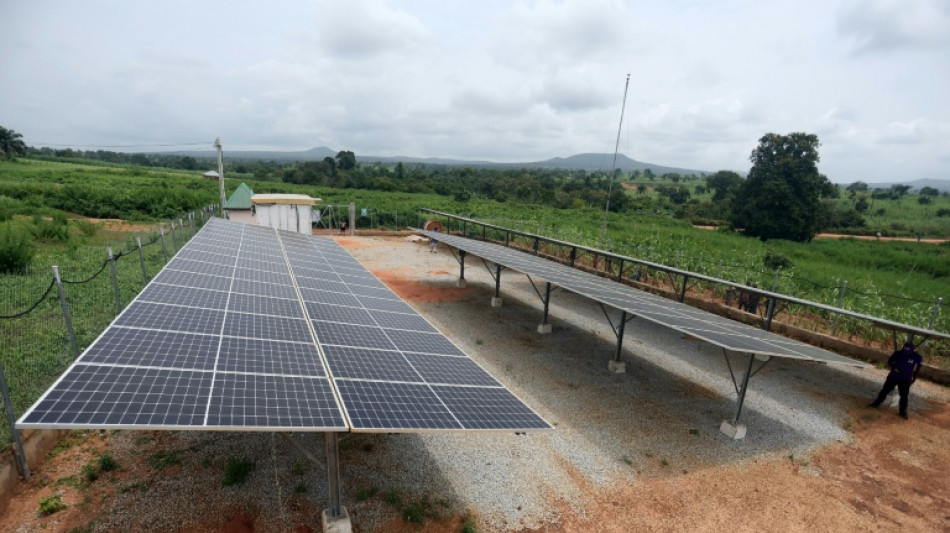
Green bonds offer hope, and risk, in Africa's climate fight / Photo: Kola Sulaimon - AFP/File
It only took two days for Nigeria to raise $59 million through green bonds -- part of a funding drive for climate and environmental projects in a nation still hooked on oil.
Africa remains a small player in the green bond market, and the debt instrument is underused -- but it is becoming a fast-growing source of funding for the world's poorest continent, which is at the forefront of climate change.
Green bonds are similar to sovereign bonds: Investors are paid interest on what is essentially a loan to the government, but in this case the money funds environmentally friendly projects.
But the continent's investment risk profile means that countries pay a high interest rate to borrow money.
Nigeria is paying 19-percent interest on the green bonds it issued earlier in June. By comparison, France is paying three-percent interest on its latest green bonds.
Nigeria's recent fundraising round is slated to put money into a slew of renewable energy, eco-friendly housing, conservation and infrastructure projects.
"Nigeria is a continental leader in the African green bond market," Lagos-based law firm Udo Udoma & Belo-Osagie told AFP in a note.
"However, to unlock the full potential of green bonds, especially in Africa, we need stronger regulatory frameworks, better project pipelines, capacity-building for issuers and enhanced investor confidence."
- Green bonds on the rise -
The continent accounted for only about $5 billion of the 2.2 trillion global green bond market in 2023, according to data from the Africa Policy Research Institute.
But that came on the back of a 125 percent increase in issuances that year and "significant growth" in the market, it said.
Nigeria was the first African state to issue sovereign green bonds, selling $30 million in 2017 and then another $41 million in 2019.
The west African nation was following an example set by Johannesburg in 2014, when the South African municipality paved the way on the continent by issuing nearly $140 million in green bonds to investors.
Since then, Kenyan developer Acorn Holdings issued east Africa's first green bonds in 2019, raising more than $40 million to finance what it called environmentally friendly student housing.
Tanzania's CRDB Bank launched its first green bonds in 2023, raising $300 million for financing renewable energy as well as infrastructure and water supply projects.
The biggest coup came last year in Ivory Coast, where $1.5 billion was raised.
Yet the continent remains underfinanced, with Nairobi-based nonprofit FSD Africa blaming "unstable macroeconomic conditions," a risky political and business environment and "a shortage of bankable green projects".
Currency depreciation and high inflation also create risks for investors. In response, governments have to offer "a risk premium to attract investors."
China and the United States, the world's two biggest polluters, dominate the green bond market as they seek ways to fund their energy transitions.
Their leadership is not surprising "given that they are carbon-intensive economies who have contributed more in the global climate crisis," said Alex Oche, an environmental law expert at Nigeria's Institute for Oil, Gas, Environment, Energy and Sustainable Development.
- Failed projects, 'greenwashing' -
Africa is responsible for just roughly four percent of global emissions that contribute to climate change.
Yet its poorer countries remain some of the least prepared to deal with the fallout of successive crises, from erratic rainfall to shifting fishing stocks, linked to rising global temperatures.
"The future of green bonds in Africa and globally is promising, but it will depend heavily on credibility, innovation and inclusive growth," said law firm Udo Udoma & Belo-Osagie.
Beyond an influx of cash, a better regulatory framework is also needed, experts said.
Razaq Fatai, a researcher for Nigerian consulting firm Vestance, studied previous projects financed by green bonds and warned that several appeared to resemble "greenwashing" -- including a reforestation project in Oyo state where "the community was not involved" in the planning.
"After a couple of years, most of the trees were dying," he said.
"If you continue to do that, continue to spend money like that, you just end up just wasting public resources, and then you have to pay interest on those debts that we encourage."
I.Menon--DT