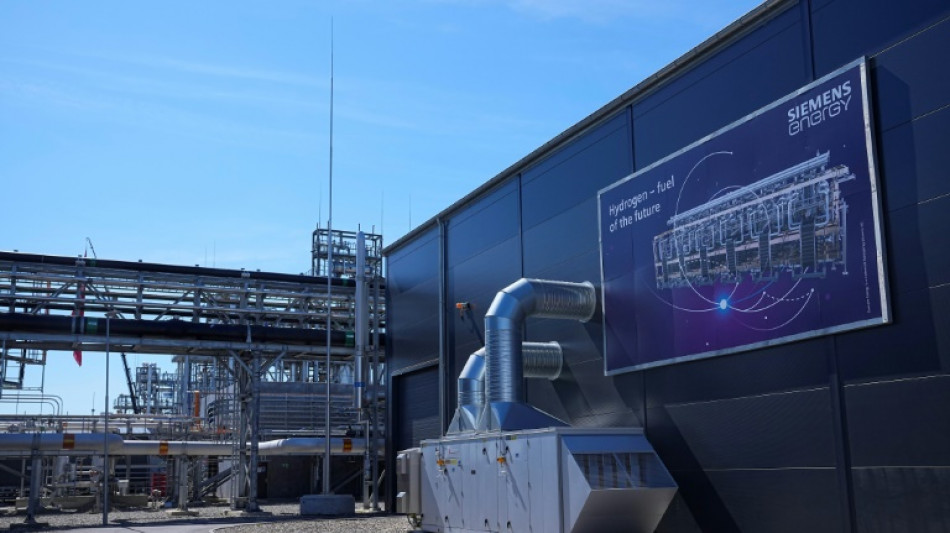
Europe's biggest 'green' methanol plant opens in Denmark / Photo: Bo Amstrup - Ritzau Scanpix/AFP
Europe's largest "green" methanol plant opened in Denmark on Tuesday, boosting the continent's emissions reduction efforts -- with customers ranging from shipping giant Maersk to toymaker Lego and pharmaceutical firm Novo Nordisk.
Sitting next to northern Europe's biggest solar panel field and a large transformer station in the Danish countryside, the site will produce e-methanol, a synthetic fuel made from renewable energy and carbon dioxide.
The site, called Kasso, is only the third e-methanol plant in operation in the world after locations in China and the United States, according to the French Bureau of E-fuels.
"Our strategy is to scale up. The next plant will be three times bigger," said Jaime Casasus-Bribian, head of projects at Danish company European Energy, which co-owns the plant with Japanese firm Mitsui.
The facility will produce up to 42,000 tonnes of e-methanol per year, the equivalent of 50 million litres.
The e-methanol will serve as fuel for Maersk ships, raw material for Lego's colourful plastic bricks and a component for Novo Nordisk's insulin injection pens.
While the plant is a milestone for Europe, it is small on a global scale.
Maersk alone would need two million tonnes of green methanol each year by 2030 if it were to reduce its fleet's carbon footprint by just 10 percent, according to its own estimates.
Laura Maersk, the company's first container ship to sail on e-methanol, will fill up at the neighbouring Aabenraa port every quarter, enough to allow it to sail for one month.
"This is an encouraging initiative in terms of the sector's potential development," Yann Lesestre, the author of an international report on e-fuels, told AFP.
He said, however, that it was too small to be of major significance.
"The feedback from the project will be interesting to verify the proper functioning of the technology on a commercial scale," he said.
The project has received a 53-million-euro ($59-million) subsidy from a Danish green investment fund.
- China world leader -
According to Lesestre's report, the European e-methanol sector accounts for 19 percent of planned capacity worldwide, compared to 60 percent in China.
The Jiangsu Sailboat site in China has been operational since 2023 and produces 100,000 tonnes annually.
Denmark -- a pioneer in renewable energy, in particular wind power -- has touted its swift development of the project, opening the plant less than two years after receiving the construction permit.
"It's a very, very important stepping stone in this whole transition of scaling up the production capacity," said Camilla Holbech, the head of renewable energies, green transition and international cooperation at the Green Power Denmark association.
"Stepping into green fuels is very, very important because in that way we can decarbonise sectors that cannot a priori run on electricity," Holbech said, citing shipping as an example.
The significant cost gap between this new industry and the fossil fuel industry explains the number of smaller-scale projects, she said.
E-methanol production costs could rival those of fossil fuels by 2040 if there is massive investment, according to a report by Green Power Denmark.
While the US and Chinese e-methanol plants use recycled carbon, the Danish site uses biogenic carbon, which is carbon found in natural materials, such as trees, plants, and other forms of biomass.
E-methanol is made by combining biogenic CO2 and green hydrogen, itself produced by electrolysis, which involves splitting water molecules using an electric current from renewable energy sources, in this case solar power.
O.Mehta--DT