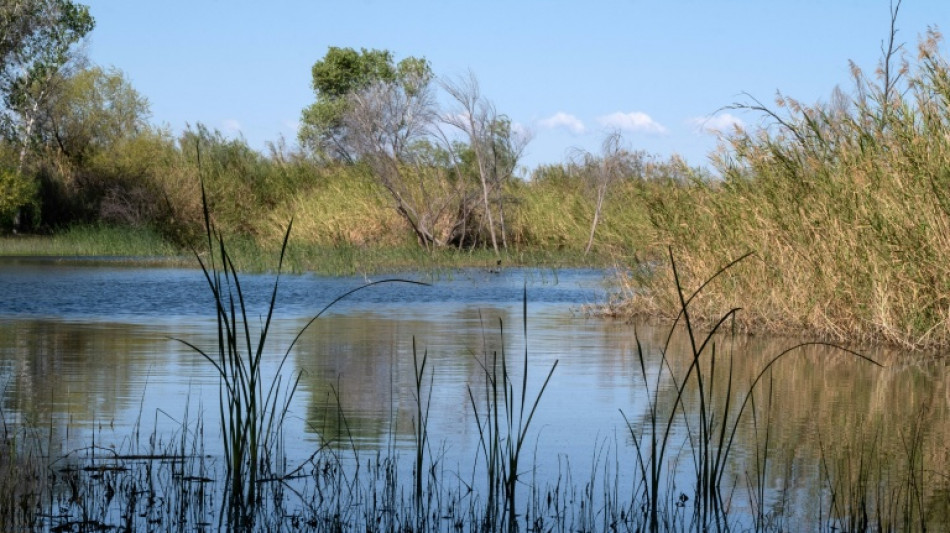
Once-dying Mexican river delta slowly nursed back to life / Photo: Guillermo Arias - AFP
In a drought-hit Mexican border region at the center of growing competition with the United States for water, conservationists are working to bring a once-dying river delta back to life.
On a stretch of the Colorado River, which on the Mexican side of the frontier is mostly a dry riverbed, native cottonwood and willow trees have been planted in place of invasive shrubs.
It is the fruit of two decades of work by environmentalists along the lower part of the river from the US-Mexican border to the upper estuary of the Gulf of California, also known as the Sea of Cortez.
"If we give a little water and care to certain sections of the river, we can recover environments that had already been completely lost," said Enrique Villegas, director of the Colorado River Delta program at the Sonoran Institute, a US-Mexican civil society group.
The Colorado starts in the Rocky Mountains and winds its way through the southwestern United States, feeding cities and farmland along the way.
By the time it crosses into Mexico most of its water has already been consumed.
What is left is diverted to supply border cities like Tijuana and to irrigate agricultural land.
It means Tijuana and nearby areas are at the mercy of how much snow falls in the Rockies, said Marco Antonio Samaniego, an expert at the Autonomous University of Baja California.
"We don't live off what rains in Tijuana. We live off what snows in those mountains," he said, adding that several years of below-average precipitation had reduced reservoir levels in the United States.
Growing competition for resources sparked a recent diplomatic row when the United States refused Mexico's request for water due to shortfalls in sharing by its southern neighbor under a decades-old treaty.
"The basis of all the problems," Villegas said, is that "there is more water distributed among all the users of the Colorado River than actually exists."
- Wildlife returns -
Over the years, dams and diversions reduced the river to a trickle and turned a delta that once teemed with birds and other wildlife into a dying ecosystem.
So conservationists secured land as well as irrigation permits, cleared invasive shrubs and planted thousands of native trees.
In 2014, water was allowed to surge down the Colorado River through a dam at the border for the first time in years to encourage the natural germination of native species.
"After years of this type of work, we now have a forest of poplars and willows on 260 hectares (642 acres) on a stretch of the Colorado River. Fauna has returned. Many birds have returned," Villegas said.
The rejuvenation has also brought back another native -- the beaver -- a species that had largely disappeared from sight in the area, Villegas said.
"On the one hand, it's a biological indicator that if you give nature a habitat then it returns and begins to reproduce. But they're also knocking down trees that we planted," he said.
At Laguna Grande, a lush oasis surrounded by dusty fields that is a centerpiece of the restoration project, coots and other birds swim contentedly in wetlands while herons startled by visitors clumsily take flight.
Nearby, on land, underground hoses feed water to trees sprouting from the dusty ground.
The Colorado River Delta is an important rest point for migratory birds including the yellow-breasted chat, vermilion flycatcher and endangered yellow-billed cuckoo, according to conservationists.
The wetlands and forest of Laguna Grande contrast starkly with parched agricultural land nearby where farmers such as Cayetano Cisneros are facing increasingly tough conditions.
"Years ago, we sowed maize, we sowed cotton, we sowed everything, and we didn't suffer because of water," the 72-year-old said on his dusty ranch.
These days, "the Colorado River no longer carries water," he said. "The environment is changing a lot."
If more of the delta and other such areas are to be nursed back to health, people must change their use of water, conservationists note.
"We can all improve our awareness of water consumption," Villegas said.
"This drought is just a warning."
V.Munir--DT