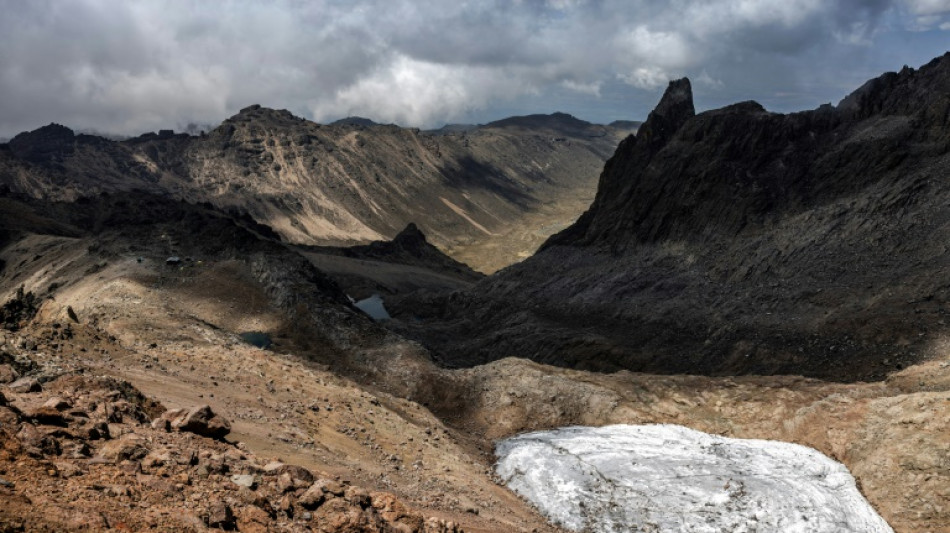
'It was beautiful': Mount Kenya's glaciers melting away / Photo: Luis TATO - AFP
Charles Kibaki Muchiri traced the water trickling across the surface of the Lewis Glacier with his fingers, illustrating how quickly climate change is melting the huge ice blocks off of Africa's second-highest mountain.
For nearly 25 years, the affable 50-year-old guide has been taking hikers to the peaks of Mount Kenya, nearly 5,000 metres (16,400 feet) above sea level, and observing their transformation from a landscape of snow and ice, to brown rock.
"It was very beautiful," he told AFP mournfully on a recent ascent.
He recalled the ice caves and thick layer of snow that lasted several months on the peaks of this ancient volcano.
The Lewis Glacier once covered one of Mount Kenya's slopes.
The imposing mass of ice visible in archive photos has now been reduced to just two blocks -- the biggest only a few dozen metres wide.
Muchiri said he fears the glacier will be entirely gone in a few years, transforming the landscape and discouraging visitors.
His observations are backed up by numerous studies, while scientists have found ice loss from the world's glaciers has accelerated over the past decade as the planet warms.
Mount Kenya is one of the only mountains on the African continent with glaciers, and scientists fear that as soon as 2030, it could become one of the first to turn entirely ice-free in modern times.
The Lewis Glacier lost 90 percent of its volume between 1934 and 2010, according to a 2011 study led by Rainer Prinz of Austria's University of Innsbruck.
A satellite study last year, published in the journal Environmental Research: Climate, found that the surface area of the ice on Mount Kenya was just 4.2 percent of the size compared with the first reliable observations in 1900.
That is in keeping with other African mountains, including the highest, Mount Kilimanjaro, which has just 8.6 percent of its ice surface left, according to the study.
- 'Just melt away' -
Although less well-known than Kilimanjaro, Mount Kenya is also a UNESCO World Heritage Site that attracts thousands of visitors each year.
Elephants can sometimes be seen in the dense forest at its base, while the trees give way to verdant hills on the ascent. After long hours of hiking, the brown rocks of the summit appear.
Prinz said the ice shrinkage is down to temperature changes at the surface of the Indian Ocean that transport moisture throughout east Africa, "and, hence, affected by our warming planet".
The mountains no longer receive sufficient snow and are deprived of the white blanket that protects the glaciers from the effects of solar radiation, he said.
"If they don't have that, they will just melt away," he said.
Porter and guide Godfrey Mwangi, 28, said he has already seen many glaciers disappear.
He pointed to a whitewashed cliff overlooking Shiptons Camp at an altitude of 4,200 metres, once covered in a sheet of ice.
The mountain is still home to atypical flora and unique landscapes, Muchiri added, but the loss of glacier ice has put a stop to certain types of technical climbing.
- 'Ice cubes' -
Rivers are also drying up, with consequences for the flora, fauna and residents of villages at the foot of the revered mountain.
The glaciers were never large enough to constitute significant water reservoirs, according to scientists, but had considerable tourist and scientific importance.
There are other ice blocks left on the mountain, but Prinz said they are now "more or less a pile of ice cubes".
The Lewis Glacier did once have an effect on local water supplies, added Alexandros Makarigakis, a UNESCO hydrologist, but it has become so small that its contribution to the local environment has evaporated.
Makarigakis welcomes projects led by young Kenyans to plant trees around the base of the mountain in the hope of slowing the loss of snow.
But he said it will only delay the inevitable.
"Pretty soon we will have a generation that will never associate Africa with glaciers," he said.
B.Krishnan--DT