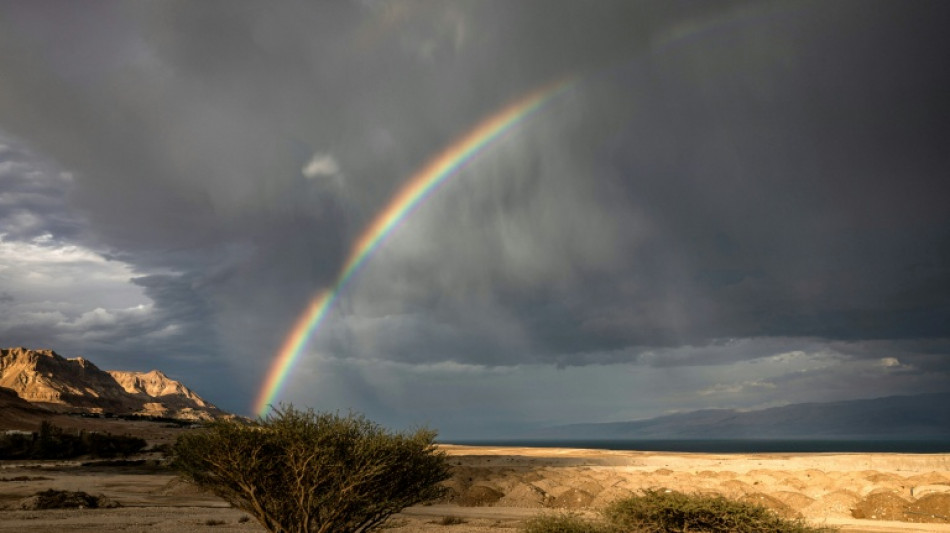
Dead Sea an 'ecological disaster', but no one can agree how to fix it / Photo: Menahem Kahana - AFP
An abandoned lifeguard cabin, a rusty pier and mangled umbrellas are all that is left of Ein Gedi, once Israel's flagship beach drawing international tourists to float in the world-famous waters of the Dead Sea.
Now, this lush desert oasis at the lowest point on Earth sits in ruins beside the shrinking sea, whose highly salty waters are rapidly retreating due to industrial use and climate change, which is accelerating their natural evaporation.
The beach has been closed to the public for five years, mainly due to the appearance of dangerous sinkholes, but also because the dramatic recession of the sea's level has made it tricky to reach its therapeutic waters, known for extraordinary buoyancy that lets bathers float effortlessly.
The increasingly exposed shoreline and the sinkholes, caused by a flow of freshwater dissolving layers of salt beneath the Earth's surface, are not new.
In fact, the Dead Sea, nestled where Israeli, Jordanian and Palestinian territory meet, has famously been dying for years.
Now, with war raging in the Middle East, efforts to tackle this ever-worsening ecological disaster appear to have dissolved too.
"Regional cooperation is the key... to saving the Dead Sea," said Nadav Tal, a hydrologist and water officer for the Israel office of EcoPeace, a regional environmental nonprofit that has long advocated for finding a solution.
"Because we are living in a conflict area, there is an obstacle," he said, describing how the sea has been declining more than one metre (three feet) per year since the 1960s.
- 'Ecological disaster' -
The evaporation of the salty waters in a time of rapid climate change and in a place where summer temperatures can reach upward of 50 degrees Celsius (122 degrees Fahrenheit) has been exacerbated by decades of water diversions from the sea's main source -- the Jordan River -- as well as various tributaries that begin in Lebanon and Syria.
The water is also being pumped out by local factories extracting natural minerals -- potash, bromine, sodium chloride, magnesia, magnesium chloride and metal magnesium -- to sell to markets across the world.
"The consequences of this water diversion is what we see around us," Tal told AFP, pointing to a nearby pier that was once submerged in water but now stands firmly on dry land.
"It is an ecological disaster," he emphasised, adding that "the declining of the Dead Sea is a disaster for Israeli tourism".
The only remaining Israeli resorts are on the man-made evaporation ponds south of the surviving Dead Sea itself.
Recently, 22-year-old Yael and her friend Noa were looking for a place to dip their toes into the soothing waters.
Relaxing beside one of the water-filled sinkholes, Yael recalled how her parents once enjoyed going to a public beach near here.
"It was like their beach on the Dead Sea, and nowadays you pass by there and it looks like, I don't know... a shipwreck," she told AFP.
"It's hallucinatory, the destruction caused by this thing (the drying up of the sea), and it's just such a special landscape."
- Call for joint effort -
Although some efforts have been made to address the Dead Sea disaster, including past agreements signed by Israel and Jordan, the wars raging in Gaza and beyond have brought regional tensions to an all-time high, meaning tackling cross-border environmental issues is no longer a priority for governments in the region.
At Israel's environment ministry, Ohad Carny has been working on the issue for years.
He said the government was looking into several solutions, including building a desalination facility and forging a canal from either the north or the south to address the general water shortages in the region, including the Dead Sea.
"It doesn't make economic or environmental sense to desalinate water and bring it directly to the Dead Sea, because then it's a waste of drinking water and the region needs desperately more drinking water and more water for agriculture," he said.
Carny said that while his focus was on the Israeli side, "we are hoping for collaborations".
"We can't do it alone. It must be a joint effort. So only time will tell, and we won't do anything without an agreement together with the Jordanian side," he said.
"We need to understand the economic and environmental aspects of the options, and of course agree about the right solution with the Jordanians."
Back at the Dead Sea, bus driver Benny, 40, was soaking up the winter sun at one of the warm sulphur-infused sinkhole pools.
"The situation is very frustrating," he said about the sea's new topography. "But everything has a plus and minus. Because of what is happening here, we have water spots like this one."
F.El-Yamahy--DT