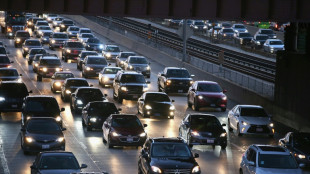
US emissions stagnated in 2024, challenging climate goals: study / Photo: MARIO TAMA - GETTY IMAGES NORTH AMERICA/AFP/File
US greenhouse gas emissions barely decreased in 2024, leaving the world's largest economy off track to achieve its climate goals, according to an analysis released Thursday, as the incoming Trump administration looks set to double down on fossil fuels.
The preliminary estimate by the Rhodium Group, an independent research organization, found a net fall of just 0.2 percent in economy-wide emissions.
Lower manufacturing output drove the modest decline, but it was undercut by increased air and road travel and higher electricity demand.
Study co-author Ben King told AFP the small drop came despite the US economy expanding last year by 2.7 percent, "a continuation of a trend that we've seen where there's a decoupling between economic growth and greenhouse gas emissions."
Overall, emissions remain below pre-pandemic levels and about 20 percent below 2005 levels, the benchmark year for US commitments under the Paris Agreement.
The accord aims to limit global warming to 1.5 degrees Celsius above pre-industrial levels, to avert the worst catastrophes of planet-wide heating.
But with 2024 effectively static, decarbonization must accelerate across all sectors.
"To meet its Paris Agreement target of a 50-52 percent reduction in emissions by 2030, the US must sustain an ambitious 7.6 percent annual drop in emissions from 2025 to 2030," the report said -- an unprecedented pace outside of a recession.
What's more, Trump has signaled plans to roll back President Joe Biden's green policies, including rules that require sweeping cuts from fossil fuel power plants and provisions of the Inflation Reduction Act, which channels hundreds of billions of dollars into clean energy.
Should these plans materialize, the US would likely achieve only a 24–40 percent emissions reduction by 2035, the report concluded.
- Off track -
Even under Biden, the US has logged more tepid reductions compared to some other major emitters.
German greenhouse gas emissions fell by three percent in 2024, following a 10 percent year-on-year drop the previous year, according to Agora Energiewende.
The European Union's emissions are forecast to have dropped by 3.8 percent in 2024, according to Carbon Brief, a UK-based analysis site.
Such predictions precede official government data and only represent estimates, meaning final figures can vary significantly.
US emissions have been trending downward in bumpy fashion since they peaked in 2004. They fell 3.3 percent in 2023 but rose 1.3 percent in 2022 and 6.3 percent in 2021 amid a post-pandemic rebound.
"When we looked at the Inflation Reduction Act a couple of years ago... we would have expected slightly lower emissions today than we're seeing right now," said King.
Still, these investments may just need more time to pay off: with the report finding clean energy and transportation spending reached a record $71 billion in last year's third quarter.
"It's kind of a mixed bag from my perspective," King said.
- Air conditioning demand -
Positives in the report include a bigger share of green energy in the grid -- solar and wind combined surpassed coal for the first time -- and a drop in methane emissions from reduced coal use and cleaner oil and gas production.
Climate scientist Michael Mann of the University of Pennsylvania told AFP he welcomed the continued decoupling of growth and emissions.
But "emissions aren't coming down anywhere near the rate they need to, yet at least," he added.
"Simply flatlining emissions puts the United States even farther off track from meeting its climate commitments," warned Debbie Weyl, US Acting Director for the World Resources Institute.
Rachel Cleetus, policy director with the climate and energy program at the Union of Concerned Scientists, called the findings "sobering," noting the increased electricity demand came from residential buildings requiring more air conditioning.
"Now that's a reality, as we see year upon year of the temperature records being broken," she told AFP, as 2024 is set to be named the hottest year on record.
R.El-Zarouni--DT