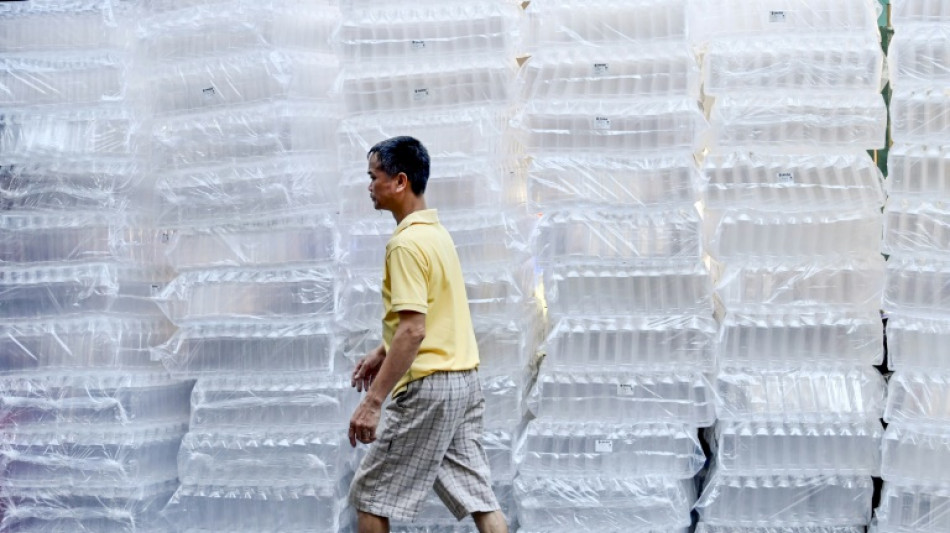
Petrol industry embraces plastics while navigating energy shift / Photo: Nhac NGUYEN - AFP/File
Amid the inexorable shift toward more electric vehicles, oil and gas producers are looking increasingly to plastics to help keep them afloat, even if that sector faces challenges of its own.
Plastics and chemical products now account for 15 percent of world demand for the refined petroleum products used to make them.
But as "robust growth" continues, that should rise to 25 percent by 2050, Guy Bailey, head of oils and chemicals markets for research firm Wood Mackenzie, told AFP.
This "reflects both the importance of plastics -- which are integral to every facet of modern life and the delivery of the energy transition –- and the longer-term decline in the demand for fuels as the transport sector electrifies."
Bailey added: "The petrochemicals sector plays an important role in the downstream sector."
- Risky transition -
Whether plastics can provide a sufficient lifeline for the petroleum industry is less clear.
"If you take a barrel of oil, most of what that barrel of oil is used for is transportation fuels, gasoline, diesel, aviation fuel. Only a small share of that is used for plastics," said Martha Moore, chief economist for the American Chemistry Council (ACC), an industry trade association.
But "that should change as electric vehicles become more affordable," said Steven Fries of the Peterson Institute for International Economics (PIIE) and a member of Britain's Climate Change Committee.
"Given that plastics make up only a modest fraction of a refined barrel of oil, they are unlikely to be the long-run solution for the industry," said Fries, who is also with the Institute for New Economic Thinking.
Adding to the challenge, said Bailey of Wood Mackenzie, is that amid the global energy transition, the plastics industry itself faces risks both in "the need to lower its carbon footprint and address the challenge of plastic waste."
Tom Sanzillo, a financial analyst with the Institute for Energy Economics and Financial Analysis (IEEFA), offered a similar caution, drawing a parallel between the petrochemical industry's current situation and the decline of coal mining.
"They think that their new market is in petrochemicals, but even there the demand will not be as great as they think," he told AFP.
- Recycling -
Whether plastics manufacturers buy needed raw materials or extract them themselves, they are turning increasingly to recycling to diversify their activity, analysts said.
Manufacturers hope a treaty on plastics being negotiated this week in Busan, South Korea, will chart a clear path for the future.
"Over time, our goal is to eliminate the need for new oil and gas into plastics," said Ross Eisenberg, head of the ACC's plastics-manufacturers division, who will be in Busan.
More and more manufacturers, he said, "are investing in recycling and are becoming recyclers themselves."
"They realize that they can actually use the product as the feedstock and not have to pull new resources out of the ground."
But that requires extensive infrastructure investments, Eisenberg said. "That's what this global agreement can really help us do."
Products will increasingly need to be designed with recycling in mind, the analysts said.
"More demand for plastics will be met through recycled and reused materials," said Fries of PIIE, adding that "the changes confronting the industry are set to progressively ratchet up."
For him, "There's no easy solution for the oil and gas industry. They'll have to change."
A.El-Nayady--DT