Norway speeds ahead of EU in race for fossil-free roads / Photo: Jonathan NACKSTRAND - AFP
On the quiet streets of an Oslo suburb, electric vehicles are parked in nearly every other driveway as Norway speeds towards its goal of becoming the first country free of fossil fuel-powered cars.
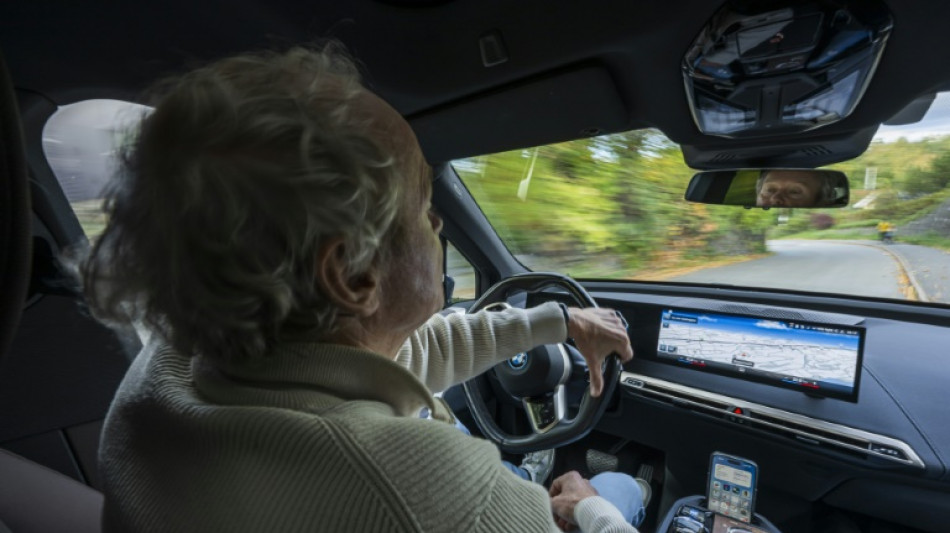
Electric cars make up 43 percent of all cars in Baerum, with resident Baard Gundersen making the switch in 2016.
Now on his second fully electric car, the CEO of a coffee company described his decision as a "no-brainer".
"It was much cheaper to buy a car like this than a traditional car, almost half price," he said at the wheel of his BMW iX SUV.
Despite being a major oil and gas producer, Norway has adopted the most ambitious electric vehicle (EV) objective in the world: only zero-emission private new cars will be sold from next year.
While not a European Union member, Norway would beat the bloc's deadline to phase out the sale of fossil fuel-burning cars by 2035 by a decade.
Driven by the popularity of Teslas, electric cars accounted for a staggering 96.4 percent of new car registrations in Norway in September, vastly outpacing the European average of 17.3 percent.
Norway has come a long way since 2012, when EVs only made up 2.8 percent of the market.
The boom has much to do with proactive policy.
At the turn of the century, authorities exempted electric cars from certain taxes.
Norway had never had its own carmaker, and the hope was that the policies would create fertile ground for a homegrown EV champion.
It turned out to be in vain, as Norway's Pivco electric car maker -- later renamed Think and for a while owned by Ford -- went bankrupt in 2011.
But the tax exemptions remained -- even if some have been rolled back in recent years -- making all-electric cars competitively priced compared to those with combustion engines, which are heavily taxed.
"We have used the stick for fossil vehicles and the carrot for electric cars," Cecilie Knibe Kroglund, state secretary at Norway's transport ministry, told AFP.
"It's possible that other countries will have to use other types of incentives depending on usage, their geography and the way public transport works. But as far as we are concerned, our incentives have worked very well," she said.
- A-ha takes on EVs -
Electric cars have also long benefited from other special privileges, like exemptions from city tolls and free parking in public car parks.
This was prompted by a civil disobedience campaign in the 1990s by environmental activist Frederic Hauge, co-founder of the NGO Bellona, and Morten Harket, the singer of iconic Norwegian pop group A-ha -- famous for the hit "Take On Me".
Travelling around in a small Fiat Panda -- converted to be electric -- the two men stubbornly racked up a mountain of fines which they refused to pay in an effort to promote zero-emission vehicles.
Their trusty car was finally seized, but a few years later authorities ended up granting electric vehicles, which were still rare at the time, the special privileges.
"I didn't feel like I was entering into the role of a rebel really," Harket told the BBC in 2022.
"It was just necessary."
In 2005, the government also allowed electric cars to use lanes reserved for public transport -- thus enabling them to avoid traffic jams.
These benefits have eroded somewhat since, but in the meantime electric cars have become the norm in the Scandinavian country.
Over the past decade, technology and car ranges have also evolved along with the development of a vast network of charging stations.
In September, the number of electric cars on Norwegian roads exceeded that of petrol cars for the first time and they are hot on the heels of diesel cars -- which are still the country's most popular vehicles.
Since November 1, all taxis in Oslo have had to be emissions-free.
- Transferable model? -
German carmaker Volkswagen, the top brand in Norway, delivered its last internal combustion car, a Golf, to Norway in July.
"Since January 1, we have removed all fossil-fuelled cars from our catalogue," Kim Clemetsen, head of marketing at a dealership that imports the brand, said.
"We now only sell electric cars."
Other brands, such as Toyota, are resisting the push and are planning to continue to offer hybrid cars and even combustion engines in 2025.
Finance Minister Trygve Slagsvold Vedum, a staunch defender of rural interests, has also thrown a spanner in the works by saying that it is "not a problem at all" if "a few" combustion-powered vehicles are still sold next year.
But if current trends hold, the country should come very close to achieving its ambition of 100 percent zero-emissions vehicles.
Christina Bu, secretary general of the Norwegian Electric Vehicle Association, thinks this should be encouraging to other countries aiming to phase out combustion engines.
"Norway was in many ways not a very likely country to succeed with this: it's a big country, long distances, very cold temperatures in winter, which affects the range of the car," Bu told AFP.
"So there's not really any reason why Norway should succeed rather than another country."
A.Ansari--DT