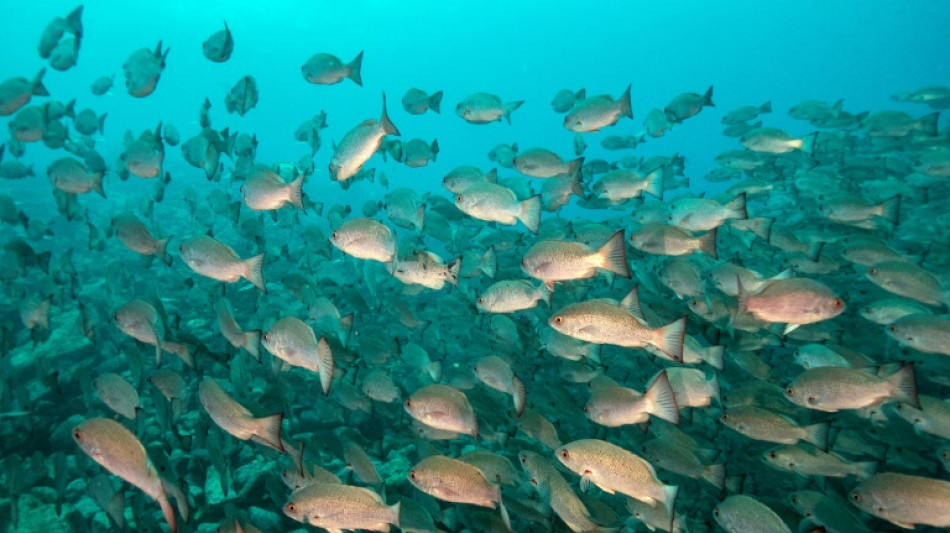
UN biodiversity conference: what's at stake? / Photo: Luis ACOSTA - AFP/File
The world's pledges to halt humankind's destruction of nature will be put to the test when the 16th UN conference on biodiversity opens Monday in Colombia.
The COP16, held in the city of Cali through November 1, is the first meeting of the international community since the adoption two years ago of an unprecedented roadmap to achieve that goal.
But putting that agreement into practice risks not moving fast enough to stop the destruction of land, oceans and species by a 2030 target date.
How will COP16 ensure countries achieve the 23 targets of the "Global Biodiversity Framework"? Can it unlock the billions of dollars needed? Can it guarantee the rights of Indigenous peoples?
Here's a summary of what's at stake:
- Delivering on promises -
Creating protected areas, restoring depleted land, cutting the use of pesticides, increasing funding for nature -- few of the targets humanity had previously set for 2020 have been reached.
To avoid repeating that failure, countries agreed at COP15 to create a monitoring mechanism, with common indicators to measure progress, and a possible review procedure.
But the details of this mechanism, crucial for holding countries to account, remain to be adopted.
Carrying out this negotiation will be the top agenda item of COP16 and its host Colombia, which wants to establish itself as a leader in the global fight to safeguard nature.
But parallel negotiations, notably financial, will also come into play.
- Securing national plans -
As of mid-October, only 29 countries out of 196 had submitted national biodiversity strategies to reflect their share of global efforts.
And 91 have submitted "national targets", or commitments on all or part of the targets, according to the UN Convention on Biological Diversity.
Several countries could publish their plan in Cali, and those of Colombia and Brazil are keenly awaited.
Some 12,000 delegates, including seven heads of state, are expected to attend COP16.
Under the spotlight, notably, will be the flagship target of the global framework: to place 30 percent of land and sea areas under minimum protection by 2030.
As of September, 8.35 percent of the seas and 17.5 percent of land were considered protected, according to the WWF environmental group, which uses preliminary data from the UN -- in other words, barely more than in 2022.
- Unlocking funding -
The efforts of rich countries to finance those of the developing world will be central to debates in Cali.
Developed countries have committed to providing $20 billion per year for biodiversity by 2025 and $30 billion by 2030.
By 2022, $15.4 billion had been raised, according to the Organisation for Economic Co-operation and Development (OECD).
Developing countries will also revive their calls for creating an autonomous fund, which is a major point of contention for rich countries, which are categorically opposed to setting up multiple funds.
To unlock private finance, biodiversity credits will be another major issue.
- Biopiracy -
"Biopiracy" -- the use of genetic resources in everything from cosmetics to seeds, medicines, biotechnology and food supplements without the agreement of those who preserve this traditional knowledge -- is a particularly knotty issue in negotiations.
Since 2014, the Nagoya protocol, which stipulates that persons providing genetic resources or traditional knowledge should benefit from the advantages arising from their use, has made it possible to pay for each use of a plant or animal.
However, these resources have become digitised genetic sequences or DSI (Digital Sequence Information) that almost exclusively benefit rich economies.
Resolving this is a priority for many developing countries and an agreement could be found in Cali to establish a global profit-sharing scheme.
But which companies will contribute? Will it be on a voluntary or compulsory basis? And how will the money be distributed?
"If a mandatory contribution of 0.1 percent is adopted, this potentially represents a billion dollars," said Sebastien Treyer, executive director of French think tank Iddri.
- Indigenous populations -
Indigenous populations are well represented at biodiversity COPs but often emerge the most disappointed by final decisions.
This year, they intend to use the summit taking place on the edge of the Amazon to have their rights and ancestral knowledge recognised, after years of marginalisation and forced displacement.
Y.I.Hashem--DT