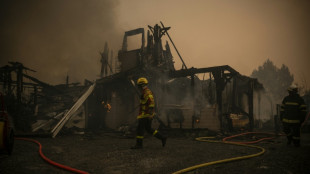
A US climate scientist sees hurricane Helene's devastation firsthand / Photo: Allison Joyce - AFP
Carl Schreck spent his career studying tropical storms thousands of miles away from home.
But when Hurricane Helene hit the American climate scientist's hometown in North Carolina and flooded several of his friends' homes, the shocking experience made him rethink his research priorities.
"I know how devastating the rainfall in hurricanes can be, but like to actually know people... that are affected by it -- it is, it's really heartbreaking to see," Schreck told AFP from his home near Ashville, the epicenter of the disaster that ravaged the southeastern United States.
As another major hurricane, Milton, was barrelling toward Florida, a study released Wednesday by the respected World Weather Attribution concluded that Helene's destructive force was exacerbated by climate change.
Schreck, a scholar at the Institute for Climate Studies at North Carolina State University, and his colleagues had been studying Helene's formation in the Caribbean for days -- until it pummeled Asheville on September 26-27.
Several of Schreck's friends saw their houses destroyed, while a family he knew died in the flooding.
"It's been over 100 years since we've seen something like this," said Schreck, whose own house was spared. "So it's been a very tragic experience for our community."
- 'Irony' -
With at least 230 people killed, Helene is the second deadliest hurricane to hit the continental United States in more than half a century after Katrina, which ravaged the state of Louisiana in 2005, claiming nearly 1,400 lives.
But amid the immense material damage, another misfortune befell the community in Asheville: a major climate data center, which shares the building with Schreck's facility, lost power in the storm, and its crucial data is currently inaccessible to scientists worldwide.
"That's one of the real ironies of this event," said Schreck. "We collect all of the world's weather and climate data right here in Asheville, going back more than 100 years, and power was cut off to that."
Emergency workers are having to pump water into the center's water cooling system from a fire truck to cool down the computers.
The National Oceanic and Atmospheric Administration (NOAA), which manages the center, says it is working "to minimize the risk of any potential data loss," but gives no timeline for when the center will resume operations.
- Communicate better? -
As soon as cellphone service was restored in the region following Helene, Schreck and his colleagues got to work.
"There has been a lot of discussion about, like, what does this mean for climate change?" Schreck recalled. "What's going on with our community? Why was this so severe? How could we have communicated it better?"
Although Helene struck Florida first, it was in the Appalachian mountains more than 500 kilometers from the coast where the vast majority of deaths occurred, mainly due to torrential flooding.
Inland rainfall, "is one of the most dangerous parts of a hurricane that usually doesn't get enough attention," he said. "And that's something that's... getting worse with climate change."
"I've always been really interested in how hurricanes affect rainfall and flooding," he added. "So that's something I'm really gonna be looking at even more going forward."
S.Al-Balushi--DT