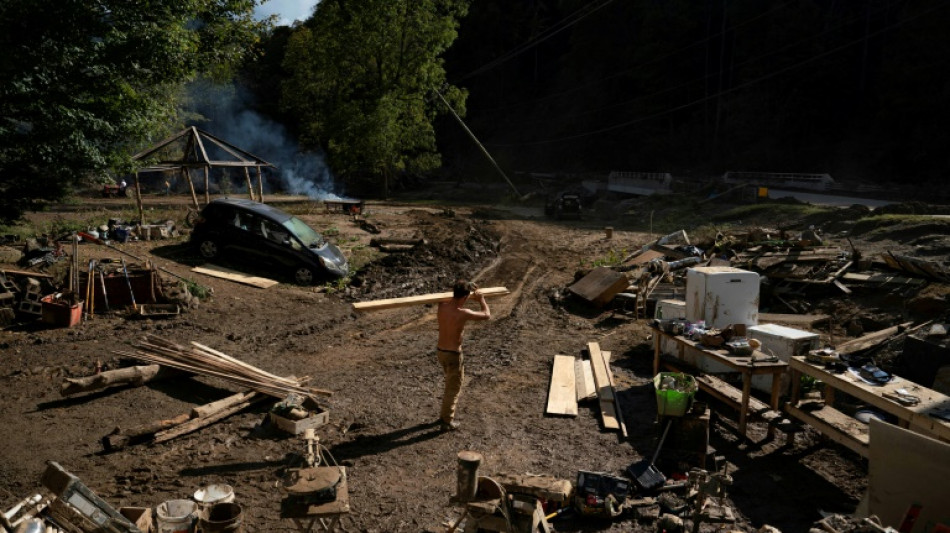
A 'forgotten' valley in storm-hit North Carolina, desperate for help / Photo: Allison Joyce - AFP/File
The only road to Pensacola, in the remote mountains of western North Carolina, is now a muddy path through deep, twisting gorges. Its main bridges were swept away last week in floods fueled by devastating Hurricane Helene -- and a cold winter is coming.
"Every major bridge into town is completely gone," Christy Edwards, a resident of the valley, told AFP. She was speaking near the site of her former craft shop -- carried away by the fast-moving floodwaters.
The isolation of this steep-sided valley, where Edwards was born and has spent her life, speaks of the utter ruination inflicted by Helene on some of the more secluded corners of the southeastern United States.
Even a week after the powerful storm's passage, access to the area is only slowly being restored.
But "winter is coming," said Edwards, a former teacher, and at an altitude of some 3,000 feet (900 meters), time is running short.
Temperatures are expected to drop sharply next week, and "these people and these homes have no heat source other than power, (though) some of them do have wood-burning stoves."
- 'We're devastated' -
Not far away, past the jumbled mass of tangled tree limbs and rocks that Helene left strewn across her yard, the local fire station has become a beehive of activity, with free food, friendly faces, and a generator providing light and comfort to huddled residents.
Janet Musselwhite, in her 60s, has come with friend Randi to try to use the station's satellite internet link to contact relatives.
"We're devastated," she said. "We don't have electricity. Most people don't have water. We have no cell service. We have very little communication. It's really hard to even get to town."
The only road into the valley is impassable except in a four-by-four -- and even that is risky.
- Swept away by mud -
The storm claimed at least one life in the Pensacola area, that of a woman who, according to her neighbor, was swept away in one of the dozens of mudslides that carved paths of desolation on area slopes early the morning of September 27.
Helene has claimed at least 220 lives overall, making it the second most deadly storm to strike the US in more than a half-century, behind 2005's Hurricane Katrina.
Scientists say Helene's rare intensity was almost certainly amplified by the warming of the seas caused by climate change.
But the mountains of western North Carolina normally escape the worst of passing hurricanes, which tend to inflict their greatest damage in low-lying coastal areas.
No one in this area had ever seen anything like this.
At the fire station, David Rogers, a bearded military veteran in a gray T-shirt, showed videos on his phone of the floods that carried away the mobile homes once parked just below his house. Their inhabitants escaped, but "three had to go to the hospital."
Mobile homes are fragile dwellings, highly vulnerable to nature's extremes, and their presence bespeaks the deep poverty of rural settings like this across the US.
Rogers said he and the survivors from the mobile homes were completely cut off from the outside world for three days.
- 'It's messy' -
Rescue teams finally arrived, and behind them, a steady stream of backhoes and bulldozers.
Work crews have been struggling from dusk to dawn to reopen roads that were left under mountains of mud and broken chunks of asphalt by the power of fast-flowing water. One man drives by on a noisy four-wheeler with rolls of paper towels tied to the back.
Amid all the din and the clamor, the authorities are maintaining a quiet presence.
Near the fire station, across from a huge camper lying on its side against a white church, Shawn Lavin, a national guardsman from New York, is part of a dozen-member team helping out.
Their chief, who declined to give his name, said that between the official relief teams, the locals, and volunteers come from far away -- some even arriving in their own helicopters -- "it's messy."
For many residents, the federal presence arrived too late, and the process of applying for emergency assistance through the Federal Emergency Management Agency (FEMA) is too complicated, requiring computer access.
"These people don't even have a computer, they don't have power," said Christy Edwards, who said she felt "forgotten."
"We need physical people here to walk up to each individual house and say, 'How can we help you?'"
In this remote corner of the Appalachian mountains, people have "always felt forgotten because we are in a rural area," she said.
"We have never asked for help. But this is way bigger than our resources here. We have to have help from our government to fix back."
F.A.Dsouza--DT