Stay or go? Pacific Islanders face climate's grim choice / Photo: Chewy Lin - AFP/File
Rising waters are slowly but steadily swallowing Carnie Riemers's backyard in the Marshall Islands, pushing her toward an agonizing choice: stay in the only home she's ever known or leave and face the prospect of becoming a climate refugee.
"It's not a comfortable topic to talk about," the 22-year-old activist tells AFP, explaining the emotional toll this looming reality has on the wider community, who are grappling with similar threats.
"We're deeply rooted in our country, and we don't want to be displaced or forced to live somewhere else -- it would be hard to preserve our culture."
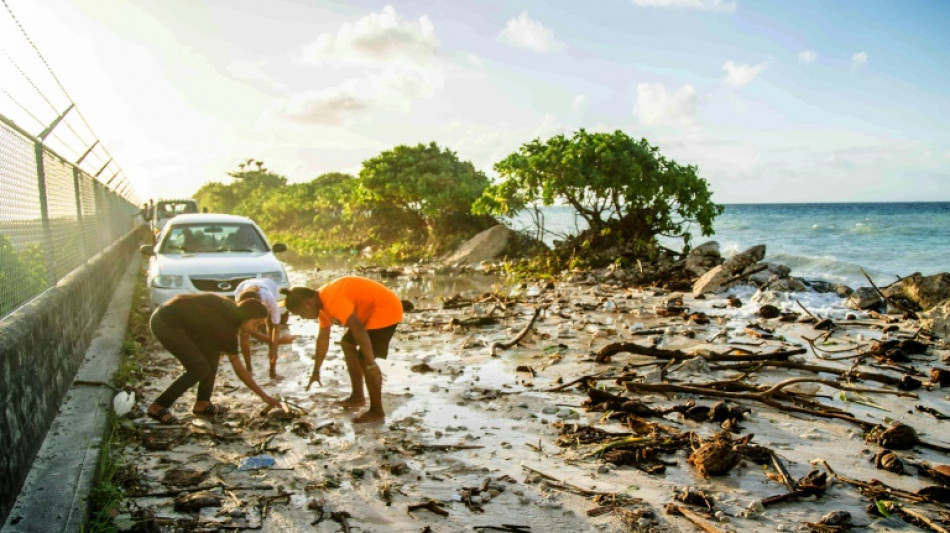
Climate change is dramatically reshaping life in Pacific Island nations, leaving them ever more vulnerable to storm surges, saltwater contamination, ruined crops, and relentless coastal erosion.
"Every day it's a constant battle," says Grace Malie, a 25-year-old from Tuvalu, the tiny archipelago facing the grim prospect of becoming the first nation to be rendered unlivable by global warming.
Speaking to AFP from the Climate Mobility Summit, held on the sidelines of the United Nations annual meeting, Malie recalls how her community was forced to ration just a few buckets of water among large extended families during a drought two years ago.
The freshwater "lenses" beneath Tuvalu's atolls, once tapped through wells, were contaminated by rising seas years ago, leaving the nation's 11,000 residents reliant on rainwater. Even their crops now grow in boxes rather than in the salt-poisoned ground.
This past February, storm waters surged from the lagoon on Tuvalu's main island, Funafuti, flooding roads and seeping into homes.
It wasn't even a tropical cyclone, says Malie -- just a regular storm -- but with higher sea levels now, any storm has the potential to wreak havoc.
- 'Matter of survival ' -
Since the start of the 20th century, global mean sea levels have risen faster than at any time in the last 3,000 years, a direct result of land ice melt and seawater expansion from planetary heating, experts say.
According to NASA's latest projections, Pacific Island nations will experience at least 15 centimeters of sea level rise in the next 30 years.
"It's the difference between flooding a few times a year, or none a year, to 30 times a year, 60 times a year, or every other day," Nadya Vinogradova Shiffer, who directs ocean physics programs for NASA's Earth Science Division, told AFP.
Even King Tides -- extra high tides caused by new or full moons -- now cause mayhem in the Marshall Islands, according to Riemers, flooding schools and blocking access to the airport.
While some Marshallese have already emigrated, forming a sizable diaspora in some places, such as the US state of Arkansas, Riemers says they only truly feel at home when they return to the islands, reconnecting with their people.
There's even talk of relocating the capital, Majuro, where Riemers lives with her family. The young activist sees a future for herself shaping these crucial discussions.
Tuvalu's situation might be even more precarious. By 2050 -- just 26 years from now -- more than half of the capital's land area will be regularly flooded, a figure set to rise to 95 percent by 2100, according to official estimates.
"For us, it's a matter of survival," Prime Minister Feleti Teo, who is helping lead diplomatic efforts to preserve the sovereignty of low-lying island nations even as they risk being submerged.
Last year, Teo signed a landmark treaty with Australia, paving the way for more Tuvaluans to obtain permanent residency there when the agreement takes effect.
Malie knows of several families who have already relocated to New Zealand and Australia, but for others, the idea of leaving is still "very taboo."
Her grandparents, for instance, have vowed to remain on the islands as long as possible -- a sentiment she shares.
"We don't want to think of the worst, because if we do, it will diminish our hopes."
F.El-Yamahy--DT