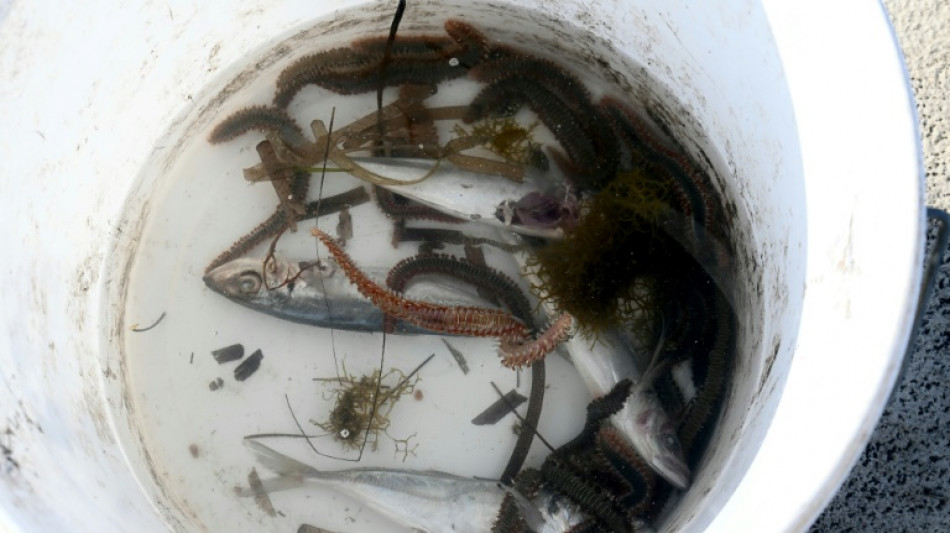
Bearded fireworm stalks shallows as Mediterranean warms / Photo: Filippo MONTEFORTE - AFP
The fish in Alfonso Barone's net are hauled aboard off Sicily half- eaten, ravaged by bearded fireworms, a voracious predator flourishing in the increasingly warm Mediterranean sea.
The centipede-like creatures, around 15 to 30 centimetres (6-12 inches) long, devour everything from coral to the dying or dead catch in fishing nets -- and rising sea temperatures caused by climate change are drastically boosting their numbers.
Barone pulls a long, wriggling red worm off a headless mackerel in his boat. Its venomous white bristles come off at the slightest touch and the 34-year-old says he has been stung several times, once even in the eye.
The fish are attacked as soon as they get caught in the net.
"They eat the head, the whole body, they gut it," Barone said as he pulled up a mangled sea bream while fishing off the village of Marzamemi, on the southeastern tip of Sicily.
Fireworms are native to the Mediterranean but used to be fewer in number and spotted only off Sicily in summer.
"With global warming the waters are heating up and becoming an ideal habitat for them, and they are growing in number, year on year... the whole year round," said Barone, who has fished since boyhood.
Gnawed fish cannot be sold, so fishermen reduce the time the nets are down in a bid to stop a feeding frenzy -- resulting in a smaller catch, bits of which come adorned anyway with brown, green or red fireworms.
"They used to eat around 30 percent of the catch... Now that's gone up to 70 percent," Barone said.
- Scavenger and predator -
The worms are also migrating north. Francesco Tiralongo, a zoologist who heads a University of Catania project to study the fireworm, has recorded cases in Calabria, southern Italy.
The bearded fireworm "is an opportunistic species that behaves both as predator and scavenger" and "there are impressive quantities of them... in very shallow waters," Tiralongo told AFP.
On Marzamemi's beach, many nervous bathers don masks or water shoes before diving in.
Fabiana Davanzo, a 56-year-old tourist from Milan, said she refused to "let it ruin my holiday, but I do always go in with my mask on so I can see the sea floor".
As he gingerly dipped his toes in the water, holidaymaker Salvatore Lazzaro, 51, said he was stung by an unidentified creature the previous day, but was braving the water once more under a sweltering sun.
Spooked swimmers and frustrated fishers are not the only problem.
"Climate warming is provoking several changes in the Mediterranean which will probably be exacerbated in the coming years," according to Federico Betti, an expert in invasive species at the University of Genoa.
The average temperature of the Mediterranean has increased by around 1.2 degrees Celsius (2.2 degrees Fahrenheit) in the last 40 years, he said.
- 'Profound changes' -
Warmer seas mean fewer seasonal variations in species, damage to deep water communities and loss of habitat, leading to more homogeneous environments unable to support rich and diverse ecosystems.
The heat can also provoke mass mortality events in which vast numbers of a certain species die, Betti said.
Other species relish it: There has been an increase in tropical, non-native species in the Mediterranean that "cause profound changes in marine ecosystems", Tiralongo said.
Those include the blue crab, which is devastating shellfish production in the Po delta in northern Italy.
The crabs have no natural predators, though Italians are attempting to turn them into a resource by harvesting them to eat.
But bearded fireworm spaghetti is not an option. And while more research needs to be done into possible solutions, Tiralongo has already made a disconcerting discovery.
"You can't kill a fireworm by cutting it in half, it has excellent regeneration capabilities," he said.
"If you slice it in two, not only does the part with the head regenerate a back half, but the back half manages in about 22 days to regenerate a head."
I.Menon--DT