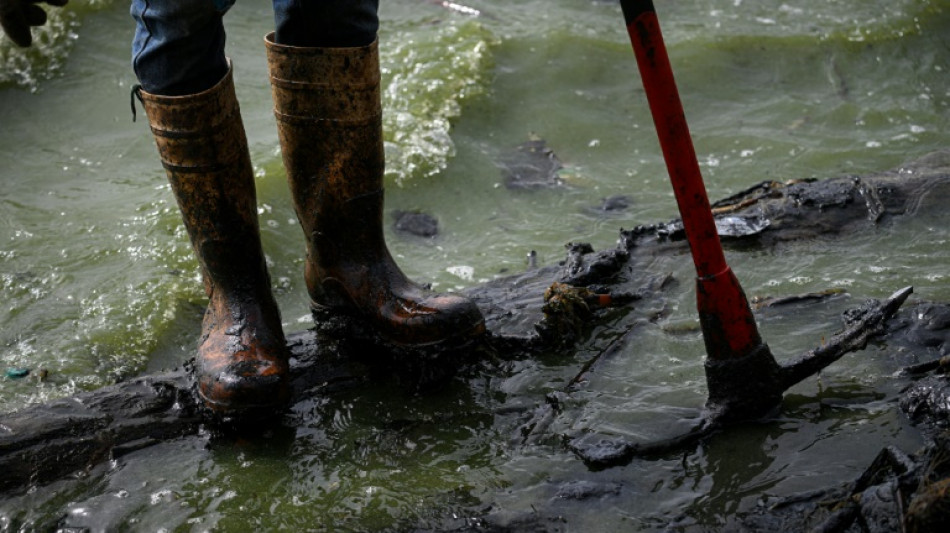
Oil-tainted lake a symptom, and symbol, of Venezuela's collapse / Photo: Federico PARRA - AFP
A putrid smell hangs over the black-stained shores of Lake Maracaibo in Venezuela, where an oil slick is emblematic of the steep decline in the country's once-enviable petroleum industry.
Here, much like elsewhere in what was once Latin America's richest country, economic hardship drives much of the discussion ahead of July 28 elections, in which President Nicolas Maduro will seek a third six-year term.
"We suffer. Fishing from the shore is no longer possible because of the oil," fisherman Yordi Vicuna, 34, told AFP, adding that catches have fallen tenfold.
He said nets must constantly be washed or replaced after being soiled by oil that leaks from decayed pipes which the government cannot afford to fix.
Much of Venezuela's economic collapse -- fueled partly by a sharp international drop in oil prices after 2014 -- has happened under the watch of Maduro, who has been in office since 2013.
Many Venezuelans -- including Vicuna -- blame US sanctions for the dire situation.
"The pipeline is damaged because of the (economic) blockade," the fisherman said, echoing the government's official line, as he and others shoveled oil-soaked sand from the lake shore.
"We ask the competent agencies, people from outside, to support the government in any way... to fix the pipelines," Vicuna added.
- Boom to bust -
More than a century ago, the hydrocarbon-rich Maracaibo Basin was the birthplace of a business that transformed Venezuela into one of the world's top 10 oil producers -- fueling a decades-long period of incredible prosperity.
The country, which has the world's largest proven oil reserves, was producing 3.5 million barrels of oil a day by 2008, with the United States as its main client.
But in just 12 years this dropped to fewer than half a million barrels following the nationalization of the industry and a crippling, months-long strike at state oil company PDVSA in protest against then-President Hugo Chavez.
Chavez sacked thousands of PDVSA staff and managers, who observers say were replaced mainly by non-expert loyalists.
As oil production dipped, Venezuela fell into an economic crisis marked by years of recession and hyperinflation that has seen an estimated seven million people -- almost a quarter of the population -- flee the country in just under a decade.
Most analysts blame the industry's rapid decline on corruption and inept management at PDVSA, worsened by the toughening of sanctions on Venezuela after Maduro's 2018 reelection, which was not recognized by dozens of countries.
- 'The lake is lost' -
A few oil pumps still operate on Lake Maracaibo's polluted shore, but dozens of machines stand idle.
The Puyuyo beach near the Bajo Grande refinery is black with oil. It was once a popular swim spot but most small hotels and bars here are now closed.
"People used to come here... Families came from all over to visit, eat fish and swim but now there are 30 centimeters (11.8 inches) of oil" on the bottom of the lake, said Guillermo Albeniz Cano.
The 64-year-old owns a beach cafe but has no clients. Instead, he barters rice and flour for the occasional fish or crab meat.
When AFP visited Puyuyo, only one table of the cafe was occupied -- by crabbers playing dominoes who said they would rather be working.
"Since there is a lot of oil in the lake, we could not go out today," said father-of-four Luis Angel Vega.
"Sometimes we don't eat for a whole day, the 26-year-old added.
His colleague Alvaro Villamil, 61, tried his luck nevertheless. On his boat "Carmen Rosa," he showed his catch of a few blue crabs he managed to get from the less-polluted center of the lake.
But it is not enough to make a living.
"It's hard... The lake is lost. There's a lot of oil," Villamil told AFP, his long-sleeved T-shirt stained with the stuff.
- 'For sale' -
Maracaibo was a flourishing city in the 20th century, with its colonial buildings, Art Deco theater and tramline.
Today, "for sale" signs on properties far outnumber election campaign posters, while tall grass and crumbling walls abound in the industrial zone.
Some 200 companies, including the German firm Siemens, once had a presence in the area. Today there are about 30.
Yet there are signs that Venezuela's oil fortunes may be looking up again.
Despite the renewal of sanctions after Maduro reneged on negotiated conditions for elections, Washington is allowing companies such as Chevron and Repsol to apply for individual licenses to keep operating in Venezuela.
And Oil Minister Pedro Tellechea said in May he was optimistic that Venezuelan oil production would reach a million barrels per day this year.
This will depend largely on what happens in next Sunday's vote, with widespread fear that Maduro will steal the election and unlock a new era of international pariahdom.
S.Saleem--DT