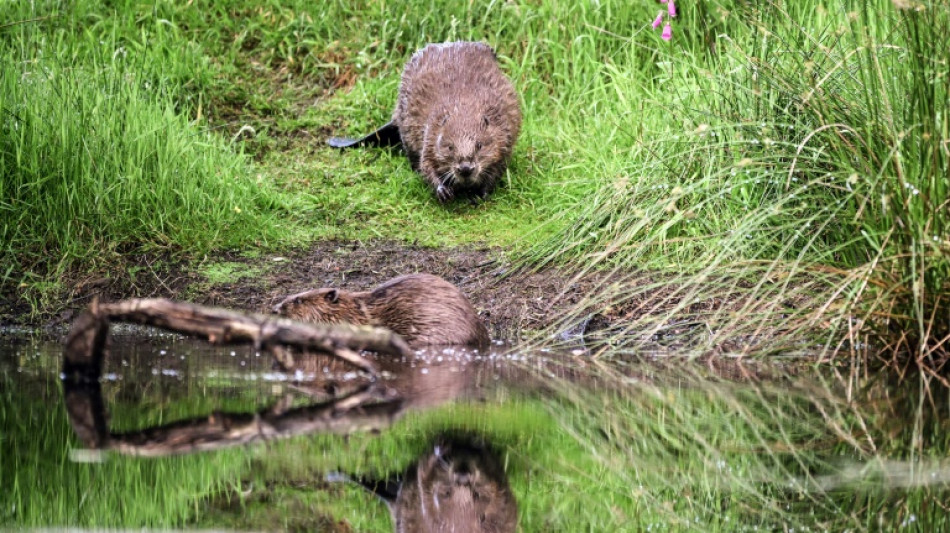
Scottish farmers damn wild beaver reintroduction policy / Photo: Andy Buchanan - AFP
As night falls in central Scotland, beavers appear in a pond under the fascinated gaze of a group of nature enthusiasts.
Beavers are "ecosystem engineers", whose activities can alleviate flooding, improve water quality and boost wildlife.
But the visitors' delight is not shared by everyone in the region, where the industrious tree-felling mammals have caused much gnashing of teeth among farmers and gardeners.
Beavers, which had disappeared from Scotland for around 400 years due to hunting, were reintroduced in the wild in 2009.
Ten years later, to the dismay of some farmers and landowners, the herbivorous rodents were designated a protected species.
Wildlife visits to see the animals in their natural habitat are now popular and bring in revenue.
"We saw a lot of them today. I feel very privileged," said Catriona Morrison, Gaelic policy manager for Historic Environment Scotland, after a "safari" at Argaty farm, north of Stirling.
Argaty is home to endangered red squirrels as well as beavers, which can reach one metre (3.2 feet) in length and weigh up to 19 kilograms (42 pounds).
The dam-building semi-aquatic wetland dwellers were relocated there after causing serious damage to agricultural land nearby.
Argaty's owner Lynn Bower raves about them, not least because the farm track no longer floods during the winter months.
"It used to flood to a depth of about four feet (1.2 metres) and we had to rebuild it every winter," she told AFP.
"Because one of the beaver families is above that, they built dams, which holds the water back and it doesn't flood.
"They have increased the area of wetland magnificently and the benefit to the other wildlife from very small things like dragonflies and frogs, right up to bats and all those sorts of things, is staggeringly quick and rather wonderful."
- Natural engineers -
There were almost 1,000 beavers in Scotland in 2020-21, according to NatureScot, the public body responsible for Scotland's natural heritage.
Their numbers have grown because they have no natural predators in the region.
NatureScot touts beavers' role in boosting biodiversity and helping flood protection by cutting trees, digging burrows and channels, and building dams.
But, as in the case of many wildlife reintroductions, the picture is complex and not everyone is as enthusiastic.
"They're wonderful engineers but there's no place for them in Scotland," said Douglas Neill, a farmer, as he watched trucks reconstruct an embankment protecting his land from flooding from the River Tay.
The embankment collapsed in October last year because of burrows dug by the beavers, turning his potato field into a lake, he explained.
Barns that can hold up to 3,000 tonnes of vegetables lie empty, he added.
"The greens want beavers but do they think about what we are going to eat?" he asked, estimating the damage to his property at more than £2.0 million ($2.5 million).
"If we want to keep producing our own food, the solution is eradication," he said.
NatureScot says managing different interests is the key.
It offers professional support to people experiencing damage caused by beavers, with measures such as fencing vulnerable areas, protecting individual trees, "more novel techniques" or, as a last resort, lethal control of excess numbers.
- 'Beaver huggers' -
In neighbouring Perthshire, in the southern Highlands, a woman points out the dozens of trees lying felled in the woods above her house.
Beavers diverted water flowing into a ditch with their dams and build huge lodges on a pond which are now home to four families.
"When we first realised we had beavers, we thought it was fantastic. They are so sweet. We didn't realise then," she said, declining to give her name because the issue is so contentious.
She does not want to see "beaver huggers" on her land, given the damage to trees, and is at her wits end.
"We've lost so many trees... Beavers can easily destroy a tree in a night," she added.
Martin Kennedy, president of the National Farmers' Union in Scotland, wants "complete exclusion areas" to protect farm production.
NatureScot says it understands farmers' difficulties and is monitoring the beaver population to "identify how people, and ecosystems, can most benefit from the presence" of the animals.
Culling beavers is an option but only as a last resort under strict conditions, it says.
A total of 52 licences were granted in 2022 and a few dozen animals were killed.
The Scottish Government in Edinburgh, which has devolved powers over environmental policy, can move beavers elsewhere in Scotland.
They have also been moved south of the border to England.
"I feel sorry for these guys," said Neill. "They have no idea what's coming. They are going to have this in the next five to 10 years."
J.Chacko--DT