Dubai Telegraph - Pakistan farmers pin poor mango crop on climate change

EUR -
AED 4.270651
AFN 72.672902
ALL 95.422215
AMD 429.02547
ANG 2.082077
AOA 1067.517186
ARS 1618.483848
AUD 1.626566
AWG 2.096078
AZN 1.973774
BAM 1.953151
BBD 2.343122
BDT 142.798158
BGN 1.941904
BHD 0.438812
BIF 3463.86137
BMD 1.162873
BND 1.487208
BOB 8.039234
BRL 5.848205
BSD 1.163322
BTN 111.584572
BWP 16.455963
BYN 3.237465
BYR 22792.305681
BZD 2.339767
CAD 1.599636
CDF 2610.64867
CHF 0.914599
CLF 0.026578
CLP 1046.027459
CNY 7.890205
CNH 7.919216
COP 4407.671428
CRC 527.729596
CUC 1.162873
CUP 30.816128
CVE 110.115645
CZK 24.332882
DJF 207.162578
DKK 7.472855
DOP 69.50692
DZD 154.525754
EGP 61.518758
ERN 17.443091
ETB 181.650343
FJD 2.562565
FKP 0.862723
GBP 0.870579
GEL 3.116726
GGP 0.862723
GHS 13.303185
GIP 0.862723
GMD 84.309218
GNF 10201.163663
GTQ 8.875077
GYD 243.394059
HKD 9.107113
HNL 30.939567
HRK 7.533552
HTG 152.326491
HUF 359.725389
IDR 20455.861774
ILS 3.398682
IMP 0.862723
INR 111.453503
IQD 1524.059056
IRR 1529177.651491
ISK 143.602844
JEP 0.862723
JMD 183.820675
JOD 0.824435
JPY 184.380467
KES 150.185168
KGS 101.69336
KHR 4667.749183
KMF 490.73227
KPW 1046.587595
KRW 1744.518339
KWD 0.358769
KYD 0.969502
KZT 546.158612
LAK 25513.833147
LBP 104179.488025
LKR 382.166578
LRD 212.894902
LSL 19.270711
LTL 3.433661
LVL 0.70341
LYD 7.387108
MAD 10.723755
MDL 20.126048
MGA 4842.515145
MKD 61.638519
MMK 2441.614111
MNT 4162.472663
MOP 9.383135
MRU 46.696663
MUR 54.85262
MVR 17.916265
MWK 2017.298534
MXN 20.208252
MYR 4.594552
MZN 74.318959
NAD 19.270463
NGN 1593.826688
NIO 42.812667
NOK 10.846201
NPR 178.534915
NZD 1.990718
OMR 0.447117
PAB 1.163342
PEN 3.988359
PGK 5.068126
PHP 71.724245
PKR 324.025388
PLN 4.246195
PYG 7089.384321
QAR 4.240748
RON 5.21664
RSD 117.388478
RUB 84.837746
RWF 1701.821006
SAR 4.38083
SBD 9.321746
SCR 15.977183
SDG 698.307965
SEK 10.982589
SGD 1.488506
SHP 0.868202
SLE 28.664959
SLL 24384.862344
SOS 664.909586
SRD 43.267005
STD 24069.117863
STN 24.466814
SVC 10.179193
SYP 128.535171
SZL 19.274106
THB 37.98524
TJS 10.854265
TMT 4.070055
TND 3.404882
TOP 2.799918
TRY 52.962748
TTD 7.896968
TWD 36.695032
TZS 3023.469146
UAH 51.367628
UGX 4368.075366
USD 1.162873
UYU 46.596798
UZS 13931.343839
VES 593.23815
VND 30647.511032
VUV 137.12648
WST 3.146267
XAF 655.07975
XAG 0.014879
XAU 0.000255
XCD 3.142721
XCG 2.096692
XDR 0.813933
XOF 655.068499
XPF 119.331742
YER 277.51928
ZAR 19.373693
ZMK 10467.246163
ZMW 21.900672
ZWL 374.444547
  • JRI

    -0.1449

    12.8616

    -1.13%

  • NGG

    -7.5300

    79.9

    -9.42%

  • RIO

    -5.7500

    103.84

    -5.54%

  • GSK

    -0.8289

    49.67

    -1.67%

  • BCE

    0.0150

    24.205

    +0.06%

  • CMSC

    -0.1000

    23.04

    -0.43%

  • RYCEF

    -0.1300

    15.9

    -0.82%

  • BCC

    -2.0450

    67.355

    -3.04%

  • RELX

    0.8100

    32.27

    +2.51%

  • BTI

    -1.5600

    65.14

    -2.39%

  • CMSD

    -0.3620

    23.188

    -1.56%

  • BP

    0.2942

    43.915

    +0.67%

  • AZN

    -3.0550

    181.905

    -1.68%

  • VOD

    -0.5700

    14.91

    -3.82%

  • RBGPF

    0.8900

    61.68

    +1.44%

Pakistan farmers pin poor mango crop on climate change
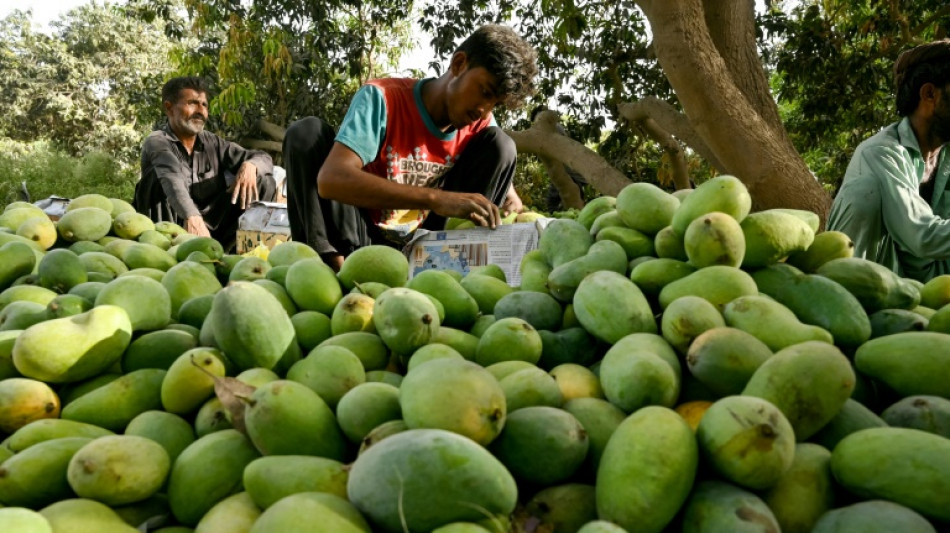
Pakistan farmers pin poor mango crop on climate change / Photo: Asif HASSAN - AFP

Pakistan farmers pin poor mango crop on climate change

Pakistan's mangoes are normally a source of national pride and much-needed income, but farmers are blaming climate change for the parasites and extreme weather ruining much of this season's crop.

Text size:

A white and orange scarf wrapped around his head in the scorching heat, farmer Muhammad Yusuf lamented the erratic weather.

An abnormally long winter was followed by the wettest April in decades, while the country is now experiencing a heatwave with temperatures hitting up tp 52 degrees Celsius (126 degrees Fahrenheit).

"Buds didn't flower on time, many buds just died. Those that started growing were infected with (parasite) black hopper," said Yusuf, who has worked half his life growing mangoes.

Now over 60 years old, Yusuf said "climate change has wreaked havoc" in his village of Tando Allahyar, around 200 kilometres (124 miles) northeast of economic hub Karachi.

Pakistan is the world's fourth-largest mango producer and agriculture accounts for almost a quarter of its GDP.

Further south in Tando Ghulam Ali, Arsalan, who manages a 900-acre mango orchard, noticed the damage as soon as the harvest started this week.

"We have production losses of 15 to 20 percent, and the picking has only just started so this figure will surely increase," said the 32-year-old.

Exports will be slashed as a result warned Arsalan, who only goes by one name.

"The mangoes turn yellow from the outside but remain underripe or overripe inside," he explained.

Ziaul Haq, a mango grower and exporter from Tando Ghulam Ali, said the "many attacks on fruit" by pests were unprecedented.

"This, in our history, has never happened before," he told AFP.

- 'Feed our families' -

The proliferation of parasites has led to an explosion in spending on pesticides.

This uptick was confirmed by several farmers in Sindh province, where Tando Allahyar and Tando Ghulam Ali are located, as well as those in the leading agricultural province of Punjab further north.

They told AFP that chemicals are now used six to seven times per year, compared to just twice three years ago.

Farmers in Sindh said they have been struggling since 2022 when a series of severe heatwaves were followed by unprecedented flooding, while those in Punjab said the declining crops yields date back several years more.

"The losses in Punjab reached 35 to 50 percent and in Sindh, 15 to 20 percent" compared to last year, said Waheed Ahmed, head of the Pakistan Federation of Fruit and Vegetable Exporters Association (PFVA).

Speaking to local media, he said that last year Pakistan had only managed to export 100,000 of the 125,000 tonnes of mangoes it planned to sell abroad.

Pakistan's 20 varieties of mangoes come second only to oranges as the most-produced fruit in the country.

The income loss from a poor harvest could have a significant impact on the country, which is in talks to secure a loan from the International Monetary Fund (IMF).

Mashooq Ali, a 30-year-old labourer in Tando Ghulam Ali, wants the government to help farmers cope.

"Landowners will earn less this year," said Ali, whose wife has started trading clothes to earn extra cash.

"And even if they paid us as much as last year, with inflation, we won't be able to feed our families."

T.Jamil--DT