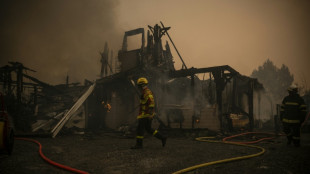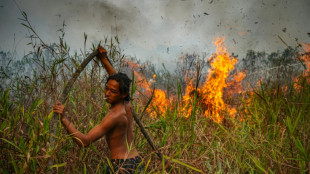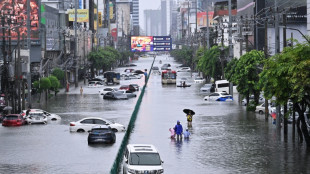
Extreme heat scorches Southeast Asia, bringing school closures and warnings / Photo: Ted ALJIBE - AFP
Extreme heat scorched parts of South and Southeast Asia Wednesday, prompting schools across the Philippines to suspend classes, heat warnings in the Thai capital and worshippers in Bangladesh to pray for rain.
The high temperatures were recorded just a day after the United Nations said Asia was the region that suffered the most disasters from climate and weather hazards in 2023, with floods and storms the chief causes of casualties and economic losses.
Extensive scientific research has found climate change is causing heatwaves to become longer, more frequent and more intense.
"It's so hot you can't breathe," said Erlin Tumaron, 60, who works at a Philippine seaside resort in Cavite province, south of Manila, where the heat index reached 47 degrees Celsius (117 degrees Fahrenheit) on Tuesday.
"It's surprising our pools are still empty. You would expect people to come and take a swim, but it seems they're reluctant to leave their homes because of the heat."
March, April and May are typically the hottest and driest months in the archipelago but conditions this year have been exacerbated by the El Nino weather phenomenon.
The heat index was expected to reach the "danger" level of 42C (108F) or higher in at least 30 cities and municipalities on Wednesday, the state weather forecaster said.
The heat index measures what a temperature feels like, taking into account humidity.
The Philippine Department of Education, which oversees more than 47,600 schools, said nearly 6,700 schools suspended in-person classes on Wednesday.
There was also a 50 percent chance of the heat intensifying in the coming days, Ana Solis, chief climatologist at the state weather forecaster, told AFP.
She said people needed to limit the time they spent outdoors, drink plenty of water and take umbrellas and hats when going outdoors to guard against the "extreme heat".
- Severe heatwaves -
Global temperatures hit record highs last year and the UN's World Meteorological Organization said Asia was warming at a particularly rapid pace, with the impact of heatwaves in the region becoming more severe.
The WMO's State of the Climate in Asia 2023 report found Asia was warming faster than the global average, with temperatures last year nearly two degrees Celsius above the 1961 to 1990 average.
"Many countries in the region experienced their hottest year on record in 2023, along with a barrage of extreme conditions, from droughts and heatwaves to floods and storms," said WMO chief Celeste Saulo, who described the report as "sobering".
WMO Deputy Secretary-General Ko Barrett said: "Extreme heat is increasingly becoming the big silent killer".
The report highlighted the accelerating rate of key climate change indicators such as surface temperature, glacier retreat and sea level rise, saying they would have serious repercussions for societies, economies and ecosystems in the region.
But "heat-related mortality is widely under-reported and so the true scale of premature deaths and economic costs... is not accurately reflected in the statistics," Barrett said Wednesday.
In Bangladesh, thousands gathered in Dhaka to pray for rain as an extreme heatwave forced authorities to shut schools around the country.
Bangladesh's weather bureau said average maximum temperatures in the capital over the past week have been 4-5C (7.2-9F) higher than the 30-year average for the same period.
"Praying for rains is a tradition of our prophet. We repented for our sins and prayed for his blessings for rains," said Muhammad Abu Yusuf, an Islamic cleric who led a morning prayer service for 1,000 people in central Dhaka.
"Life has become unbearable due to lack of rains," he told AFP. "Poor people are suffering immensely."
Similar prayer services were held in other parts of Bangladesh, police said.
- 'It's terrible' -
The Indian Meteorological Department said in a news release severe heatwave conditions were likely in the eastern and southern states of Odisha, West Bengal, Sikkim and Karnataka over the next five days.
Thai authorities in Bangkok issued an extreme heat warning and urged people to stay indoors for their own safety.
Temperatures were forecast to hit 39C (102F) in the sprawling Thai capital, while the heat index rose above 52C (126F).
"Warning: the heat index today is 'extremely dangerous'. Please avoid activities outdoors," the Bangkok city environment department wrote on Facebook.
Thailand sweltered through a heatwave this week that pushed the mercury in the northern province of Lampang close to a national record of 44.6C (112.3F) on Monday.
The Philippines ranks among the countries most vulnerable to the impacts of climate change and around half of its provinces are drought-stricken.
Mary Ann Gener, a government worker in Occidental Mindoro province, said people working indoors with air conditioning were fine.
"But it's terrible for those outside," she said.
"You get a headache immediately after you go out. You really need to hydrate."
burs-pbt/dhw
R.El-Zarouni--DT