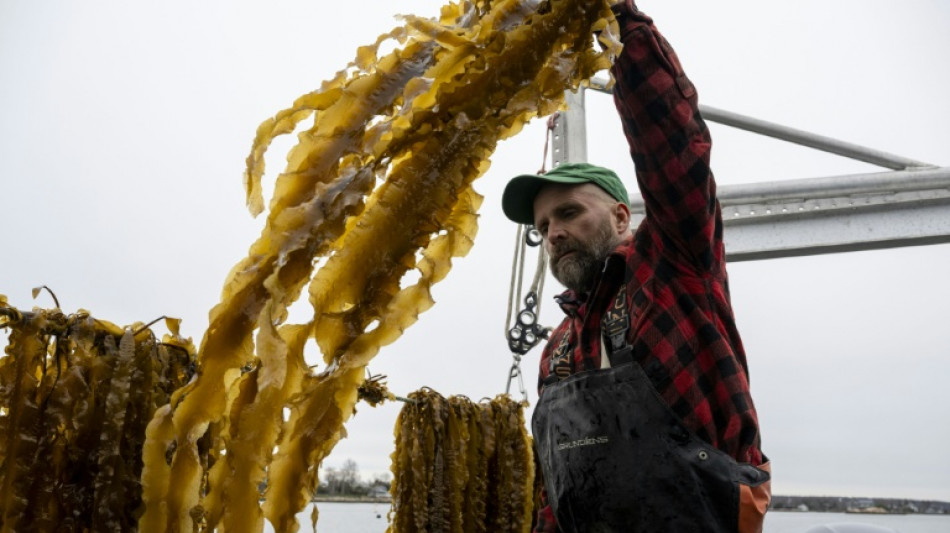
A leader in US seaweed farming preaches, teaches and builds a wider network / Photo: ANGELA WEISS - AFP/File
Bren Smith and his GreenWave organization are helping lay the foundations for a generation of seaweed-growing farmers in the United States, while working to build a network of producers and buyers.
Seen from a boat, GreenWave's farm seems unimpressive -- little more than lines of white and black buoys, a few hundred yards (meters) off the Connecticut coast.
But beneath the dark Atlantic waters, suspended from ropes tied between the buoys around six feet (two meters) down, seaweed in varying shades of brown undulates.
GreenWave, which uses no pesticides or herbicides, last year harvested more than 20 metric tons of kelp from this location and from another one a bit farther east.
While seaweed-farming has been practiced for decades in Asia, such aquaculture is a relatively new phenomenon in the US.
- Training others -
Bren Smith, who is Canadian, worked in industrial fishing for years before turning to so-called regenerative aquaculture -- cultivating marine resources while caring for their ecosystem and even helping it flourish.
Research shows that kelp absorbs more carbon dioxide (CO2) than a land forest of comparable surface area, while providing nutrients and a habitat for other living organisms.
Once an crop is harvested, it is used primarily in food products, cosmetics or as natural fertilizer.
GreenWave also cultivates mussels and oysters, which help purify surrounding seawater.
But its ambition reaches far beyond the bounds of its sea "farm," which has been kept intentionally small.
"We're training the next generation of ocean farmers," said Smith, author of the book "Eat Like a Fish: My Adventure as a Fisherman Turned Ocean Farmer."
To do so, GreenWave has developed a suite of training tools, from brochures to videos. Nearly 8,000 people have profited from the training.
GreenWave helped "connect me to other farms and farmers and disseminate the knowledge that our industry is building," said Ken Sparta, who has been growing seaweed on his Spartan Farms near Portland, Maine since 2019.
"I'm not sure where our industry would be without them, and it certainly wouldn't be growing at this rate," Sparta said.
- 'Collaborate, not compete' -
GreenWave also issues starter grants of up to $25,000 per project, thanks to a combination of private donations and public subsidies.
And it established the Seaweed Source platform, which brings producers together with buyers, with more than 65 companies now involved.
Crucially, GreenWave developed an inexpensive technique allowing harvested seaweed to be preserved for up to 10 months, whereas kelp generally begins deteriorating after only a few hours.
"We don't do policy stuff," said Smith, standing on the bridge of his small boat. "It's just, like, what do you need to do to be successful?"
Despite seaweed's proven ability to capture carbon dioxide, Smith has not yet tried to include carbon credits in his business model.
"It's seeming like markets aren't great at incentivizing carbon," the 51-year-old told AFP.
Along with GreenWave co-founder Emily Stengel, Smith has had to confront the challenges of a warming climate.
"When Bren started farming, he would be out planting in maybe the end of October," said Toby Sheppard Bloch, director of infrastructure at GreenWave.
"And in 2021, we were out planting at the end of December... We lost two months of growing season," due to warming waters.
With harvests plummeting, "We realized that something had to change if we were going to continue to farm these waters," said Bloch.
GreenWave had the idea of creating a seed bank -- where seeds could get an early start before being put in the sea -- which helped farmers gain two months of growing time.
They used electric wine coolers as a cheaper alternative to a laboratory cold room.
The seed bank is open to any farmer to use, and seeds can be deposited or taken out at any time.
"Our belief is, really, what we need to do is collaborate and not compete," said Smith, wearing his trademark green cap.
"Let's bring together fishermen and all these folks that are being impacted by climate change and move them into solutions and breathing life back into the ocean."
I.Uddin--DT