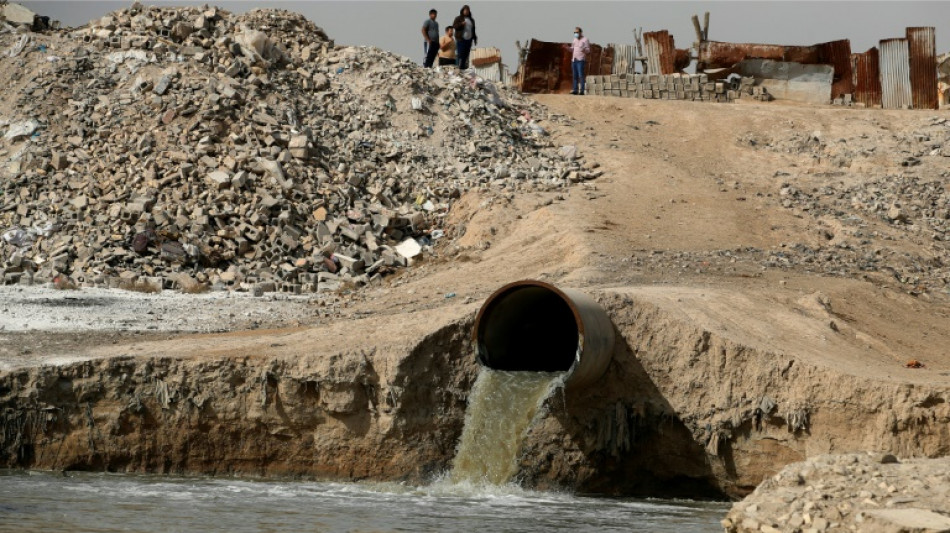
Rampant water pollution threatens Iraq's shrinking rivers / Photo: AHMAD AL-RUBAYE - AFP
Stricken by drought and depleted by upstream dams, Iraq's once mighty rivers the Tigris and Euphrates are suffocating under pollutants from sewage to medical waste.
In a country where half the population lacks access to safe drinking water, according to UN figures, state institutions are to blame for a man-made disaster which is turning rivers into waste dumps.
"What is strange about water pollution in Iraq is that most government institutions are responsible for it," Khaled Shamal, the ministry of water resources spokesman, told AFP.
He warned that Iraq's sewage network dumps "large quantities" of wastewater into the two major waterways, after superficial treatment or none at all.
"Most hospitals near a river dump their medical waste and sewage straight into it," Shamal added. "It is dangerous and catastrophic."
Dirty and unsafe water is a prime health threat in Iraq, where decades of conflict, mismanagement and corruption have taken a toll on infrastructure, including the water system.
Petrochemical factories, power plants and agricultural drainage that carries fertilisers and other toxins further pollute Iraq's water.
- Overloaded with toxins -
In the country known as "the land of two rivers", water pollution has become so severe that it is now visible to the naked eye.
In Baghdad's eastern suburbs, AFP filmed a pipe discharging green-coloured water with a foul odour into the Diyala river.
Ali Ayoub, a water specialist from the UN children's agency UNICEF, warned that Baghdad's two main water treatment plants are overloaded with twice their intended capacity.
The treatment facilities were built for a population of three to four million, but at least nine million live in Baghdad today.
"Inadequate infrastructure, limited regulations and poor public awareness are the main factors contributing to the significant deterioration of water quality in Iraq", Ayoub said.
"Two-thirds of industrial and household wastewater are discharged untreated into the rivers," amounting to six million cubic metres a day.
But Iraq's government is taking steps to improve water quality, he said.
The government has said it no longer approves projects that could be a source of pollution unless they provide water treatment.
It has developed a three-year plan to "strengthen the water and sanitation system" to provide "safe drinking water, especially to the most vulnerable communities", Ayoub said.
In partnership with UNICEF, Baghdad's Medical City –- a complex of hospitals with 3,000 beds, on the banks of the Tigris –- has recently inaugurated a water treatment plant, Akil Salman, the complex's projects manager, told AFP.
The facility has started operating with three units, each capable of treating 200 cubic metres of waste a day. Four additional units with a capacity of 400 cubic metres each are expected to be completed "within two months".
Instead of directing its wastewater to Baghdad's overburdened treatment facilities, the Medical City can use the treated water for the hospitals' gardens and to fill the firefighters' tanks, Salman said.
- 'We have to buy water' -
Iraq, which endures blistering summer heat and regular sandstorms, is one of the five countries most impacted by some effects of climate change, says the United Nations.
The country of 43 million people has suffered four consecutive years of withering drought, and water scarcity has become extreme.
It is worsened, according to authorities, by upstream dams built by Iraq's neighbours Iran and Turkey, lowering water levels in the Tigris and Euphrates, which have irrigated Iraq for millennia.
The water flow to Iraq "has declined significantly, leading to an increase in the concentration of pollutants in the water", environment ministry spokesperson Amir Ali Hassoun said.
Previously, authorities routinely opened valves to increase the river flow and dilute pollutants, but this strategy has become impossible due to a shortage of water which has forced them to look for other options.
In addition to "raising awareness" among the population, Iraqi officials say they are closely monitoring wastewater management.
"Hospitals are required to install wastewater treatment facilities," Hassoun said.
"We hope that 2024 will be the year we eliminate all violations," referring to hospitals dumping untreated sewage and medical waste into the rivers.
In Iraq's south, water pollution is much worse.
"Wastewater from other areas is discharged into the river, polluting the water that reaches us," said 65-year-old Hassan Zouri from the southern province of Dhi Qar.
"The water carries diseases. We cannot drink it or use it at all," added the father of eight.
"We used to rely on the river for drinking, washing, and irrigation, but now we have to buy water."
B.Krishnan--DT