Dubai Telegraph - Scientists in UK set fusion record

EUR -
AED 4.271395
AFN 77.137565
ALL 96.599921
AMD 444.393553
ANG 2.081967
AOA 1066.539094
ARS 1674.842321
AUD 1.750327
AWG 2.094989
AZN 1.976877
BAM 1.956212
BBD 2.345584
BDT 142.319961
BGN 1.956415
BHD 0.438447
BIF 3441.169388
BMD 1.163075
BND 1.509962
BOB 8.064698
BRL 6.320503
BSD 1.16464
BTN 104.721596
BWP 15.522201
BYN 3.366894
BYR 22796.267035
BZD 2.342283
CAD 1.611016
CDF 2593.656932
CHF 0.937415
CLF 0.027452
CLP 1076.92585
CNY 8.215496
CNH 8.209174
COP 4451.137047
CRC 569.429667
CUC 1.163075
CUP 30.821483
CVE 110.288218
CZK 24.257667
DJF 207.382766
DKK 7.468371
DOP 74.997078
DZD 151.420443
EGP 55.361545
ERN 17.446123
ETB 180.8773
FJD 2.642278
FKP 0.873233
GBP 0.873964
GEL 3.128107
GGP 0.873233
GHS 13.311802
GIP 0.873233
GMD 85.484624
GNF 10124.261915
GTQ 8.920878
GYD 243.611285
HKD 9.051513
HNL 30.673325
HRK 7.53475
HTG 152.506371
HUF 383.715831
IDR 19412.649685
ILS 3.758302
IMP 0.873233
INR 104.604047
IQD 1525.621171
IRR 48965.451146
ISK 148.803539
JEP 0.873233
JMD 186.348429
JOD 0.82461
JPY 182.24976
KES 150.42084
KGS 101.710875
KHR 4663.500597
KMF 493.144059
KPW 1046.763379
KRW 1711.080639
KWD 0.357192
KYD 0.9705
KZT 600.593854
LAK 25257.20853
LBP 104290.206677
LKR 359.454126
LRD 205.552389
LSL 19.857095
LTL 3.434257
LVL 0.703532
LYD 6.334306
MAD 10.777969
MDL 19.775078
MGA 5196.071531
MKD 61.558432
MMK 2442.510417
MNT 4125.754449
MOP 9.334565
MRU 46.246531
MUR 53.792378
MVR 17.915637
MWK 2019.416443
MXN 21.167727
MYR 4.793037
MZN 74.331577
NAD 19.857095
NGN 1688.970731
NIO 42.8546
NOK 11.807339
NPR 167.554553
NZD 2.0133
OMR 0.447205
PAB 1.164645
PEN 3.916024
PGK 4.942125
PHP 68.873221
PKR 326.467224
PLN 4.22708
PYG 8143.679386
QAR 4.244794
RON 5.090194
RSD 117.454302
RUB 89.773981
RWF 1695.049552
SAR 4.364119
SBD 9.572795
SCR 16.435764
SDG 699.59103
SEK 10.894557
SGD 1.507322
SHP 0.872607
SLE 28.031404
SLL 24389.095877
SOS 664.43702
SRD 44.918531
STD 24073.30113
STN 24.50558
SVC 10.190145
SYP 12860.070988
SZL 19.854094
THB 37.00032
TJS 10.731859
TMT 4.082393
TND 3.423221
TOP 2.800405
TRY 49.540704
TTD 7.887627
TWD 36.304242
TZS 2845.595197
UAH 49.163739
UGX 4125.868572
USD 1.163075
UYU 45.509581
UZS 13978.942826
VES 299.615391
VND 30663.305312
VUV 141.481394
WST 3.239754
XAF 656.092299
XAG 0.018957
XAU 0.000276
XCD 3.143269
XCG 2.098942
XDR 0.815968
XOF 656.092299
XPF 119.331742
YER 277.422482
ZAR 19.817109
ZMK 10469.073263
ZMW 26.931554
ZWL 374.509627
  • RBGPF

    -1.0600

    78.05

    -1.36%

  • NGG

    -0.4400

    74.89

    -0.59%

  • SCS

    0.0200

    16.14

    +0.12%

  • BCE

    -0.1900

    23.15

    -0.82%

  • JRI

    -0.0190

    13.701

    -0.14%

  • CMSD

    0.0500

    23.22

    +0.22%

  • CMSC

    0.0200

    23.24

    +0.09%

  • RELX

    0.0600

    39.54

    +0.15%

  • BCC

    0.1900

    72

    +0.26%

  • RIO

    1.3800

    74.4

    +1.85%

  • RYCEF

    -0.2300

    14.6

    -1.58%

  • GSK

    -1.2000

    47.27

    -2.54%

  • BTI

    -0.1200

    57.29

    -0.21%

  • BP

    -0.2300

    35.55

    -0.65%

  • AZN

    -1.4600

    89.82

    -1.63%

  • VOD

    0.0000

    12.5

    0%

Scientists in UK set fusion record
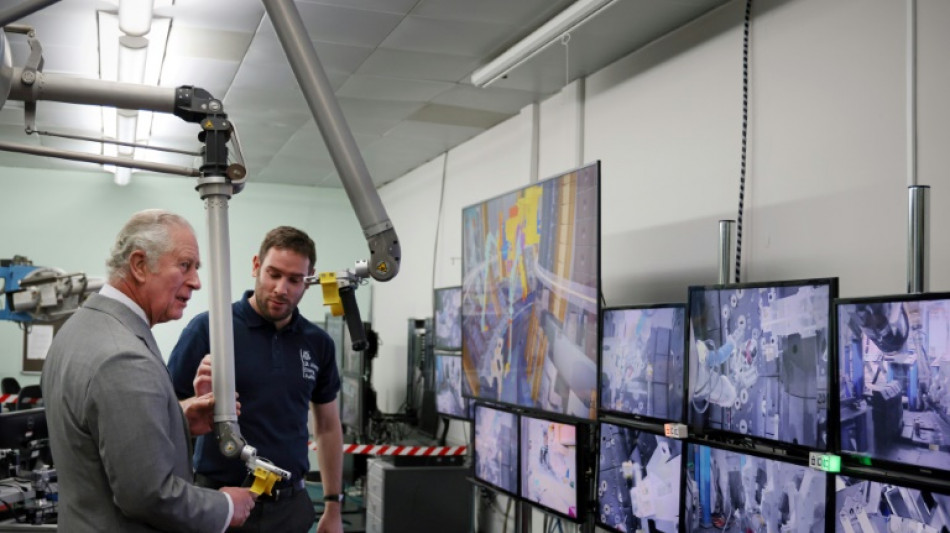
Scientists in UK set fusion record / Photo: ADRIAN DENNIS - POOL/AFP

Scientists in UK set fusion record

Scientists in Britain announced Thursday they had smashed a record for generating fusion energy in the final experiment using the Joint European Torus (JET) machines.

Text size:

Nuclear fusion is the same process that the sun uses to generate heat. Proponents believe it could one day help tackle climate change by providing an abundant, safe and clean source of energy.

A team at the JET facility near Oxford in central England generated 69 megajoules for five seconds using 0.2 milligrams of fuel, beating its previous record set in 2022 by 10 megajoules, the UK Atomic Energy Authority (UKAEA) said.

That is enough to power around 41,000 homes for five seconds.

It is the final experiment to be conducted at the JET site using a donut-shaped machine called a tokamak.

"JET has operated as close to power-plant conditions as is possible with today's facilities, and its legacy will be pervasive in all future powerplants," said Ian Chapman, UKAEA CEO.

"JET's research findings have critical implications not only for ITER -– a fusion research mega-project being built in the south of France -– but also for ... other global fusion projects, pursuing a future of safe, low-carbon, and sustainable energy," he added.

Over 300 scientists and engineers from EUROfusion, a consortium of researchers across Europe, contributed to JET's landmark experiments over 40 years.

Inside JET's tokamak, 0.1 milligrammes each of deuterium and tritium -- both isotopes of hydrogen -- were heated to temperatures 10 times hotter than the centre of the sun to create plasma.

This mixture was held in place using magnets as it spun around, fusing and releasing tremendous energy as heat.

Fusion is inherently safe in that it cannot start a run-away process.

Deuterium is freely available in seawater, while tritium can be harvested as a byproduct of nuclear fission.

Using equivalent weights, it releases nearly four million times more energy than burning coal, oil or gas, and the only waste product is helium.

Despite the new record, JET did not generate more energy than was put into producing it.

The Lawrence Livermore National Laboratory in the United States became the only facility to achieve this feat -- the holy grail of nuclear fusion -- in late 2022, using a different process involving lasers.

JET conducted its first deuterium-tritium experiments in 1997.

The results announced Thursday demonstrated the ability to create fusion for five seconds, as longer than that would cause JET's copper wire magnets to overheat.

ITER will be equipped with superconductor electromagnets which will allow the process to continue for longer, hopefully longer than 300 seconds.

If all goes well at ITER, a prototype fusion power plant could be ready by 2050.

International cooperation on fusion energy has historically been close because, unlike the nuclear fission used in atomic power plants, the technology cannot be weaponised.

The France-based megaproject also involves China, the EU, India, Japan, South Korea, Russia and the US.

A.Murugan--DT