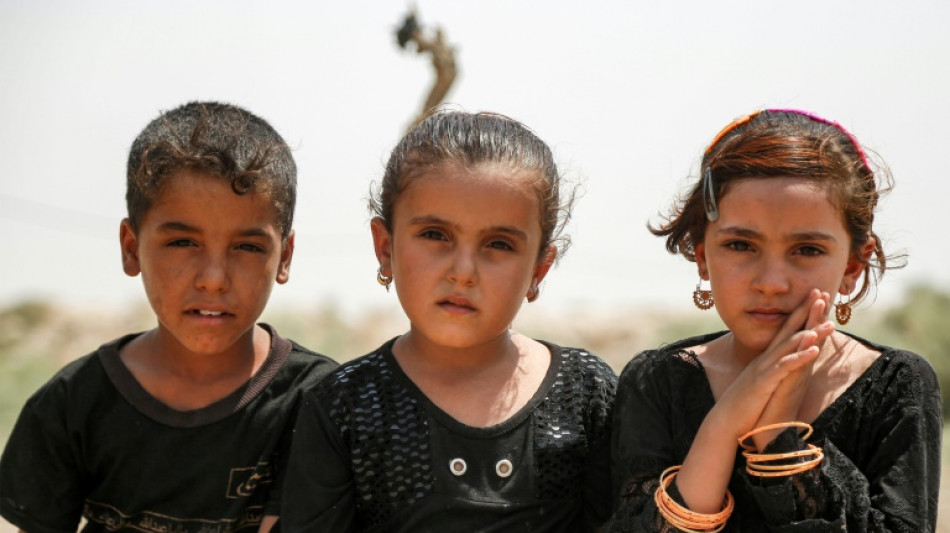
Climate change and filthy water drive disease in Iraq / Photo: Hayder INDHAR - AFP
A worried Iraqi father points at a blister on the face of his one-year-old daughter, the result of a parasitic infection carried by sandflies in her remote village.
"It's a skin disease, the 'Baghdad boil'," Najeh Farhan said of the pustule on Tiba's mouth as the toddler played with a pacifier at their home in the drought-hit province of Al-Diwaniyah.
Like countless other children in Iraq -- a country battling the effects of war, entrenched poverty, water stress and a heating planet -- Tiba is sick but has no access to good health care.
"There is no medical centre, we have nothing," Farhan, a father of seven, said of his small village of Al-Zuweiya.
Tiba has been infected with an illness called cutaneous leishmaniasis, endemic in Iraq for decades.
By 2022, the World Health Organization said 8,000 infections had been registered in the country.
But this year, in a "surprising development", it reported the first confirmed case in what had been a "traditionally sand fly-free" province in northern Iraq.
The UN agency has pointed to "inadequate access to medical treatment in remote areas" as a driver of the disease -- but a senior WHO official also highlighted the effects of climate change.
"The sandfly, like any other insect, thrives at a specific temperature and humidity level," Wael Hatahit, the WHO's acting representative in Iraq, told AFP.
He pointed to Iraq's "temperature rise and the change in the water fall pattern" and said the northward spread of the disease the sandfly carries "cannot be explained unless there is climate change".
- 'Rising temperatures' -
Tiba and one of her brothers, who suffers from jaundice and a skin rash, are victims of Iraq's broader public health crisis.
From cholera to chronic diarrhoea and sandstorm-triggered asthma attacks, the list of health problems confronting disadvantaged communities is long.
The Iraqi Red Crescent has been running a campaign in nine provinces across the country's south and centre where soaring heat and drought have badly hit farming communities.
It has sent 25 doctors, 150 volunteers, five mobile clinics and 10 ambulances on a campaign to provide free medical care and raise awareness on a range of health threats.
On a recent stop, women dressed in black were waiting alongside ambulances to have a child examined, in Al-Ayyach, another Diwaniyah village, as aid workers sorted through their medical supplies.
Raghda Ihsane, a pharmacist, listed the most common cases the team was treating: "Intestinal infections, dermatological diseases, skin rashes resulting from poor water quality, inflamed urinary tracts."
Dirty and unsafe water is a prime health threat in Iraq, one of the five countries worst hit by climate change impacts and now gripped by its fourth consecutive year of drought.
The scarcity is compounded by reduced Tigris and Euphrates river flows because of upstream dams, and damage done by conflict and neglect to treatment plans and water infrastructure.
- 'Contaminated water' -
An environment ministry official recently admitted that "sewer pipes in Baghdad discharge wastewater directly into the Tigris River", in comments quoted by the state-run Al-Sabbah daily.
Cholera is raging in the north, particularly in Sulaimaniyah, Iraqi Kurdistan's second city, where the WHO had registered 152 confirmed cases by September 12.
"The principal cause is the use of non-potable water," said Sabah Hourami, director of Sulaimaniyah's health authority.
Officials were taking action, he insisted, by testing the chlorine content of public water supplies and tightening controls on water tankers, restaurants and mosques.
As patients have flocked to local hospitals, he said, "we no longer screen people. Those suffering from diarrhoea and vomiting are automatically treated as cholera cases."
Water stress is at the core of the health threats, said medical anthropologist Mac Skelton, who heads the Institute of Regional and International Studies at the American University of Iraq-Sulaimani.
"Decreased water flow means higher concentrations of sewage and industrial pollutants in the water supply, which Iraq's water treatment facilities typically cannot process adequately," he said.
This, he said, was "associated with a range of conditions such as cholera, gastrointestinal diseases, skin diseases and diarrhoea".
Looking ahead, Skelton said, Iraq needs "improved public health systems to warn the populace of heightened contamination and to monitor outbreaks".
He added that "enhancing Iraq's seriously deteriorated water treatment infrastructure is also essential".
G.Koya--DT