Climate change worsening heatwaves, air quality: UN / Photo: Sakis MITROLIDIS - AFP
Climate change is driving more intense and more frequent heatwaves, which in turn generate a "witch's brew" of pollutants, threatening the health of humans and other living things, the UN warned Wednesday.
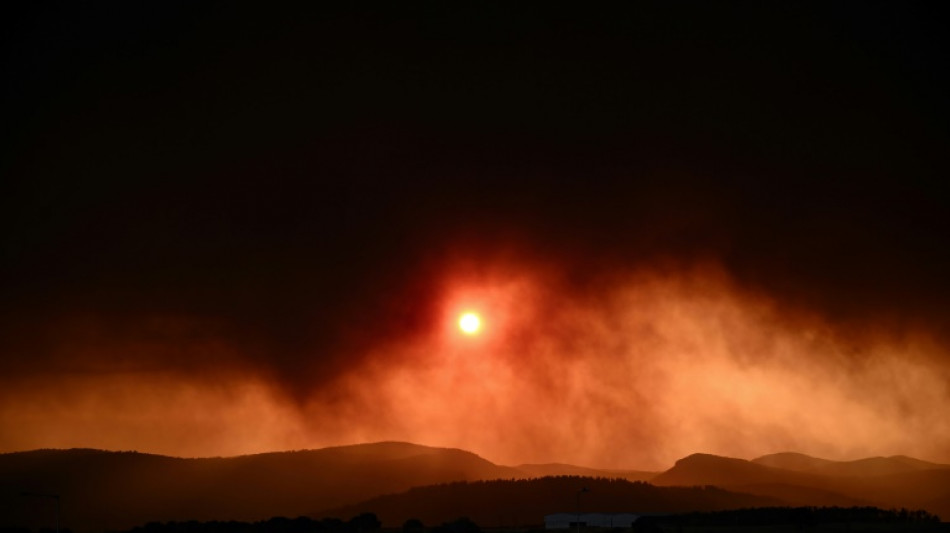
The wildfire smoke recently suffocating cities from Athens to New York may be the most visible sign of air pollution brought on by heat waves.
But extreme heat can also induce a whole host of other chemical processes that are hazardous for human health, the United Nations' World Meteorological Organization said in its annual Air Quality and Climate Bulletin.
"Heatwaves worsen air quality, with knock-on effects on human health, ecosystems, agriculture and indeed our daily lives," WMO chief Petteri Taalas said in a statement.
A recent study by the Energy Policy Institute at the University of Chicago (EPIC) indicated that fine particulate air pollution from things like vehicle and industrial emissions but also sand and wildfires, is "the greatest external threat to public health" worldwide.
Taalas stressed that "climate change and air quality cannot be treated separately".
"They go hand-in-hand and must be tackled together to break this vicious cycle."
- 'More extreme' -
While Wednesday's report was based on 2022 data, Taalas cautioned that in terms of temperatures, "what we are witnessing in 2023 is even more extreme".
On Wednesday, the European Union's Copernicus Climate Change Service said the Earth had just had its hottest three months on record, with last July the hottest month ever recorded, followed by August and that 2023 was on track to become the hottest year on record.
That is bad news for air quality levels.
"Air quality and climate are interconnected because the chemical species that affect both are linked, because the substances responsible for climate change and for the degradation of air quality are often emitted by the same sources, and because changes in one inevitably cause changes in the other," WMO said.
It pointed for instance to how the combustion of fossil fuels emits carbon dioxide and nitrogen oxide into the atmosphere, which are not only heat-trapping greenhouse gases but can lead to the formation of pollutants like ozone and nitrate aerosols.
Researchers meanwhile widely agree that climate change is causing more intense and more frequent heatwaves, and that this in turn is leading to a growing risk of more severe wildfires, WMO said.
- 'Closely linked' -
"Heatwaves and wildfires are closely linked," said Lorenzo Labrador, a WMO researcher at the Global Atmosphere Watch network which compiled Wednesday's Bulletin.
"Smoke from wildfires contains a witch's brew of chemicals that affects not only air quality and health, but also damages plants, ecosystems and crops – and leads to more carbon emissions and so more greenhouse gases in the atmosphere," he said in the statement.
The 2022 data detailed in the report showed how heatwaves last year triggered wildfires in the Northwestern United States, leading to unhealthy air.
Soaring temperatures in Europe, accompanied by unusually high amounts of desert dust reaching the continent, meanwhile led to increased concentrations of both particulate matter and ground-level ozone pollution, it said.
While high-altitude, or stratospheric ozone provides humans with vital protection from harmful the ultra-violet rays of the sun, ozone close to the Earth's surface is harmful to human health.
It also reduces crop yield, with ozone-induced losses averaging 4.4-12.4 percent globally for staple food crops, and wheat and soybean losses as high as 15-30 percent in parts of India and China.
A.Murugan--DT