Typhoon Saola weakens as it edges along southern China / Photo: ISAAC LAWRENCE - AFP
Typhoon Saola swept across southern China on Saturday after tearing down trees and smashing windows in Hong Kong, although the megacity avoided a feared direct hit from one of the region's strongest storms in decades.
Tens of millions of people in the densely populated coastal areas of southern China had sheltered indoors on Friday ahead of the storm.
Saola had triggered Hong Kong's highest threat level on Friday evening -- issued only 16 times since World War II -- and registered winds of around 210 kilometres per hour at its peak.
It was downgraded before dawn on Saturday as the typhoon passed the city and tracked towards coastal areas of mainland China, with no reported casualties and far less damage than that created by 2018's powerful Typhoon Mangkhut.
But authorities warned people to stay away from the shoreline, as Saola was still whipping up strong gales around the island.
AFP journalists saw multiple fallen trees and scaffolding strewn across Hong Kong roads, broken windows, and leaking facades around major buildings, while local media reported that solar panels had been ripped off rooftops.
In eastern Hong Kong's Heng Fa Chuen housing estate, a resident said she had felt "some swaying" in her building during the night.
"But overall, we didn't feel unsafe," she told AFP, contrasting it to 2018's Mangkhut which had temporarily disrupted the supply of water and electricity in some housing blocks.
Thomas Wong, a shopkeeper in Causeway Bay, said Saola still left him stranded overnight in his home goods store.
"I didn't leave my shop because the transportation was not running... I had no choice," he said, adding that he lived in the northern Hong Kong district of Tai Po.
The last storm to earn the city's highest typhoon alert, Mangkhut shredded trees and unleashed floods across the city, leaving more than 300 people injured in its wake.
In mainland China, it killed six people and impacted the lives of more than three million others.
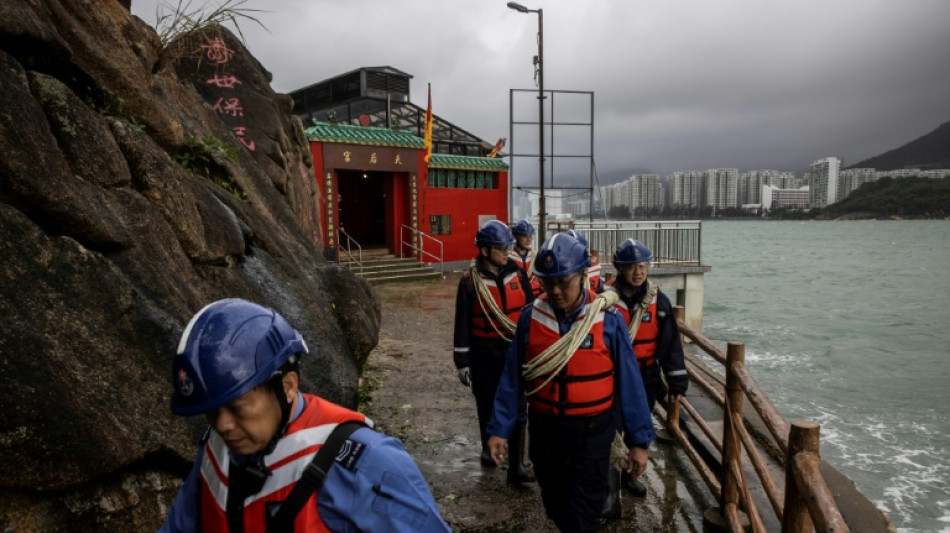
Hong Kong's Civil Aid Service said Saturday more than 500 people were deployed around the city to evaluate the damage, including volunteer workers who patrolled a low-lying fishing village in Lei Yue Mun district.
They removed twisted iron cladding to less wind-whipped areas and snapped photos of rising sea waters, as residents surveyed the pavement damage done to uprooted trees that pulled up concrete.
"I'm waiting to see if there is a storm surge and whether the waters will rise," one woman in Lei Yue Mun told a TV news station.
Hong Kong's airport authority announced it would gradually resume flights, after mass cancellations and delays the day before.
"Hopefully they won't delay it again," Eugene Wang, a Chinese businessman visiting from Singapore, told AFP as he lunged his suitcase onto the MTR en route to the airport.
Neighbouring gambling hub Macau also announced the reopening of casinos that had been closed for a day -- a rarity -- due to the severity of Saola.
- Frequent, unpredictable storms -
Saola made landfall before dawn in the Chinese coastal city of Zhuhai, which is part of the Pearl River Delta -- a low-lying region prone to massive storms that includes Hong Kong, Macau and Guangdong province.
Workers on Saturday moved metal railings during the storm from the roads, and cleared sand whipped from a nearby beach.
China had initially warned that Saola "may become the strongest typhoon to make landfall" in the region since 1949, but by Saturday afternoon, Guangdong province downgraded its emergency response due to the weakened windspeed.
Across the South China Sea on Saturday, another typhoon, Haikui, tracked rapidly towards Taiwan, where authorities raised land and sea warnings, though the impact was expected to be mild.
Southern China is frequently hit in summer and autumn by typhoons that form in the warm oceans east of the Philippines and then travel west.
Climate change has made tropical storms more unpredictable while increasing their intensity, bringing more rain and stronger gusts that lead to flash floods and coastal damage, experts say.
I.Viswanathan--DT