German drought prompts rethink for ancient palace park trees / Photo: Mathias HEINE - AFP
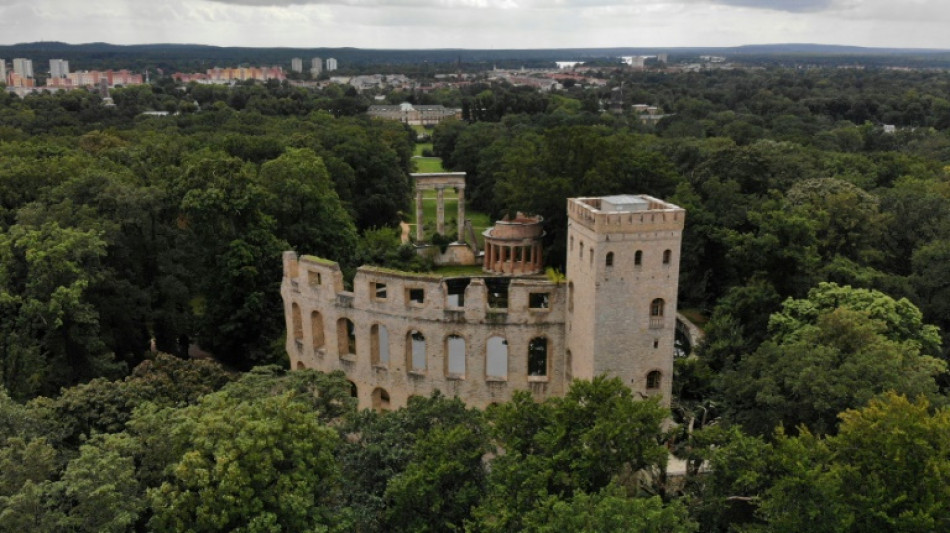
Climate change is taking a heavy toll on the ancient trees of Sanssouci, the sumptuous summer palace built in the 18th century as the Prussian answer to Versailles.
The sprawling grounds with their manicured gardens in Potsdam southwest of Berlin are surrounded by a park filled with soaring, centuries-old giants that are now feeling the bite of persistent droughts.
Forest manager Sven Hannemann, standing at the foot of an oak with a six-metre (20-foot) trunk circumference, gazed up at its canopy which once stretched over 500 square metres.
Now its sickly branches are only dotted with green. Hannemann gave the old giant another two years, "then it will be dead".
In its 600 years, the tree had withstood storms, frigid temperatures and two world wars, but the lack of rain in the last few years due to the climate crisis has sounded its death knell.
"In 2018 when it was very dry, it suffered a real shock like many woody plants here in the park," Hannemann told AFP.
"And since then it's actually been shrinking."
Sanssouci Park stretching across 300 hectares (around 740 acres) has been part of Potsdam's UNESCO World Heritage collection of stately homes and gardens since 1990.
Its palace draws more than 300,000 visitors each year.
The park, which counts some 26,000 trees, is now losing between 180 and 300 per year -- at least three times the number that died annually before severe weather in 2017-18, a spokesman for the Palaces and Parks of Potsdam and Berlin foundation said.
Although 2023 has been less dry than previous years, rainfall has proved insufficient to counteract past drought damage and around half of the trees are showing signs of distress, he said.
Beyond the lack of moisture, voracious insects have been feasting on the trees.
- 'Takes decades' -
Hannemann knelt at the foot of the dying oak and let sawdust trickle through his hand -- the work of capricorn and oak splendour beetles.
The insects have nibbled a veritable deluge of debris out of the growth layer between the sapwood and the bark, as evidenced by thumb-thick holes in the trunk.
"They eat the cambium and no tree can live without cambium," referring to the cell layer under the bark that is responsible for secondary growth, Hannemann said.
The dying giant trees leave gaping holes in the forest, which harm other trees because their trunks and the forest floor are exposed to the sun's radiation without protection.
Hannemann plucked a leaf from a beech shoot and demonstrated the protective reflex of deciduous trees.
"Then the beech leaf curls up -- so far, so smart," he said.
"What's not so smart about it is that the sun gets through to the thick inner branches which weren't used to it in the first place, and then the branches get a sunburn."
It's a vicious circle that Hannemann said impacts all tree species.
Dead oaks or beech trees can then at best only serve as habitats for bats, insects or mushrooms.
But if the trunks and branches are too rotten and pose a safety risk to park visitors, they must be felled.
Yet there is still hope for the gnarled inhabitants of historic parks such as Sanssouci, whose Rococo palace Prussian King Frederick the Great designed and built as a retreat during his reign from 1740 until 1786.
Gardeners at the historic sites are experimenting with heat-resistant tree species from the Mediterranean region with some promising results, Hannemann said.
His team in Potsdam is also relying on the power of evolution.
"We believe that native woody plants also adapt to some extent," he said.
For example, acorns from trees that are obviously less affected by drought get planted in the forest floor.
However, the newer, more robust trees will need time to grow the thick protective canopies needed for the ecosystem.
"That takes decades," Hannemann said.
Y.Sharma--DT