Streets become rivers as Beijing records heaviest rain in 140 years / Photo: Jade Gao - AFP
Deadly rains that pummelled China's capital in recent days were the heaviest since records began 140 years ago, Beijing's weather service said on Wednesday, as a massive cleanup operation began.
Millions of people have been hit by extreme weather events and prolonged heatwaves around the globe in recent weeks, events that scientists say are being exacerbated by climate change.
And the Beijing Meteorological Service said the capital has just experienced the "heaviest rainfall in 140 years", when city authorities started keeping records.
"The maximum (amount) of rainfall recorded during this storm, which was 744.8 millimetres, occurred at the Wangjiayuan Reservoir in Changping," the service said, adding the largest volume previously recorded was 609 millimetres in 1891.
At least 11 people have died in the rains in Beijing, state broadcaster CCTV said Tuesday, with more than a dozen missing.
The epicentre of flooding shifted to neighbouring Hebei province on Wednesday.
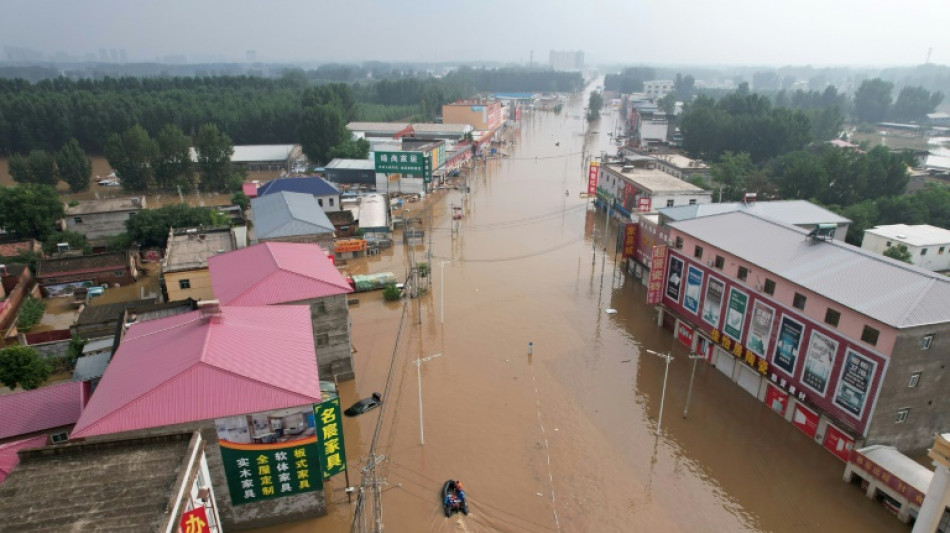
Dramatic aerial photographs taken by AFP of Hebei's Zhuozhou city showed shopping streets turned into rivers of brown water, while others showed farmland in the surrounding areas completely submerged and floodwater stretching for miles.
A 34-year-old print factory worker, who gave only his surname of Liu, said water began pouring into Zhuozhou's factory district on Monday afternoon.
"First we tried to block the water, but then it was impossible," Liu told AFP.
"We couldn't get any of our plant's equipment or materials out to shelter. We were trapped inside until midday today before being rescued."
AFP saw rescuers using boats to ferry instant noodles, bread and drinking water to residents who could not or did not want to leave properties engulfed by water.
- Tons of rubbish -
In Beijing's Fangshan district, on the border between the capital and Hebei province, an AFP team saw a park that had been completely flooded, with tons of rubbish that had been washed away by torrential rains stuck near a bridge.
"I have never seen something like this in more than 40 years," said a 71-year-old resident called Li, who also did not want to give her full name.
A police officer said the area became "extremely dangerous" on Tuesday.
Journalists also saw a military vehicle with caterpillar wheels on its way back from the worst-affected areas.
State media footage showed rescuers rowing inflatable rafts through waterlogged neighbourhoods, while locals clung to construction scaffolding awaiting help.
Storm Doksuri, a former super typhoon, swept northwards over China after hitting southern Fujian province last week, following its battering of the Philippines.
Heavy rains began pounding the typically dry capital and surrounding areas on Saturday.
The amount recorded in just 40 hours neared the average rainfall for the entire month of July.
State media warned last week that 130 million people would be affected by the extremely heavy rainfall across northern China.
Swaths of suburban Beijing and the surrounding areas have been inundated, with state media reporting 974,400 people have been evacuated in the capital and neighbouring Hebei province.
A further 42,211 people were evacuated in Shanxi province to the west.
Authorities in the capital lifted the red alert for flooding on Wednesday morning "as the water flow in major rivers has gone below the warning mark", state news agency Xinhua said.
- 'Extreme weather' -
China has been hit hard by extreme weather in recent months, from record-breaking heatwaves to deadly rain.
Ma Jun, director of the Beijing-based NGO the Institute of Public and Environmental Affairs, said that while the typhoon had brought the rain, rising ocean temperatures caused by climate change were also causing the extreme weather.
"China has suffered unprecedented extreme heatwaves since last year... this year, there are record-breaking high temperatures in Northern China," Ma told AFP.
"These heatwaves are linked to global warming, and this is what most climate scientists around the world tend to agree," he said.
With rainfall easing, the focus has moved to the relief operation, with hundreds of rescue workers from the Chinese Red Cross being sent to hard-hit areas to clean up debris and help evacuate victims, Xinhua said.
Two of the 11 people killed in the rains in Beijing died while "on duty during rescue and relief", according to state broadcaster CCTV.
In neighbouring Hebei province, nine people were killed and six were missing, it said.
Another two casualties were reported in northeastern Liaoning province at the weekend.
President Xi Jinping called on Tuesday for "every effort" to rescue those "lost or trapped" by the storm.
And visiting a relief work site in Beijing's Mentougou -- one of the capital's hardest-hit areas -- Vice-Premier Zhang Guoqing urged "all-out" efforts to rescue those still missing.
The country is now on alert for the arrival of Typhoon Khanun, the sixth such storm of the year, as it nears China's east coast.
Y.Amjad--DT