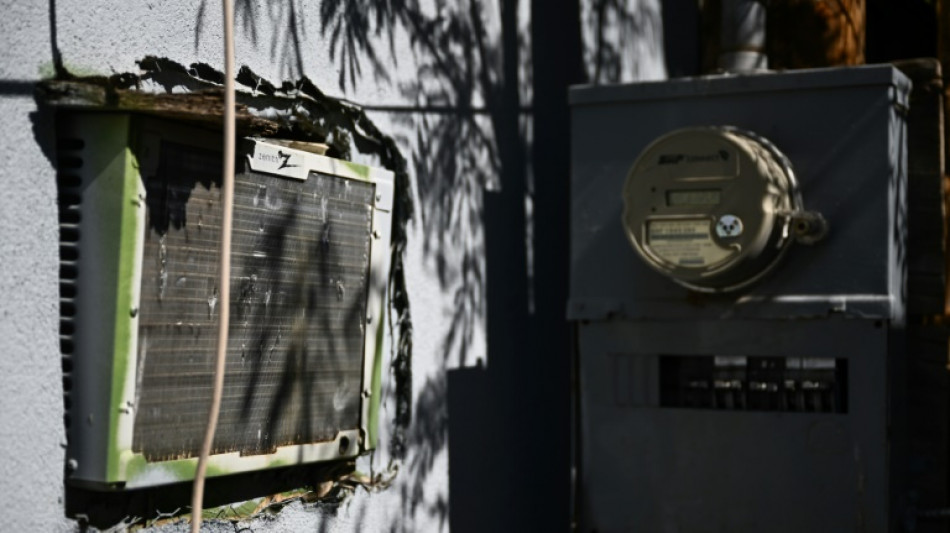
In a warming world, is an air-conditioned future inevitable? / Photo: Patrick T. Fallon - AFP/File
They are ubiquitous in the United States, controversial in Europe and coveted in South Asia. As heatwaves intensify across the world, air conditioning has taken center stage.
For better or for worse, these power-hungry appliances are among the most common adaptations to a warming world. They have become a necessary tool for the survival of millions, according to experts.
But while they bring immediate, life-saving relief, air conditioners come at a cost to the climate crisis because of their enormous energy requirements.
Air conditioning is responsible for the emission of approximately one billion metric tons of carbon dioxide per year, according to the International Energy Agency (IEA), out of a total of 37 billion emitted worldwide.
It is possible to end this vicious cycle, experts say, by increasing the contribution of renewable energies, developing less energy-intensive air conditioners and augmenting them with other cooling techniques.
"There are some real purists who think that we can eliminate, but I just don't think that's feasible," Robert Dubrow, a Yale epidemiologist who specializes in the health effects of climate change, told AFP.
Access to air conditioning already saves tens of thousands of lives a year, a figure that is growing, according to a recent IEA report co-authored by Dubrow.
Studies show that the risk of heat-related death is reduced by about three-quarters for those living in homes with an air conditioner.
In the United States, where about 90 percent of households have AC, studies have highlighted the role of air conditioning in protecting the population -- and the potentially devastating effect of widespread power cuts during heatwaves.
But globally, of the 3.5 billion people living in hot climates, only about 15 percent have air conditioners at home.
- High costs, high emissions -
The number of air conditioners in the world, about two billion today, is set to skyrocket as temperatures and incomes rise.
India, China and Indonesia -- the first, second and fourth most populous countries in the world -- are among those that will see the strongest growth.
By 2050, the share of households in India equipped with air conditioners could increase from 10 to 40 percent, according to a recent study.
But such an increase in electricity consumption would be equivalent to the current total annual production of a country like Norway.
If India's future grid uses as much fossil fuels as it does today, that would mean around 120 million tons more carbon dioxide emitted annually -- or 15 percent of the country's current energy sector emissions.
The problems posed by increased air conditioning do not stop there. Running power plants also causes air pollution.
Air conditioners also generally use fluorocarbon gases as refrigerants, which have a warming power thousands of times greater than CO2 when they escape into the atmosphere.
And by discharging their hot air out into the streets, air conditioning contributes to urban heat island effects.
A 2014 study found that at night heat emitted from air-conditioning systems in city centers increased the mean air temperature by more than 1 degree Celsius (almost 2F).
Finally, due to its cost, access to air conditioning poses a major equity issue.
Once installed, the price of the electricity bill can force families to choose between cooling and other essential needs.
- 'Complementary' solutions -
For Enrica De Cian, a professor in environmental economics at Ca Foscari University in Venice, the use of AC is "an important strategy in certain conditions and in certain places."
But, she adds, it's essential to combine it with "complementary" approaches.
First, by continuing to ramp up renewable energy production, and wind down fossil fuels, so that energy used by air conditioners leads to fewer emissions.
Second, by developing and installing affordable air conditioners that consume less energy, which some companies are working on. The IEA advocates for stricter efficiency standards, but also recommends air conditioners to be set at a minimum of 24C (75F).
Beyond limiting emissions, greater efficiency would also curb the risks of power cuts linked to excessive demand. On hot days, air conditioning can account for more than half of peak consumption.
But above all, the experts hammer home the simultaneous need for spatial planning measures: including more green spaces and bodies of water, sidewalks and roofs that reflect the Sun's rays, and better building insulation.
"We have to achieve sustainable indoor cooling," said Dubrow.
The proposed solutions are "very feasible," he adds. "It's a matter of political will for them to be implemented."
H.El-Hassany--DT