Animal testing put to the test in Swiss vote
Switzerland goes to the polls Sunday to decide whether animal and human testing should be banned -- a proposal that has triggered an outcry in a country heavily reliant on big pharma.
Opinions suggest that the proposal by animal rights defenders is highly unlikely to pass.
But if it did, "Switzerland would be the only country internationally with such a ban," said Yves Fluckiger, president of the Swiss universities lobby group.
Researchers insist that medical progress is impossible without experimentation.
At the University of Geneva, Patrycja Nowak-Sliwinska, head of the molecular pharmacology laboratory, unveils her cell incubator where intestinal organoids from cancer patients are being cultivated.
These structures, made up of cells, make it possible to test a large number of potential treatments.
"With the in vitro model, we try to find promising candidates" -- and only the latter would then be tested on animals, said Nowak-Sliwinska, who received a prize rewarding researchers who work to replace animals with other methods.
But even she said it would be impossible to do all the research without animal experimentation and clinical trials.
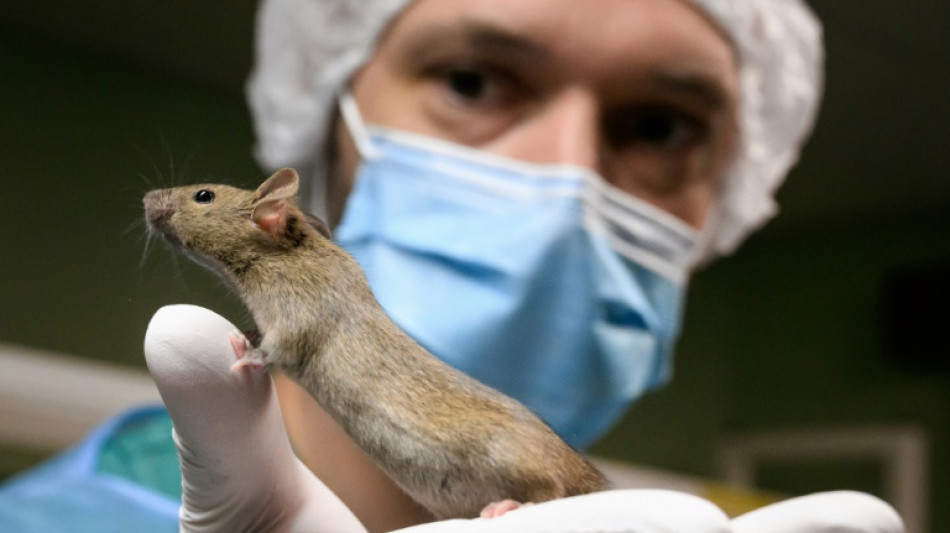
This is why the university's Faculty of Medicine has an animal facility in the basement housing some 25,000 animals -- mostly mice and rats.
- Strict protocols -
Inside, Professor Doron Merkler conducts research to find a treatment for a form of multiple sclerosis.
The research could not advance without using mice, into which he injects modified cells to observe how the disease affects the nervous system.
The mouse he is working on is showing symptoms: instability, difficulty moving, and partial paralysis of the limbs.
The experiments are framed by a strict protocol regarding their degree of severity, and animal keepers are trained to detect when an animal is not well.
"If no veterinary care can be provided to the animal, we can decide with the researcher to sacrifice it," said Pierre Bonnaventure, head of animal facilities at the faculty.
In Switzerland, researchers seeking to use live animals must make a formal request, establish that there is no alternative method available and that the conditions imposed on the animals will be as light as possible.
The number of animals used has consequently fallen sharply, from nearly two million per year in the early 1980s to around 560,000.
Some 20,000 animals a year undergo severe interventions, such as the implantation of a tumour, according to federal authorities.
- Proposal 'goes too far' -
Under Switzerland's direct democracy system, campaigners collected enough signatures to trigger a popular vote.
The proposal would outlaw experiments not only on animals but on humans too, as well as ban the importation of new drugs developed through such means.
"Animal experiments should be considered a crime," Renato Werndli, a doctor among those who launched the initiative, told AFP.
All the major political parties in Switzerland are against the proposal.
For the government, the ban "goes too far" and would have "serious consequences for health" -- and also for the economy, in a country where the chemical and pharmaceutical sector represents just over half of all exports.
Interpharma, the Swiss pharmaceutical industry's lobby group, warned that in the event of a ban, "the institutions and companies concerned would be forced to relocate their activities abroad".
Switzerland has already rejected three initiatives on the subject -- in 1985 (70 percent), 1992 (56 percent) and 1993 (72 percent) -- and is expected to do likewise this time.
But it remains to be seen whether the majority will be as big, in a society where animal welfare has grown in importance.
For Samia Hurst, a bioethicist at the University of Geneva, the new initiative commits "a fairly frequent mistake, which is to target biomedical research".
However, she told AFP: "Animal experimentation, among the various uses that humanity makes of other species, is both the most closely monitored and undoubtedly the most justified."
R.El-Zarouni--DT