As species decline, green turtles offer glimmer of hope / Photo: SAI AUNG MAIN - AFP
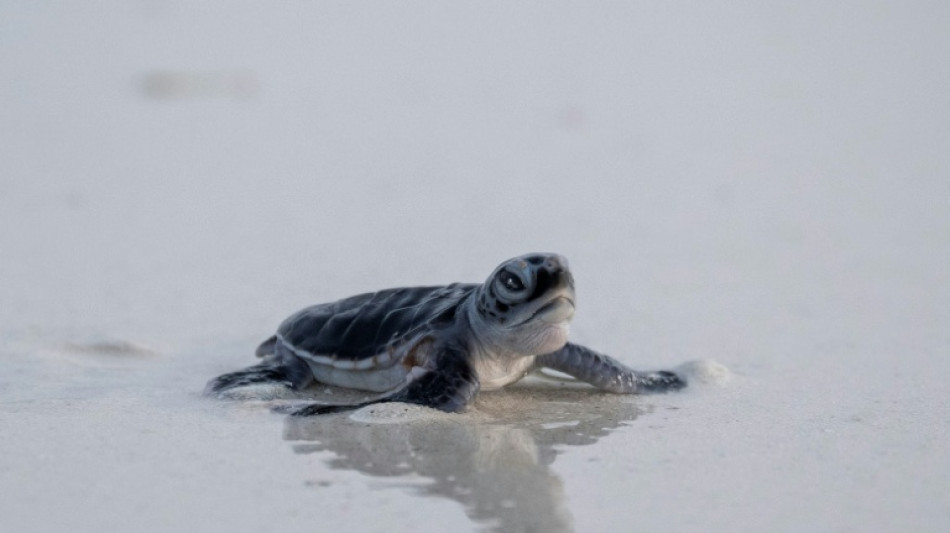
The palm-sized green turtle hatchling flailing through the sand on a Malaysian island may seem vulnerable, but its species has emerged as a symbol of hope for wildlife conservation.
Green turtles have made the rare jump from endangered to "least concern" in global conservation rankings, a remarkable success when many species are declining.
Conservation NGO World Wildlife Fund (WWF), in its biannual Living Planet Report released Thursday, found a 73-percent decline in the average size of monitored wildlife populations over 53 years.
But around 50 percent of the thousands of vertebrates monitored for the report are stable or increasing.
That includes green turtles, thanks to decades of efforts including egg relocation, marine protection and trade bans.
Malaysian turtle expert Juanita Joseph has spent years on the frontlines, carrying out cutting-edge genetic research and even convincing her own father to stop eating turtle eggs.
Still, when the International Union for the Conservation of Nature last year announced green turtles were no longer endangered, she could hardly believe it.
"Never in my mind (did I think) that one day turtles can be 'least concern'. I cried... I said I've done my part," she told AFP at Universiti Malaysia Sabah, where she is a professor.
All six other sea turtle species are still vulnerable or critically endangered, apart from the flatback turtle, whose status is unclear because of data shortages.
Turtles are targeted for food and their shells, killed in fishing nets, and constrained by development and pollution at nesting beaches and feeding grounds.
Climate change also skews populations more female because heat determines sex development in eggs.
Even now, recovery is uneven. While green turtles globally are "least concern", some regional populations are still endangered and declining.
- 'Our heritage' -
Malaysia is something of a regional exception. Green turtle nesting at Sabah state's Turtle Islands has tripled since the 1970s to over 20,000 nests annually.
That reflects "over five decades" of work, said Sabah Parks director Maklarin Lakim.
The Turtle Islands have been protected since 1977, and Sabah banned turtle meat and egg consumption in 1997.
"This is our heritage, this is our biodiversity," Maklarin said.
"We would like to protect that as long as possible."
Much of the conservation success has relied on people like Sitti Rasah Abdul, 50, from a fishing community on Malaysia's Omadal island.
Since 2012, she and other members of a women's cooperative have relocated turtle eggs from beaches to a hatchery to protect them from predators and poachers.
The 20-strong team started conservation work with WWF, but now self-funds, ploughing 10 percent of revenue from their handicraft and catering business into turtle protection.
"I'm already old," said Rasah, on the wooden jetty that extends from her home into aquamarine seawater.
"But I feel a sense of responsibility to ensure that there are still turtles around for the next generation."
A 45-minute boat ride away, green and hawksbill turtle hatchlings emerged from relocated nests in a hatchery at the high-end Mataking Reef Resort.
Hotel owner Sophia Sie fell in love with turtles decades ago when her father acquired land on Mataking island, and now around 10 percent of her staff works on conservation.
In 2006, "we had about 600 eggs collected... today we have about 36,000 eggs," Sie told AFP.
Guests can release hatchlings, and while Sie considers conservation a passion, it is also good business.
"The survival of our business here is very much dependent on the natural resources and the beauty around us," she said.
- 'Long-term project' -
The hatchlings tipped from a basket onto a Mataking beach face long odds. Just one in 1,000 will survive to sexual maturity at 20 years old.
Hatchlings spend around a decade in the open ocean, a period sometimes called the "lost years" because scientists know so little about it.
Working out where turtles spend those years, and where they forage and reproduce, is key to sustaining conservation success, said Gavin Jolis, marine species strategy manager at WWF-Malaysia.
The NGO has created the world's first global turtle DNA database, Shellbank, using samples from turtle tissue and shells to trace populations and even target poachers.
"In order to save sea turtles, we have to look at the life cycle," said Jolis.
"That's where the genetic work comes in."
The neat rows of test tubes in Joseph's lab contain bits of hatchling flipper snipped from babies that did not survive.
Sequencing them reveals a turtle's "haplotype", a kind of genetic fingerprint.
The work has already helped show that turtles foraging in parts of Malaysia come from Micronesia, and identified the likely source of turtle shell intercepted in Britain.
While each conservation effort faces different challenges, the battle to protect green turtles teaches "to really be resilient and patient with the work", said Jolis.
"We should not look at just a short-term project, it's a long-term project."
Y.Al-Shehhi--DT