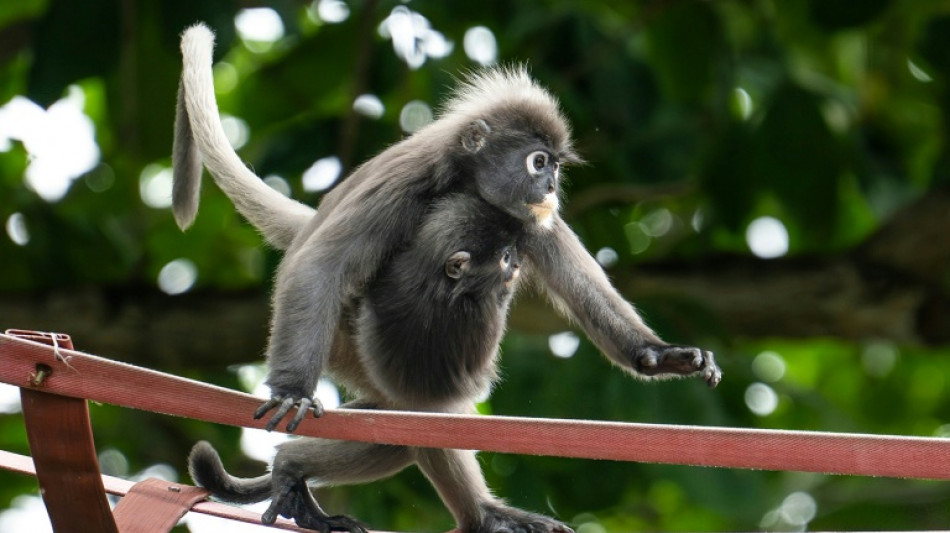
Sky bridges, citizen science protect endangered Malaysia monkeys / Photo: Mohd Rasfan - AFP
A graceful black monkey edges across a swaying red rope bridge strung over a busy residential road in Malaysia's Penang, watched by local conservationists who carefully record her movements.
For Malaysia's endangered dusky langurs, recognisable by the "masks" of white fur that ring their eyes, survival increasingly depends on such man-made crossings and the work of "citizen scientists".
A fragmented habitat, conflict with local communities, and poaching have all pushed the species to endangered status.
But the Langur Project Penang (LPP) conservation group hopes that low-tech engineering and high-tech community engagement can help protect the species, also known as the dusky leaf monkey.
Key to their efforts is helping the monkeys navigate fragmented habitat crisscrossed by busy roads where the animals are often killed.
LPP founder Yap Jo Leen realised the need for a solution when she saw dusky langurs repeatedly risking road crossings as she carried out fieldwork in 2016.
"I realised that they don't just stay in the forest. They also cross roads to the coastal area to look for food," she told AFP.
She came up with the idea of building some kind of crossing, and pairing the solution with community engagement.
"At the time, the idea was wild because no one in Malaysia had actually done it before" she said of the crossing plan.
Similar canopy bridges have helped other endangered primates elsewhere, including in Indonesia, where an orangutan was recently seen using such a crossing for the first time.
- 'Safe haven' -
Yap's team experimented with different materials before settling on upcycled fire hoses "twisted to mimic tree branches".
They are suspended over roads from a tree on one side and a custom-installed pole on the other.
LPP has now installed three, including in April in the coastal suburb and beach destination of Batu Ferringhi.
Yap said the group's research showed they work. At one site, at least eight monkeys died in traffic accidents between 2016 and 2018. No deaths have been recorded since the crossing was installed in 2019.
The crossings also allow groups of monkeys that were once largely confined to an area to expand their range.
"They have more opportunity to venture closer to the hills... and find their way to a safe haven," she said.
That not only benefits the animals, but decreases pressure on local communities that have come into conflict with hungry roving bands of dusky langurs seeking food in urban neighbourhoods.
Addressing that conflict is another part of LPP's efforts.
It recruits members of the local community to serve as "citizen scientists" who track langur movements, collect data and record GPS coordinates using spreadsheets and the Wikiloc trail app.
The volunteers receive a small stipend and training in fieldwork in return for committing to tracking the monkeys for at least three months.
The data helps researchers understand more about the monkeys, including their home range and their feeding habits, and could one day even help guide reforestation efforts.
- 'We have to coexist' -
The current volunteers range from age 17 to 65 and "call themselves the 'monkey stalkers' or 'monkey whisperers'", Yap said with a laugh.
Former IT manager Teo Hoon Cheng signed up after encountering "magnificent" langurs on hiking trails over a decade ago.
"You don't need background knowledge in zoology or biology. Anyone can be a citizen scientist," he said.
Other locals work with LPP to ease tensions between the community and the monkeys, including retired graphic designer Tan Soo Siah.
"Somebody needs to step up to act as a bridge for this communication," the 64-year-old said.
Residents complain about the noise the monkeys make when crossing their roofs, as well as occasional "break-ins" when windows are left open.
Tan tries to explain why the monkeys are there, and how they can be gently moved along with a little spray of water.
The work has "taught me the meaning of coexistence," he said.
"It's good that we can use my experience to show how we can live in harmony with the primates."
Fellow resident Lim Hock Cheng said the community was gradually learning to accept the animals.
"We've encroached into their habitat... We have to coexist, learn to live with each other," the 66-year-old said.
"The dusky langurs are also part of our society."
This article is part of a reporting project between Mongabay and Agence France-Presse (AFP).
Z.W.Varughese--DT