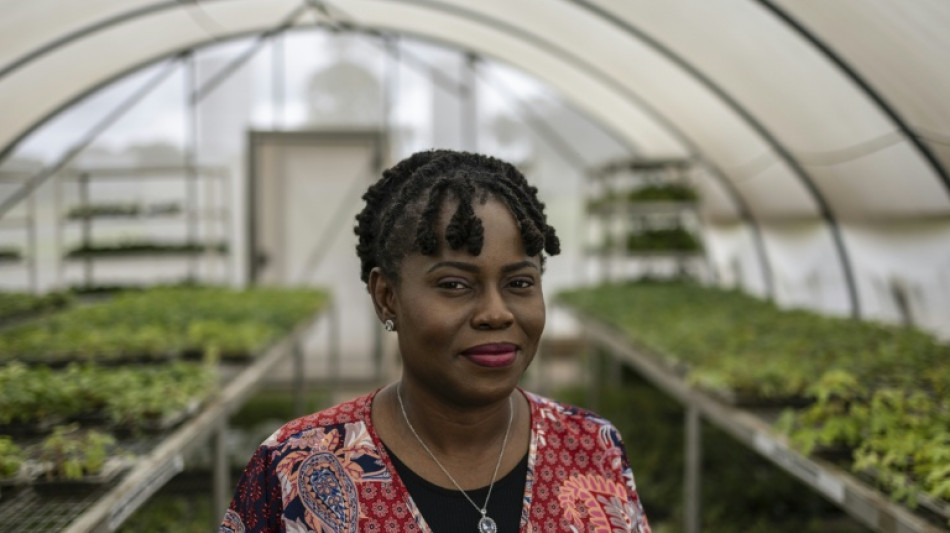
Award-winning Nigerian agronomist dreams of a cassava 'revolution' / Photo: OLYMPIA DE MAISMONT - AFP
Mercy Diebiru-Ojo's ambitions are straightforward -- increase Nigerian yam and cassava yields by 500 percent, fight hunger and raise her country's position on the agricultural value chain from a mere grower to a processor.
The first steps, at least, are already underway for the 44-year-old agronomist, who was awarded this year's prestigious Africa Food Prize for her research on yams and cassava, both major food staples in Africa.
Traditionally, farmers in Nigeria -- which produces 70 percent of the world's yams -- replant chunks of yams and cassava from the previous year's harvest, to grow this year's crop.
Gradually, the plants lose their resistance to diseases -- a serious problem for food security in a country where 30 million people are not getting enough to eat, according to the United Nations' World Food Programme.
Diebiru-Ojo's research involves growing the plants hydroponically in greenhouses, where they are protected from disease.
Then, as they sprout, a portion is cut and planted in potted mineral-rich soil in the greenhouse.
Only later is it replanted in the fields outside.
"So your materials are going to grow very vigorously in terms of vegetative growth,.. even the root formation and all of that," Diebiru-Ojo told AFP in an interview on the sprawling campus of the International Institute of Tropical Agriculture (IITA), in the southwestern city of Ibadan.
The result -- 30 tonnes of yams and cassava per hectare, compared to the typical five.
Diebiru-Ojo worked with US agro-research firm Sahtechno, which developed what it calls "semi-autotrophic hydroponics" (SAH) some two decades ago, to adapt the technique to Nigerian agriculture.
Her techniques, if widely adapted, could be welcome news for the country's farmers.
- Huge potential -
Despite being the world's top cassava producer, "when it comes to the yield, actual yield potentials and all of that, we are still way behind", Diebiru-Ojo said.
As is the case in many African countries, skilled farmers, with generations of knowledge, face a host of challenges.
They must rely on seasonal rains for irrigation, soils are declining in health, financing costs are high and governments have limited budgets for extension services.
Despite producing roughly 20 percent of the world's cassava each year, Africa's most populous country still imports some $600 million in cassava products, according to the Central Bank of Nigeria.
Yams are also a prized ingredient in Nigerian cuisine -- fried, boiled, mashed or turned into flour.
But there's also a huge -- if largely unrealised -- potential for their use in bioplastics and biofuels, as well as cosmetics, pharmaceuticals and textiles, thanks to their starch.
Moving up the so-called "value chain" -- switching from producing raw materials to transforming them into finished products -- is a key step in any country's economic development, economists say.
Diebiru-Ojo, who was named an Africa Food Prize Laureate last month alongside Kenya's Mary Abukutsa-Onyango, is quick to talk of a "revolution of the cassava sector" in Nigeria.
It's an ambition shared by the government -- at least rhetorically -- in a country where critics say a focus on oil has long sidelined investments in agriculture.
- Cassava a 'strategic asset' -
"Cassava is one of the most strategic assets in our agricultural portfolio," Vice President Kashim Shettima said in July.
He specifically mentioned IITA's research, and the need to do more processing and food transformation locally.
The promise of increased yields also comes at a time when rural farms are under pressure from various armed groups -- jihadists in the northeast, armed gangs in the northwest and farmer-herder conflicts in the Middle Belt.
The country's myriad conflicts are adding to existing pressures on hunger and food inflation.
But with better techniques, even in "a very small space, maybe just a garden behind your house, you can produce a lot", Diebiru-Ojo said.
Take-off will require help from the private sector to market the seeds and train farmers on SAH.
Already, IITA collaborates with public institutions and private companies in 15 countries on the continent.
The objective is "helping a food-secure Africa, not only Nigeria", Diebiru-Ojo said.
An added bonus, she said, would be for her win to serve as an "inspiration to a whole lot of others coming, especially for the women in agriculture".
H.Sasidharan--DT