Stench of death as Sudan army, paramilitaries battle for capital / Photo: Ebrahim Hamid - AFP
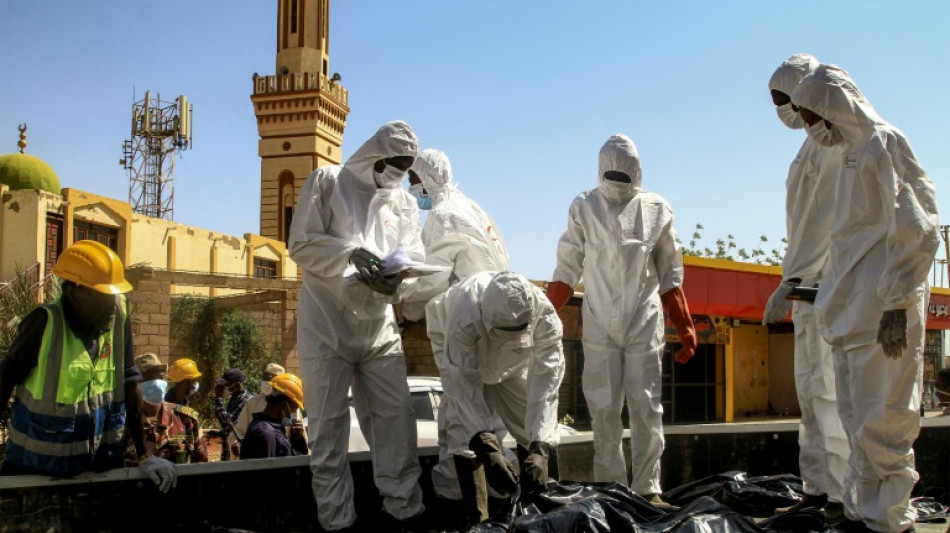
In a war-ravaged neighbourhood of Sudan's capital Khartoum, the stench from a gaping sewage pit is unbearable as Red Crescent workers pull a bloated body from deep underground.
The volunteers say 14 more remain below.
"They were shot in the head, some have crushed skulls," Hisham Zein al-Abdeen, head of forensic medicine at Sudan's health ministry, told AFP at the scene.
The victims, he said, were either shot or beaten to death before being thrown in.
Behind him, a truck idles, its flatbed already filling with bodies retrieved from the sewer well in East Nile, an eastern district of Khartoum now reduced to ruins.
Nearly two years of war between the army and the paramilitary Rapid Support Forces (RSF) have left large swathes of the capital unrecognisable.
Once a bustling metropolis, Khartoum has seen well over 3.5 million of its people flee since the war began, according to the United Nations.
Millions more, unable or unwilling to leave, live among abandoned buildings, wrecked vehicles and what the army says are hidden mass graves.
- A city destroyed -
Since April 2023, the conflict has pitted army chief Abdel Fattah al-Burhan against his former deputy and RSF commander Mohamed Hamdan Daglo.
The war has left tens of thousands dead and uprooted more than 12 million, according to UN figures, with many living in makeshift camps and over 3.5 million fleeing across borders.
The RSF initially seized the streets of Khartoum, but in recent months, the army has clawed back territory, regaining control of Bahri -- also known as Khartoum North -- and East Nile to its east.
Now, less than a kilometre separates army units in central Khartoum from the presidential palace, overtaken by RSF troops at the start of the war.
Despite these advances, Daglo remains defiant, vowing that his forces will not withdraw from the capital.
"We will not leave the Republican Palace," Daglo said in a video address shared on Telegram.
"We are coming for Port Sudan," he added, referring to the de facto capital on the Red Sea, where the government has been based since Khartoum fell.
An AFP team, travelling under military escort, crossed from Khartoum's twin city of Omdurman -- recaptured by the army last year -- into Bahri and its war-ravaged outskirts.
The convoy passed through eerie, abandoned neighbourhoods including Al-Haj Yousif, where the skeletal remains of shuttered shops and crumbling pavements stretch along the streets.
Rubble, debris and discarded tires litter the roads.
Every few blocks, small clusters of people sit outside empty buildings and stores pockmarked with bullet holes.
Hospitals and schools no longer function. The army says it has uncovered multiple mass graves, including one at the Omdurman courthouse.
The civilians still in the city appear visibly shaken by the trauma of war.
"At night, I used to hear gunshots. Then, I saw them carrying bodies and throwing them in the well," said Salha Shams El-Din, who lives near the pit where she said RSF troops dumped bodies.
- Starvation -
For those who survived to see the army recapture the district early this month, life remains a constant struggle.
There is no electricity, and clean water and food are scarce.
On a quiet street in Bahri, some 40 women sit beneath a makeshift tent, preparing Ramadan meals at a community kitchen, one of many that struggled under RSF control.
They stir large pots of aseeda -- a thick porridge made from cornflour -- and lentils over open flames, using firewood.
Gas is no longer available. Water trucks now come from Omdurman, an improvement from when residents had to risk sniper fire just to reach the Nile River, itself a health risk with no sanitation.
The soup kitchens have become civilians' last line of defence against mass starvation, according to the UN. But throughout the war, they have struggled to stay afloat.
With roads cut off, markets devastated and RSF fighters robbing volunteers at gunpoint, feeding those in need was nearly impossible.
"When the RSF was here, we couldn't get money in. Any money we'd receive, they would take," said Mouayad al-Haj, a volunteer at the community kitchen in Bahri.
"Now things are different, phone networks are back and we can at least go to Omdurman every two weeks to buy supplies," he told AFP.
What began as a power struggle between Burhan and Daglo has spiralled into the world's largest displacement and hunger crisis.
The conflict has decimated Sudan's infrastructure, crumbled an already weak economy and pushed millions to the brink of mass starvation.
Famine has been declared in three displacement camps, according to the UN-backed Inegrated Food Security Phase Classification.
In Khartoum alone, at least 100,000 people are suffering famine conditions, the IPC found.
T.Jamil--DT