Dubai Telegraph - Climate change fuelled rains behind deadly Nigeria floods: study

EUR -
AED 4.370669
AFN 78.547025
ALL 96.278273
AMD 450.622905
ANG 2.130388
AOA 1091.328986
ARS 1722.405317
AUD 1.696403
AWG 2.142194
AZN 2.027299
BAM 1.948242
BBD 2.397439
BDT 145.456903
BGN 1.998632
BHD 0.448652
BIF 3526.404033
BMD 1.190108
BND 1.507439
BOB 8.225227
BRL 6.216527
BSD 1.190302
BTN 109.307763
BWP 15.571644
BYN 3.390219
BYR 23326.113255
BZD 2.393953
CAD 1.609722
CDF 2686.669586
CHF 0.915437
CLF 0.025998
CLP 1026.336493
CNY 8.269346
CNH 8.273029
COP 4348.154126
CRC 589.42316
CUC 1.190108
CUP 31.537857
CVE 109.839785
CZK 24.336455
DJF 211.96123
DKK 7.467284
DOP 74.93895
DZD 154.05412
EGP 55.854602
ERN 17.851617
ETB 184.910124
FJD 2.613417
FKP 0.862744
GBP 0.866184
GEL 3.207311
GGP 0.862744
GHS 13.03963
GIP 0.862744
GMD 87.474037
GNF 10444.566682
GTQ 9.129733
GYD 249.028048
HKD 9.291725
HNL 31.417639
HRK 7.529934
HTG 155.774996
HUF 380.663726
IDR 19981.910283
ILS 3.677993
IMP 0.862744
INR 109.392866
IQD 1559.343768
IRR 50133.292068
ISK 144.991072
JEP 0.862744
JMD 186.526346
JOD 0.84382
JPY 183.952632
KES 153.523692
KGS 104.074336
KHR 4786.390347
KMF 490.324072
KPW 1071.195635
KRW 1717.629069
KWD 0.365042
KYD 0.991765
KZT 598.65749
LAK 25616.049626
LBP 106592.204903
LKR 368.1019
LRD 214.546736
LSL 18.899793
LTL 3.514079
LVL 0.719884
LYD 7.469085
MAD 10.797202
MDL 20.016559
MGA 5319.451876
MKD 61.630387
MMK 2499.281315
MNT 4245.956935
MOP 9.571785
MRU 47.493541
MUR 54.066684
MVR 18.387421
MWK 2064.02702
MXN 20.580588
MYR 4.691392
MZN 75.869455
NAD 18.899793
NGN 1652.869038
NIO 43.800805
NOK 11.394485
NPR 174.888761
NZD 1.960817
OMR 0.4576
PAB 1.190302
PEN 3.979727
PGK 5.095275
PHP 70.13127
PKR 333.014626
PLN 4.205883
PYG 7973.067429
QAR 4.339763
RON 5.098662
RSD 117.438673
RUB 90.603841
RWF 1736.335388
SAR 4.46358
SBD 9.59001
SCR 16.419937
SDG 715.847357
SEK 10.540451
SGD 1.510158
SHP 0.892889
SLE 29.00886
SLL 24955.965041
SOS 680.257991
SRD 45.284203
STD 24632.829038
STN 24.405725
SVC 10.414682
SYP 13162.086558
SZL 18.89362
THB 37.47471
TJS 11.111392
TMT 4.177278
TND 3.419932
TOP 2.865494
TRY 51.769455
TTD 8.081781
TWD 37.504815
TZS 3064.528011
UAH 51.016503
UGX 4255.561501
USD 1.190108
UYU 46.191183
UZS 14551.667152
VES 436.587186
VND 30871.396828
VUV 142.347093
WST 3.230425
XAF 653.416494
XAG 0.011999
XAU 0.000238
XCD 3.216326
XCG 2.145213
XDR 0.814683
XOF 653.427432
XPF 119.331742
YER 283.71971
ZAR 19.020916
ZMK 10712.396649
ZMW 23.359765
ZWL 383.214232
  • RBGPF

    1.3800

    83.78

    +1.65%

  • SCS

    0.0200

    16.14

    +0.12%

  • RYCEF

    -0.4300

    16

    -2.69%

  • CMSC

    0.0050

    23.7

    +0.02%

  • BCC

    -0.7700

    79.4

    -0.97%

  • BTI

    -0.0750

    60.135

    -0.12%

  • RELX

    -0.6000

    35.565

    -1.69%

  • NGG

    -0.6800

    84.37

    -0.81%

  • GSK

    0.6850

    51.34

    +1.33%

  • RIO

    -4.4050

    90.725

    -4.86%

  • JRI

    0.0420

    12.997

    +0.32%

  • CMSD

    -0.0300

    24.03

    -0.12%

  • BCE

    -0.0450

    25.44

    -0.18%

  • VOD

    -0.0850

    14.625

    -0.58%

  • AZN

    0.6950

    93.285

    +0.75%

  • BP

    -0.4150

    37.625

    -1.1%

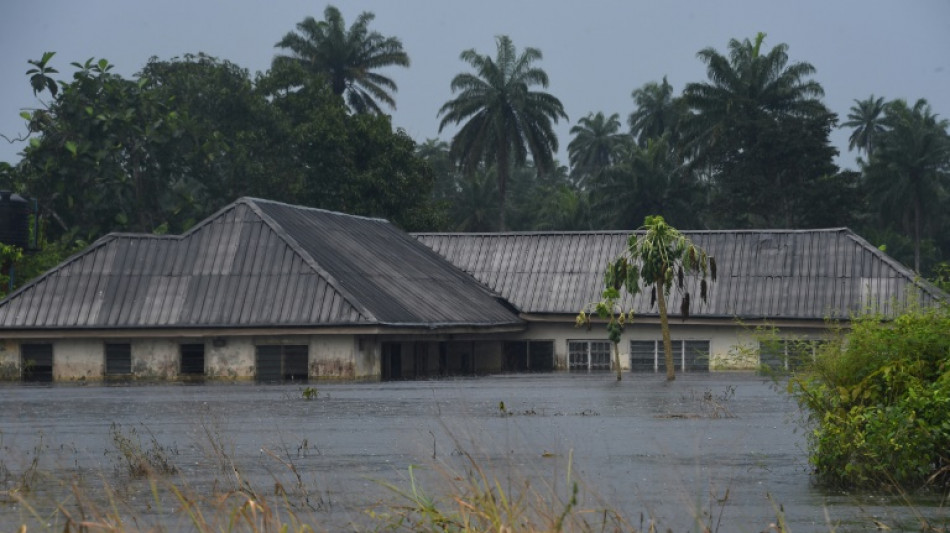
Climate change fuelled rains behind deadly Nigeria floods: study
Climate change fuelled rains behind deadly Nigeria floods: study / Photo: PIUS UTOMI EKPEI - AFP

Climate change fuelled rains behind deadly Nigeria floods: study

Heavy rains behind floods that killed over 600 people in Nigeria this year were about 80 times likelier because of human-induced climate change, scientists reported Wednesday.

Text size:

The floods mainly struck Nigeria but also Niger, Chad and neighbouring countries, displacing over 1.4 million people and devastating homes and farmland in a region already vulnerable to food insecurity.

Researchers from the World Weather Attribution (WWA) consortium said in a study that the floods -- among the deadliest on record in the region -- were directly linked to human activity that is exacerbating climate change.

They matched long-term data on climate -- which shows the planet has warmed by about 1.2 degrees Celsius (2.2 degrees Fahrenheit) since 1800 as carbon emissions have risen -- against weather events.

The heavy rainfall that sparked the floods was 80 times likelier because of "human-caused climate change," according to their findings.

In addition, "this year's rainy season was 20 percent wetter than it would have been without the influence of climate change," they said.

"The influence of climate change means the prolonged rain that led to the floods is no longer a rare event," the study found.

"The above-average rain over the wet season now has approximately a one in 10 chance of happening each year; without human activities it would have been an extremely rare event."

Over 600 people were killed in Nigeria alone because of the floods from June to October this year, and nearly 200 in Niger and 22 in Chad.

- 'Real and present problem' -

The report comes as COP27 climate talks are underway in Egypt's Sharm el-Sheikh, where developing nations are demanding rich polluters pay for climate-change linked calamities.

Africa is home to some of the countries least responsible for carbon emissions but hardest hit by an onslaught of weather extremes, with the Horn of Africa currently in the grips of a severe drought.

"This is a real and present problem, and it's particularly the poorest countries that are getting hit very hard. So it's clear that solutions are needed," Maarten van Aalst, director of the Red Cross Red Crescent Climate Centre, said at a WWA press conference.

In a separate WWA study also released Wednesday, researchers examined a 2021 drought that reduced crop production in Mali, Burkina Faso, Niger, Nigeria and Chad that contributed to a food crisis this year.

The study failed to find concrete climate change links, because of "a lack of reliable weather station data", but showed "that even small shifts in rainfall can have major effects in the region".

It added that high global food prices deepened the crisis, along with the Russian invasion of Ukraine which disrupted deliveries of key fertilisers to Africa.

The WWA publishes rapid-response reports following extreme climate events.

Their studies are not peer-reviewed, a process that can take months, but are widely backed by scientists.

F.A.Dsouza--DT