Huupe Mini 2 Review: A Smart Basketball Hoop That Struggles With Its Own Ambition
The Huupe Mini 2 transforms a standard doorframe into a digital basketball court, offering shot tracking and social gaming features alongside streaming apps. However, despite accurate scoring mechanics, the device suffers from significant usability issues, including excessive noise, poor battery management, and a confusing interface that limits its appeal to casual users.
The Huupe Mini 2 represents an attempt to merge the physical activity of basketball with the digital convenience of smart home entertainment, but the result is a gadget that prioritizes novelty over practicality. Manufactured by Huupe, which produces smart hoops and add-on kits for existing setups, the Mini 2 is designed as a pint-sized, indoor alternative to traditional basketball goals. It clips over the top of a standard doorframe, allowing users to shoot hoops without leaving their room.
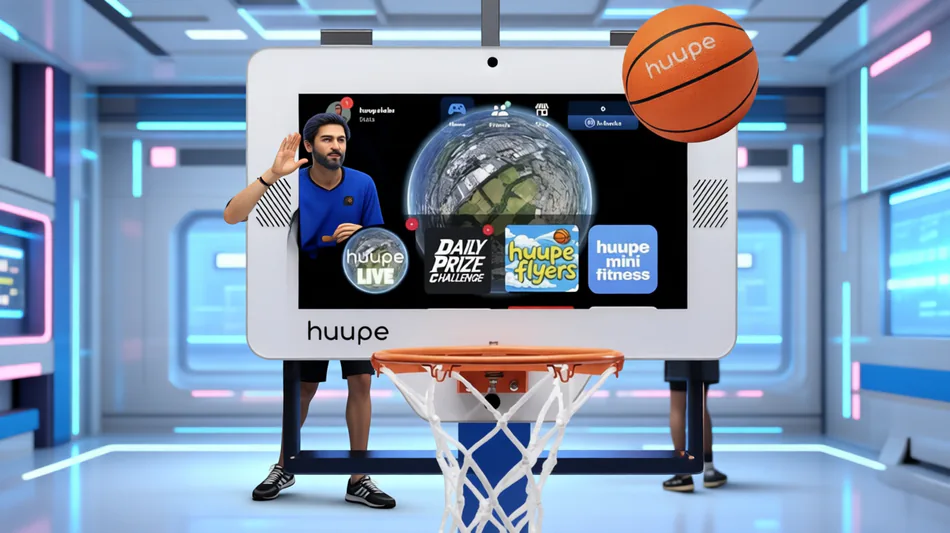
The device functions effectively as a smart television with a basketball hoop mounted to it. The unit features a 19-inch diagonal LCD screen surrounded by a border that houses stereo speakers and a camera used to track the player’s movements and shot accuracy. The total backboard size measures 25 inches diagonally, fitting within most doorframes. The package includes a 5-inch inflatable rubber basketball, a hand pump, a USB-C charger with a lengthy cable for continuous power, and a traditional remote control necessary for navigating the system.
Unlike larger Huupe hardware that relies on mobile applications, the Mini 2 is a self-contained, web-based device. Setup involves connecting the backboard to a Wi-Fi network via the remote, similar to configuring a modern smart TV. According to the company, the Mini 2 offers several behind-the-scenes upgrades over the original model, including a faster CPU, improved display quality, and significantly enhanced shot tracking. The battery is rated for four hours of use, though real-world performance often falls short due to standby drain.
Once connected, the device opens a suite of entertainment options that extend beyond basketball. The home screen displays traditional tiles accessible via the remote. The core functionality, labeled "Just Huupe," tracks shots and records shooting percentages in untimed sessions. For competitive play, users can access "Huupe Live" or the "Daily Prize Challenge," which pit players against global opponents to score the most points within a set time frame. Winners receive nominal prizes, such as $10 for daily challenges or a month of cozy sweatsuits for longer contests. Other modes include "Most 3 Pointers in 90 Seconds" and "Family Mode," a digital version of the game Horse.
Many of these social features require online friends who also own Huupe Mini 2 units, limiting their utility for users without a network of compatible devices. The device also attempts to offer gesture-based gaming through "Huupe Flyers," a Flappy Bird-style game where players flap their arms to keep a virtual ball airborne. However, this feature relies heavily on camera calibration and proved unreliable during testing, failing to register movements consistently.
Beyond sports, the Mini 2 operates as a streaming platform. It includes apps for YouTube, HBO Max, ESPN, Disney+, Prime Video, Hulu, and Spotify. Notably, it lacks support for Netflix, a significant omission for a device positioning itself as an entertainment hub. The built-in speakers are also a weak point; audio quality varies significantly across apps, with some sources producing nearly inaudible sound.
The shot-tracking technology is the device’s primary technical achievement. Sensors detect successful baskets and use the camera to measure the shooter’s distance from the backboard, assigning point values accordingly. During weeks of testing, the system accurately recorded every made basket without false negatives or positives. However, the distance calculation logic remains inconsistent. Shots taken from across a room were sometimes counted as one-pointers, while shots from just a few feet away registered as three-pointers. The system appeared to favor shots taken straight-on to the backboard for lower point values, while wing shots earned more, regardless of actual distance. This variability is exacerbated by room geometry; obstacles such as furniture often interfere with camera tracking, requiring users to crawl under beds or around corners to retrieve balls.
Physical usability presents further challenges. The hoop is small, and the springy backboard causes the ball to rebound wildly, making it difficult to make baskets even at close range. This unforgiving nature discourages extended play sessions. More critically, the noise generated when the included inflatable rubber ball hits the device is extreme. Users have reported being reprimanded by family members for disturbing the household during use. While Huupe intends the device to be used only with the provided ball, testers found that purchasing a 5-inch foam basketball from third-party retailers significantly reduces impact noise and softens the rebound without compromising shot registration.
Battery management is another significant flaw. Although the battery lasts four hours during active play, it drains rapidly in standby mode. Users who turn off the device after morning sessions often find it completely dead by afternoon. Furthermore, the device requires a minimum charge of approximately 5 percent to power on via the USB-C cable, meaning it cannot simply be plugged in and used immediately if the battery is fully depleted. The power button on the remote control was found to be unresponsive during testing, forcing users to locate the physical power switch on the bottom of the backboard to turn the system off.
Priced at $429 after a deep discount from its list price of $799, the Huupe Mini 2 occupies a narrow niche. It is unlikely to be purchased by individuals for personal use, requiring a specific interest in basketball and a tolerance for leaving one’s room to play. While it offers a unique fusion of sports and technology, its technical inconsistencies, noise levels, and limited ecosystem prevent it from becoming a staple household entertainment device.
A.El-Sewedy--DT