Dubai Telegraph - New potentially hazardous asteroid discovered

EUR -
AED 4.300214
AFN 72.597184
ALL 95.550065
AMD 431.637839
ANG 2.096491
AOA 1074.907628
ARS 1629.918298
AUD 1.612742
AWG 2.109126
AZN 1.99189
BAM 1.955146
BBD 2.358351
BDT 143.731916
BGN 1.955348
BHD 0.44173
BIF 3484.082224
BMD 1.170923
BND 1.490089
BOB 8.091535
BRL 5.870425
BSD 1.170928
BTN 112.003574
BWP 15.774194
BYN 3.262781
BYR 22950.09632
BZD 2.354993
CAD 1.60492
CDF 2624.039488
CHF 0.915469
CLF 0.026393
CLP 1038.74981
CNY 7.951682
CNH 7.943268
COP 4441.042695
CRC 533.030785
CUC 1.170923
CUP 31.029467
CVE 110.59423
CZK 24.324291
DJF 208.096742
DKK 7.471679
DOP 69.376586
DZD 155.049792
EGP 61.966667
ERN 17.563849
ETB 184.274054
FJD 2.558877
FKP 0.865557
GBP 0.866003
GEL 3.138391
GGP 0.865557
GHS 13.22866
GIP 0.865557
GMD 85.47764
GNF 10277.774521
GTQ 8.933012
GYD 244.974323
HKD 9.170455
HNL 31.158511
HRK 7.527872
HTG 152.924065
HUF 358.279526
IDR 20518.90831
ILS 3.401292
IMP 0.865557
INR 112.293123
IQD 1533.909499
IRR 1537422.268797
ISK 143.59035
JEP 0.865557
JMD 185.182514
JOD 0.830165
JPY 184.869469
KES 151.342104
KGS 102.396924
KHR 4696.573541
KMF 492.958538
KPW 1053.850627
KRW 1746.830185
KWD 0.361078
KYD 0.975803
KZT 549.571454
LAK 25701.766259
LBP 105091.319448
LKR 380.01936
LRD 214.45466
LSL 19.215559
LTL 3.457432
LVL 0.70828
LYD 7.406137
MAD 10.741758
MDL 20.081882
MGA 4888.604405
MKD 61.625963
MMK 2458.100405
MNT 4191.523978
MOP 9.445422
MRU 46.836558
MUR 54.915793
MVR 18.043889
MWK 2039.101101
MXN 20.10583
MYR 4.600587
MZN 74.820773
NAD 19.215251
NGN 1604.752859
NIO 42.978783
NOK 10.730693
NPR 179.212403
NZD 1.972092
OMR 0.450217
PAB 1.170948
PEN 4.01451
PGK 5.105167
PHP 72.113064
PKR 326.220283
PLN 4.246318
PYG 7160.604505
QAR 4.26626
RON 5.204876
RSD 117.409299
RUB 86.852884
RWF 1709.547991
SAR 4.400414
SBD 9.405158
SCR 17.375484
SDG 703.141388
SEK 10.912829
SGD 1.490521
SHP 0.874212
SLE 28.806891
SLL 24553.678219
SOS 669.252372
SRD 43.551288
STD 24235.747845
STN 24.88212
SVC 10.245572
SYP 129.479481
SZL 19.30271
THB 37.890742
TJS 10.965713
TMT 4.109941
TND 3.372844
TOP 2.819302
TRY 53.198997
TTD 7.944478
TWD 36.901627
TZS 3048.974879
UAH 51.490435
UGX 4390.606169
USD 1.170923
UYU 46.515233
UZS 14142.410812
VES 594.904751
VND 30854.413933
VUV 138.14421
WST 3.164699
XAF 655.754426
XAG 0.01342
XAU 0.00025
XCD 3.164478
XCG 2.110276
XDR 0.813756
XOF 653.960059
XPF 119.331742
YER 279.411601
ZAR 19.23033
ZMK 10539.723885
ZMW 22.101267
ZWL 377.036819
  • CMSC

    -0.0600

    23.05

    -0.26%

  • BCC

    -0.9500

    66.98

    -1.42%

  • CMSD

    -0.0400

    23.56

    -0.17%

  • GSK

    0.0900

    50.99

    +0.18%

  • RIO

    2.5400

    112.04

    +2.27%

  • BCE

    -0.0800

    24.39

    -0.33%

  • AZN

    3.1800

    187.72

    +1.69%

  • BP

    -0.2600

    44.14

    -0.59%

  • NGG

    -0.2600

    86.98

    -0.3%

  • BTI

    1.7100

    65.35

    +2.62%

  • RBGPF

    -0.2100

    60.79

    -0.35%

  • JRI

    -0.0100

    13.13

    -0.08%

  • RYCEF

    -0.1700

    16.03

    -1.06%

  • VOD

    0.4150

    15.51

    +2.68%

  • RELX

    -1.1500

    31.62

    -3.64%

New potentially hazardous asteroid discovered
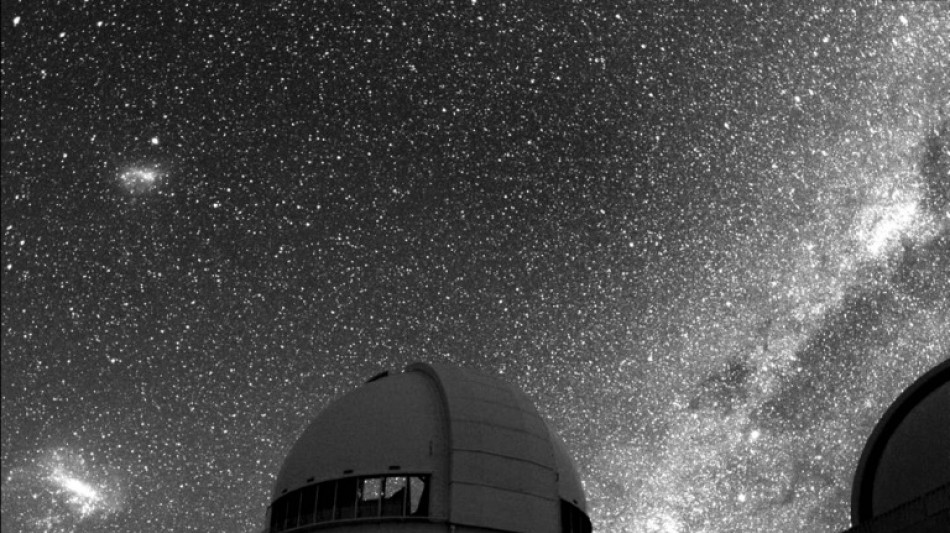
New potentially hazardous asteroid discovered / Photo: ROGER SMITH, AURA, NOAO, NSF - ROGER SMITH, AURA, NOAO, NSF/AFP

New potentially hazardous asteroid discovered

An international team of astronomers on Monday announced the discovery of a large asteroid whose orbit crosses that of Earth, creating a small chance far in the future of a catastrophic collision.

Text size:

The 1.5 kilometer- (0.9 mile-) wide asteroid, named 2022 AP7, was discovered in area notoriously difficult to spot objects due to the glare from the Sun.

It was found along with two other near-Earth asteroids using a high-tech instrument on the Victor M. Blanco telescope in Chile that was originally developed to study dark matter.

"2022 AP7 crosses Earth’s orbit, which makes it a potentially hazardous asteroid, but it currently does not now or anytime in the future have a trajectory that will have it collide with the Earth," said lead author of the findings, astronomer Scott Sheppard of the Carnegie Institution for Science.

The potential threat comes from the fact that like any orbiting object, its trajectory will be slowly modified due to myriad gravitational forces, notably by planets. Forecasts are therefore difficult on the very long term.

The newly-discovered asteroid is "the largest object that is potentially hazardous to Earth to be discovered in the last eight years," said NOIRLab, a US-funded research group that operates multiple observatories.

2022 AP7 takes five years to circle the Sun under its current orbit, which at its closest point to Earth remain several million kilometers away.

The risk is therefore very small, but in case of a collision, an asteroid of that size "would have a devastating impact on life as we know it," said Sheppard. He explained that dust launched into the air would have a major cooling effect, provoking an "extinction event like hasn’t been seen on Earth in millions of years."

His team's results were published in the scientific journal The Astronomical Journal. The two other asteroids pose no risk to Earth, but one is the closest asteroid to the Sun ever found.

Some 30,000 asteroids of all sizes -- including more than 850 larger than a kilometer wide -- have been catalogued in the vicinity of the Earth, earning them the label "Near Earth Objects" (NEOs). None of them threaten Earth for the next 100 years.

According to Sheppard, there are "likely 20 to 50 large NEOs left to find," but most are on orbits that put them in the Sun's glare.

In preparation for a future discovery of a more threatening object, NASA conducted a test mission in late September in which it collided a spacecraft with an asteroid, proving that it was possible to change its trajectory.

R.Mehmood--DT